
MOC-4 SC-VTOL
Means of Compliance with SC-VTOL — Batch 4
Issue 2 — FINAL Source checked 2026-11-28
Scope, source and reading notes
Complete final batch 4 of SC-VTOL means of compliance. Later batches may amend individual provisions in earlier batches.
Aerospace Consulting reference note: Fourth final batch, introducing further means of compliance and amendments to previous MoC publications.
The complete selected publication is available in reading text and as the original PDF. Reading text is extracted from the official PDF; page layout is simplified, and figures and tables should be checked in the original page view.
Search covers extracted text. Words contained only in graphics may not be searchable. The original publication is available below.
Official source recordOriginal PDF on this siteSource: EASA. Reproduced with source acknowledgment; source edition and status are shown above. SHA-256: d66389491b058ad129efdb1faa6d7d29a1a2bc2bf70dda5612bd6b3f53e2d321
Doc. No: MOC-4 SC-VTOL Issue: 2 Date: 11 July 2025
Fourth Publication of Means of Compliance with the Special Condition VTOL
(e) Conditions that may result in a significant transient at disengagement (e.g., FGS controlling at the limit of its authority), whether the latter is manual or automatic, should be annunciated through an alert, commensurate with the urgency of the situation. (f) If applicable, envelope protection alerts should activate with suitable margins to the condition to avoid, while not resulting in nuisance activations. They should be prioritized based on the urgency of the flight crew awareness and response.
Explanatory Note:
Point (b)(3) aims at providing sufficient awareness to the flight crew, with regard to whether the FGS is coupled with the guidance panel in basic modes, or with ground navaids such as an ILS, or with a PBN function using ground navaids, or GNSS, or inertial data, barometric data; and which are the targets that the FGS outer loops are enslaved to.
As mentioned in section 2, specific technologies, such as the use of HUD, may require additional considerations, which may be project-specific or perhaps lead to the definition of dedicated additional MOCs.
12. Safety Assessment
(a) Part of the safety assessment is to determine failure conditions, their effects and their severity classifications, taking into account different types of functional failure modes (e.g., loss of function, malfunction), flight crew awareness (e.g., annunciated, unannunciated), flight phases (e.g., cruise, approach), operational and environmental events, etc. In performing the safety assessment, the applicant should consider the following non-exhaustive lists of elements characteristic of the FGS:
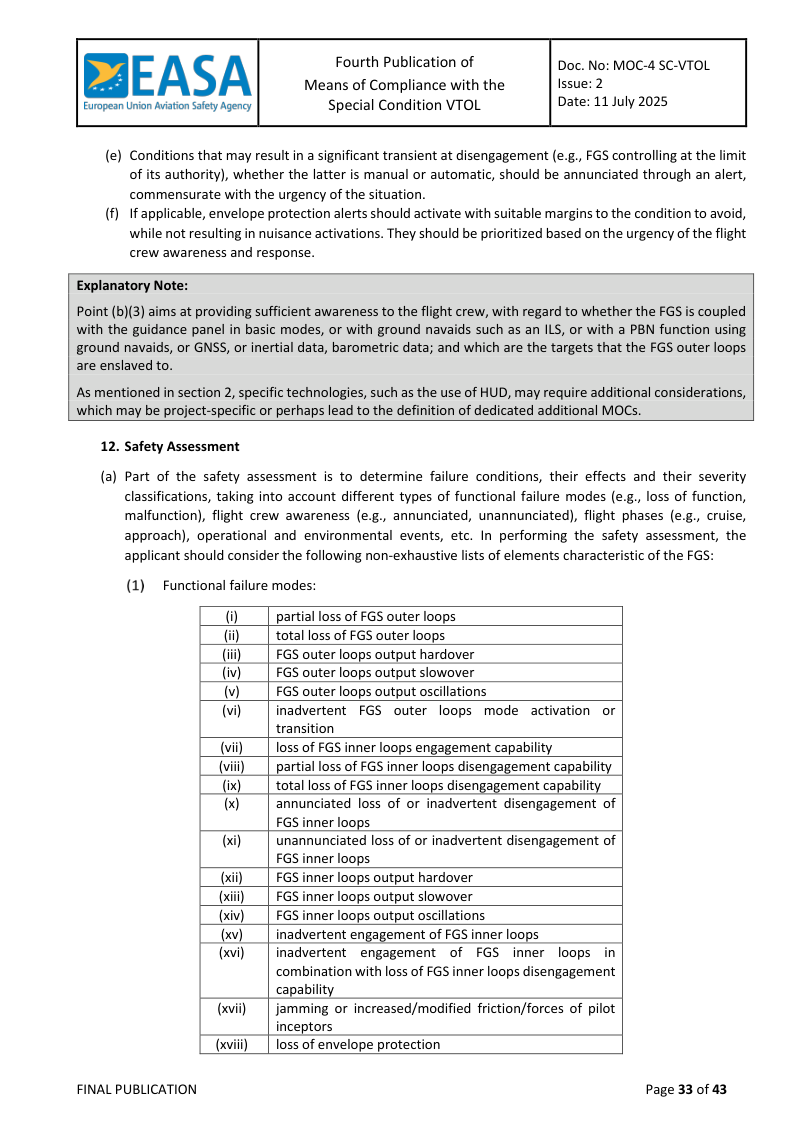
Functional failure modes:
(i) partial loss of FGS outer loops (ii) total loss of FGS outer loops (iii) FGS outer loops output hardover (iv) FGS outer loops output slowover (v) FGS outer loops output oscillations (vi) inadvertent FGS outer loops mode activation or transition (vii) loss of FGS inner loops engagement capability (viii) partial loss of FGS inner loops disengagement capability (ix) total loss of FGS inner loops disengagement capability (x) annunciated loss of or inadvertent disengagement of FGS inner loops (xi) unannunciated loss of or inadvertent disengagement of FGS inner loops (xii) FGS inner loops output hardover (xiii) FGS inner loops output slowover (xiv) FGS inner loops output oscillations (xv) inadvertent engagement of FGS inner loops (xvi) inadvertent engagement of FGS inner loops in combination with loss of FGS inner loops disengagement capability (xvii) jamming or increased/modified friction/forces of pilot inceptors (xviii) loss of envelope protection
View figures, tables and original page layout
Connected references
Source-backed citations and subject-based engineering context are labelled separately. These links do not establish equivalence or project acceptance.
Related technical context
Engineering contextEvidence and scope
SC-VTOL-02 and MOC-4 SC-VTOL — published scope
Aerospace Consulting navigation suggestion based on the subject and stated scope of the two publications.
This connection does not establish regulatory equivalence, acceptance of a newer edition, or applicability of a project-specific precedent to another programme.
Supporting source