
MOC-4 SC-VTOL
Means of Compliance with SC-VTOL — Batch 4
Issue 2 — FINAL Source checked 2026-11-28
Scope, source and reading notes
Complete final batch 4 of SC-VTOL means of compliance. Later batches may amend individual provisions in earlier batches.
Aerospace Consulting reference note: Fourth final batch, introducing further means of compliance and amendments to previous MoC publications.
The complete selected publication is available in reading text and as the original PDF. Reading text is extracted from the official PDF; page layout is simplified, and figures and tables should be checked in the original page view.
Search covers extracted text. Words contained only in graphics may not be searchable. The original publication is available below.
Official source recordOriginal PDF on this siteSource: EASA. Reproduced with source acknowledgment; source edition and status are shown above. SHA-256: d66389491b058ad129efdb1faa6d7d29a1a2bc2bf70dda5612bd6b3f53e2d321
Doc. No: MOC-4 SC-VTOL Issue: 2 Date: 11 July 2025
Fourth Publication of Means of Compliance with the Special Condition VTOL
(i) Limit drop test: as defined in CS 27.725 Amdt. 6, with the following modification: The
drop height must be that resulting in a drop contact velocity equal to the greatest probable sinking speed likely to occur at ground contact with the system in the failed state. (ii) Reserve energy absorption drop test: as defined in CS 27.727 Amdt. 6, with the following
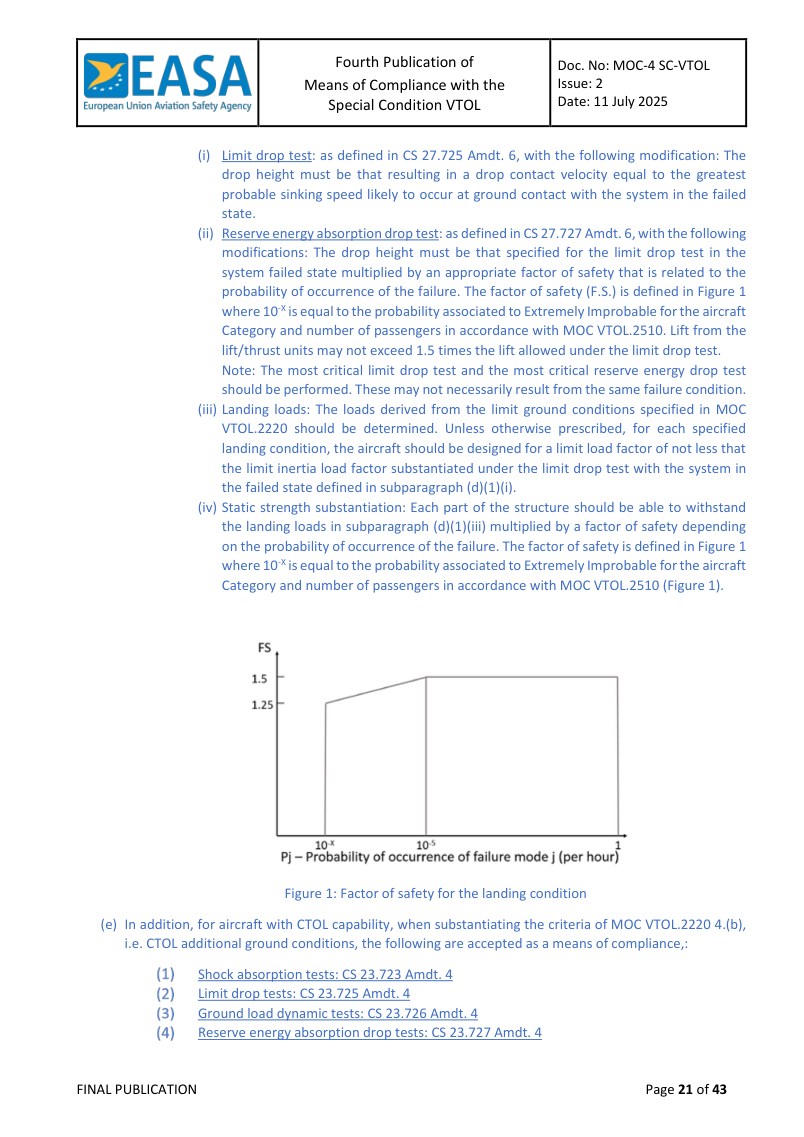
modifications: The drop height must be that specified for the limit drop test in the system failed state multiplied by an appropriate factor of safety that is related to the probability of occurrence of the failure. The factor of safety (F.S.) is defined in Figure 1 where 10-X is equal to the probability associated to Extremely Improbable for the aircraft Category and number of passengers in accordance with MOC VTOL.2510. Lift from the lift/thrust units may not exceed 1.5 times the lift allowed under the limit drop test. Note: The most critical limit drop test and the most critical reserve energy drop test should be performed. These may not necessarily result from the same failure condition. (iii) Landing loads: The loads derived from the limit ground conditions specified in MOC VTOL.2220 should be determined. Unless otherwise prescribed, for each specified landing condition, the aircraft should be designed for a limit load factor of not less that the limit inertia load factor substantiated under the limit drop test with the system in the failed state defined in subparagraph (d)(1)(i). (iv) Static strength substantiation: Each part of the structure should be able to withstand the landing loads in subparagraph (d)(1)(iii) multiplied by a factor of safety depending on the probability of occurrence of the failure. The factor of safety is defined in Figure 1 where 10-X is equal to the probability associated to Extremely Improbable for the aircraft Category and number of passengers in accordance with MOC VTOL.2510 (Figure 1).
Figure 1: Factor of safety for the landing condition
(e) In addition, for aircraft with CTOL capability, when substantiating the criteria of MOC VTOL.2220 4.(b), i.e. CTOL additional ground conditions, the following are accepted as a means of compliance,:
Shock absorption tests: CS 23.723 Amdt. 4 Limit drop tests: CS 23.725 Amdt. 4 Ground load dynamic tests: CS 23.726 Amdt. 4 Reserve energy absorption drop tests: CS 23.727 Amdt. 4
View figures, tables and original page layout
Connected references
Source-backed citations and subject-based engineering context are labelled separately. These links do not establish equivalence or project acceptance.
Related technical context
Engineering contextEvidence and scope
SC-VTOL-02 and MOC-4 SC-VTOL — published scope
Aerospace Consulting navigation suggestion based on the subject and stated scope of the two publications.
This connection does not establish regulatory equivalence, acceptance of a newer edition, or applicability of a project-specific precedent to another programme.
Supporting source