
AMC 20-158A
Aircraft electrical and electronic system high-intensity radiated fields (HIRF) protection
Current AMC; incorporated in AMC-20 Amendment 23 Source checked 2026-11-28
Scope, source and reading notes
HIRF protection for aircraft electrical and electronic systems, including all three appendices.
Aerospace Consulting reference note: Provides the HIRF protection framework and supporting environmental, transfer-function and safety-assessment guidance.
Complete selected AMC and associated material, from PDF pages 518–559 of the AMC-20 consolidation. The original PDF contains the whole consolidation. Reading text is extracted; original figures and layout remain available.
Search covers extracted text. Words contained only in graphics may not be searchable. The original publication is available below.
Official source recordOriginal PDF on this siteSource: EASA. Reproduced with source acknowledgment; source edition and status are shown above. SHA-256: b3d02d6ad4cd2833f79be85634221f52ea8bd90a84c733257193e4a60a2d536a
equipment and components of the system required for the normal operation of the Level A functions are not susceptible when complying with paragraphs (a)(1), (a)(2) and (a)(3), then it is acceptable that the equipment and components required only for non-normal situations do not show compliance with the requirements of paragraph (a). In this case, it is considered acceptable that the equipment and components of the system required only for non-normal situations show compliance at least with the requirements of paragraph (b).
4. Level B or Level C systems. The specifications in CS 23.1308(b)(c), 25.1317(b)(c), 27.1317(b)(c), and 29.1317(b)(c) address adverse effects on systems that perform functions whose failure would reduce the capability of the aircraft or the ability of the flight crew to respond to an adverse operating condition when all equipment, components and electrical interconnections of the Level B or Level C system are exposed to HIRF test Level 1 or 2, or 3 respectively.
If some of the electrical and electronic equipment of a Level A system perform Level B or Level C functions, and effects on these equipment items are noted when the system is submitted to Level A HIRF environments, these effects should be reassessed when the system is submitted to HIRF test Level 1 or 2, or 3 respectively.
5. Failure conditions. The HIRF safety assessment should consider all potential adverse effects due to system failures, malfunctions, or misleading information. The HIRF safety assessment may show that some systems have different failure conditions in different phases of flight; therefore, the system HCL corresponds to the most severe failure condition. For example, an automatic flight control system may have a catastrophic failure condition for autoland, while automatic flight control system operations in cruise may have a hazardous failure condition.
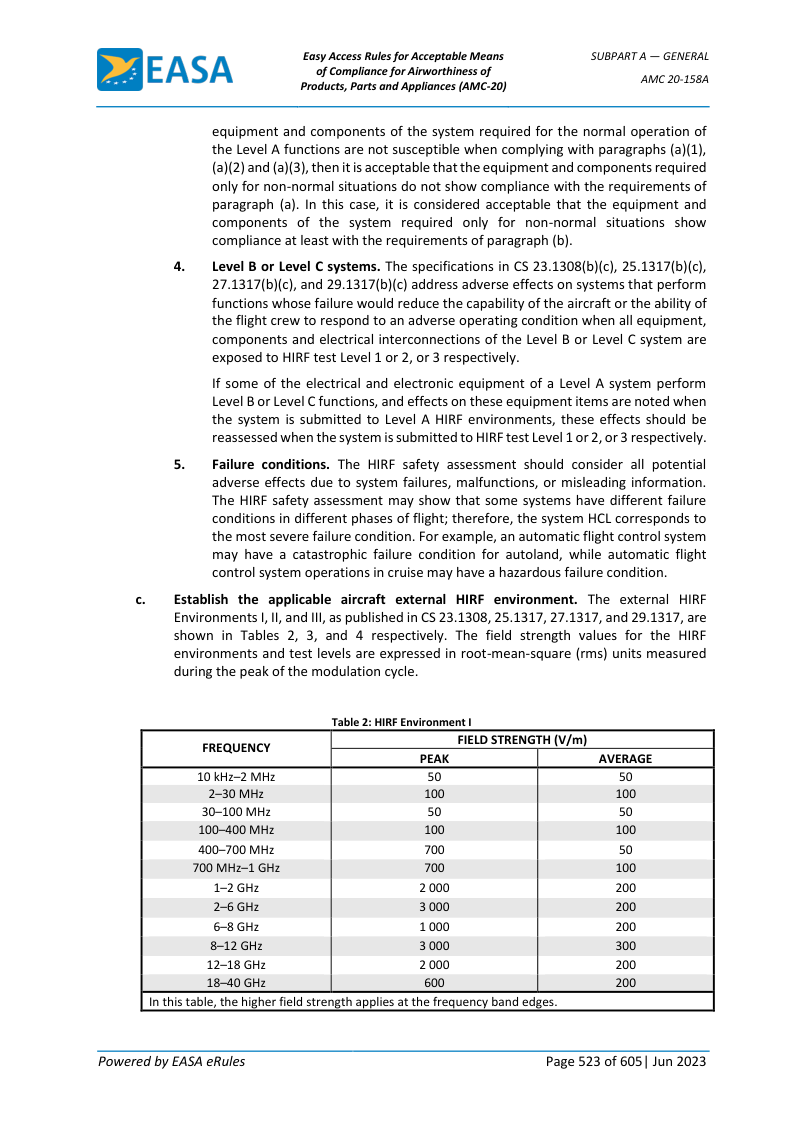
c. Establish the applicable aircraft external HIRF environment. The external HIRF Environments I, II, and III, as published in CS 23.1308, 25.1317, 27.1317, and 29.1317, are shown in Tables 2, 3, and 4 respectively. The field strength values for the HIRF environments and test levels are expressed in root-mean-square (rms) units measured during the peak of the modulation cycle.
Table 2: HIRF Environment I
FREQUENCY FIELD STRENGTH (V/m) PEAK AVERAGE 10 kHz–2 MHz 50 50 2–30 MHz 100 100 30–100 MHz 50 50 100–400 MHz 100 100 400–700 MHz 700 50 700 MHz–1 GHz 700 100 1–2 GHz 2 000 200 2–6 GHz 3 000 200 6–8 GHz 1 000 200 8–12 GHz 3 000 300 12–18 GHz 2 000 200 18–40 GHz 600 200 In this table, the higher field strength applies at the frequency band edges.
View figures, tables and original page layout
Connected references
Source-backed citations and subject-based engineering context are labelled separately. These links do not establish equivalence or project acceptance.
Related technical context
Engineering contextEvidence and scope
AC 20-158B and AMC 20-158A — published scope
Aerospace Consulting navigation suggestion based on the subject and stated scope of the two publications.
This connection does not establish regulatory equivalence, acceptance of a newer edition, or applicability of a project-specific precedent to another programme.
Supporting source