Appendix A gives an acceptable means for certain powered-lift under §21.17(b). These criteria are not universally applicable CFR requirements; establish the basis for the particular aircraft.
The source, within reach.
Search within this AC, jump to a source page, or download the complete saved publication.
This extraction supports search. Read the original page for complete notation and layout.
07/18/2025                                               AC 21.17-4

6     TYPE CERTIFICATION PROCEDURES.

6.1     Application for Type Certification.

6.1.1    Application for type certification must be made in accordance with the requirements of
       § 21.15 as described in Order 8110.4.

6.1.2   An application for type certification of a powered-lift that meets the applicability of this
     AC is effective for 3 years as specified in § 21.17(c), unless an applicant shows at the
        time of application that the product requires a longer period of time for design,
        development, and testing, and the Administrator approves a longer period.

6.2    Type Certification Basis.
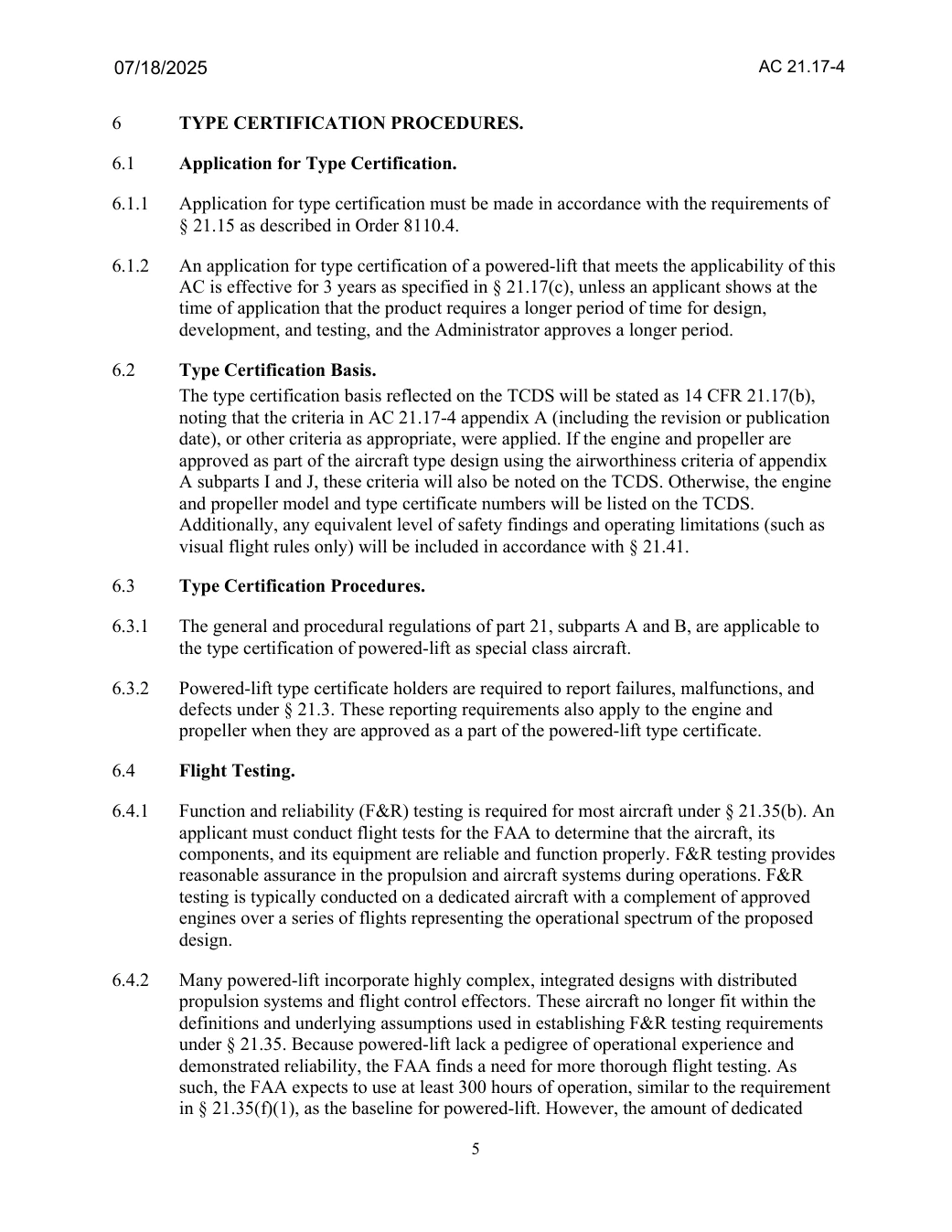
       The type certification basis reflected on the TCDS will be stated as 14 CFR 21.17(b),
        noting that the criteria in AC 21.17-4 appendix A (including the revision or publication
          date), or other criteria as appropriate, were applied. If the engine and propeller are
        approved as part of the aircraft type design using the airworthiness criteria of appendix
     A subparts I and J, these criteria will also be noted on the TCDS. Otherwise, the engine
       and propeller model and type certificate numbers will be listed on the TCDS.
         Additionally, any equivalent level of safety findings and operating limitations (such as
         visual flight rules only) will be included in accordance with § 21.41.

6.3    Type Certification Procedures.

6.3.1   The general and procedural regulations of part 21, subparts A and B, are applicable to
         the type certification of powered-lift as special class aircraft.

6.3.2    Powered-lift type certificate holders are required to report failures, malfunctions, and
         defects under § 21.3. These reporting requirements also apply to the engine and
         propeller when they are approved as a part of the powered-lift type certificate.

6.4      Flight Testing.

6.4.1    Function and reliability (F&R) testing is required for most aircraft under § 21.35(b). An
         applicant must conduct flight tests for the FAA to determine that the aircraft, its
        components, and its equipment are reliable and function properly. F&R testing provides
        reasonable assurance in the propulsion and aircraft systems during operations. F&R
         testing is typically conducted on a dedicated aircraft with a complement of approved
        engines over a series of flights representing the operational spectrum of the proposed
         design.

6.4.2   Many powered-lift incorporate highly complex, integrated designs with distributed
        propulsion systems and flight control effectors. These aircraft no longer fit within the
         definitions and underlying assumptions used in establishing F&R testing requirements
        under § 21.35. Because powered-lift lack a pedigree of operational experience and
        demonstrated reliability, the FAA finds a need for more thorough flight testing. As
         such, the FAA expects to use at least 300 hours of operation, similar to the requirement
         in § 21.35(f)(1), as the baseline for powered-lift. However, the amount of dedicated

                                          5
Saved from the FAA on November 17, 2026. All original pages are retained. Engineering explanations are presented separately below.
Aerospace Consulting / Engineering perspective
Begin with the aircraft and the agreed basis.
Connect the operating concept, aircraft-level failure effects, system architecture and assurance planning. Keep FAA powered-lift criteria and EASA SC-VTOL provisions distinct when developing the safety and certification approach.
A focused review, an agreed assessment package or ongoing support alongside your team. We can agree the relevant inputs and scope in the initial conversation.
This opens your email application.
Start a conversation
Tell us about your programme, the system you are developing and the support you need.
We can agree a focused use-case review, a defined evidence package or ongoing programme support.
This opens your email application.
Specialist aerospace expertise
Aerospace Consulting is led by Hussein Khimji, an FAA Designated Engineering Representative in systems and equipment, with a focus on system safety, flight controls and avionics.
We work with aircraft developers and systems suppliers to connect technical decisions, safety assessments and certification evidence.
This is the proposed introduction. The full About page will add your approved biography and associate expertise.
Systems engineering & development assurance
Tell us about the aircraft or system, its intended function, stage of development and the support you need.