Appendix A gives an acceptable means for certain powered-lift under §21.17(b). These criteria are not universally applicable CFR requirements; establish the basis for the particular aircraft.
The source, within reach.
Search within this AC, jump to a source page, or download the complete saved publication.
This extraction supports search. Read the original page for complete notation and layout.
07/18/2025                                               AC 21.17-4
                                                                        Appendix A

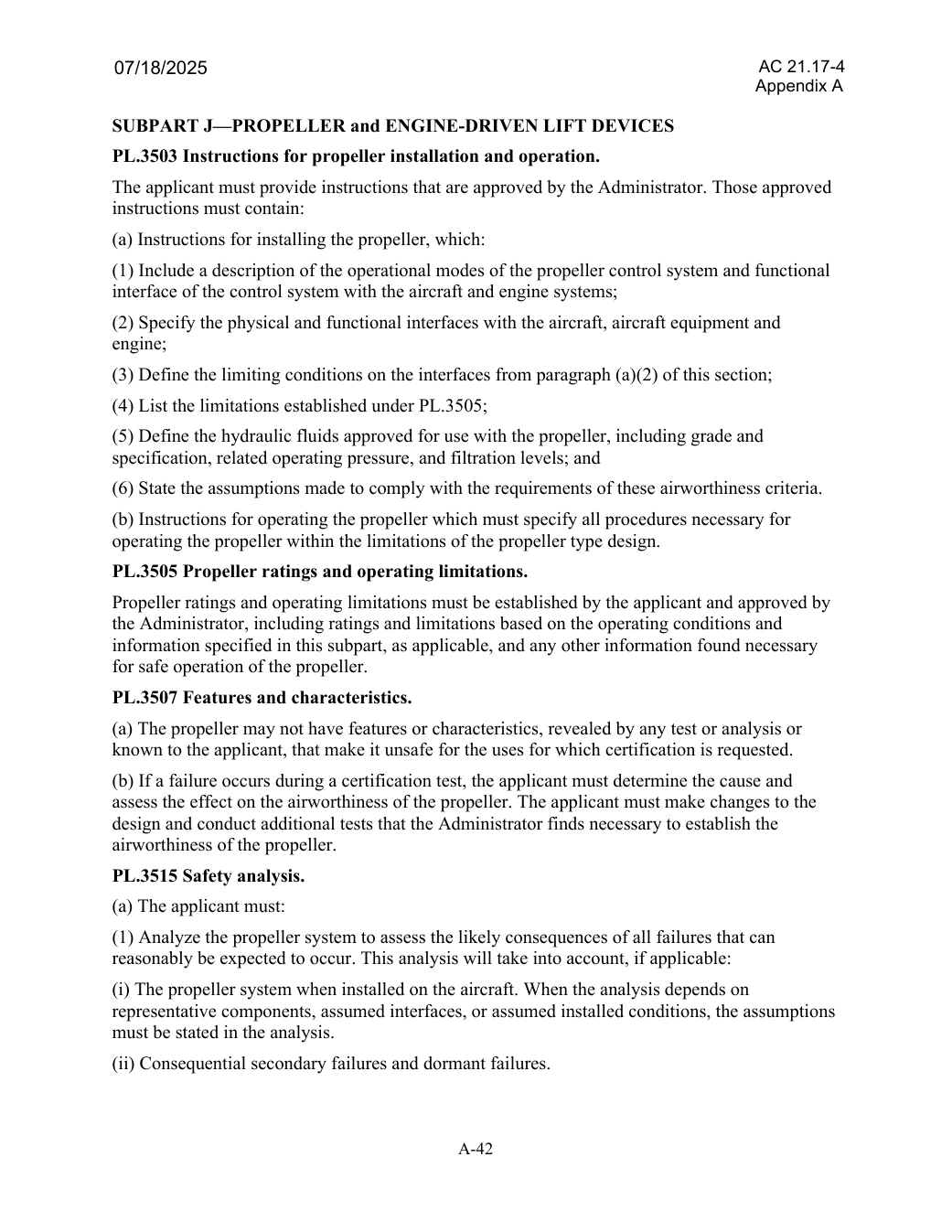
SUBPART J—PROPELLER and ENGINE-DRIVEN LIFT DEVICES
PL.3503 Instructions for propeller installation and operation.
The applicant must provide instructions that are approved by the Administrator. Those approved
instructions must contain:
(a) Instructions for installing the propeller, which:
(1) Include a description of the operational modes of the propeller control system and functional
interface of the control system with the aircraft and engine systems;
(2) Specify the physical and functional interfaces with the aircraft, aircraft equipment and
engine;
(3) Define the limiting conditions on the interfaces from paragraph (a)(2) of this section;
(4) List the limitations established under PL.3505;
(5) Define the hydraulic fluids approved for use with the propeller, including grade and
specification, related operating pressure, and filtration levels; and
(6) State the assumptions made to comply with the requirements of these airworthiness criteria.
(b) Instructions for operating the propeller which must specify all procedures necessary for
operating the propeller within the limitations of the propeller type design.
PL.3505 Propeller ratings and operating limitations.
Propeller ratings and operating limitations must be established by the applicant and approved by
the Administrator, including ratings and limitations based on the operating conditions and
information specified in this subpart, as applicable, and any other information found necessary
for safe operation of the propeller.
PL.3507 Features and characteristics.
(a) The propeller may not have features or characteristics, revealed by any test or analysis or
known to the applicant, that make it unsafe for the uses for which certification is requested.
(b) If a failure occurs during a certification test, the applicant must determine the cause and
assess the effect on the airworthiness of the propeller. The applicant must make changes to the
design and conduct additional tests that the Administrator finds necessary to establish the
airworthiness of the propeller.
PL.3515 Safety analysis.
(a) The applicant must:
(1) Analyze the propeller system to assess the likely consequences of all failures that can
reasonably be expected to occur. This analysis will take into account, if applicable:
(i) The propeller system when installed on the aircraft. When the analysis depends on
representative components, assumed interfaces, or assumed installed conditions, the assumptions
must be stated in the analysis.
(ii) Consequential secondary failures and dormant failures.


                                       A-42
Saved from the FAA on November 17, 2026. All original pages are retained. Engineering explanations are presented separately below.
Aerospace Consulting / Engineering perspective
Begin with the aircraft and the agreed basis.
Connect the operating concept, aircraft-level failure effects, system architecture and assurance planning. Keep FAA powered-lift criteria and EASA SC-VTOL provisions distinct when developing the safety and certification approach.
A focused review, an agreed assessment package or ongoing support alongside your team. We can agree the relevant inputs and scope in the initial conversation.
This opens your email application.
Start a conversation
Tell us about your programme, the system you are developing and the support you need.
We can agree a focused use-case review, a defined evidence package or ongoing programme support.
This opens your email application.
Specialist aerospace expertise
Aerospace Consulting is led by Hussein Khimji, an FAA Designated Engineering Representative in systems and equipment, with a focus on system safety, flight controls and avionics.
We work with aircraft developers and systems suppliers to connect technical decisions, safety assessments and certification evidence.
This is the proposed introduction. The full About page will add your approved biography and associate expertise.
Systems engineering & development assurance
Tell us about the aircraft or system, its intended function, stage of development and the support you need.