
Meaning-bearing probability exponents
AC 21.17-4 · A-43Open saved PDF here ↗
Extracted text for finding words
This extraction supports search. Read the original page for complete notation and layout.
07/18/2025                                              AC 21.17-4
                                                                        Appendix A

(iii) Multiple failures referred to in paragraph (d) of this section, or that result in the hazardous
propeller effects defined in paragraph (g)(1) of this section.
(2) Summarize those failures that could result in major propeller effects or hazardous propeller
effects defined in paragraph (g) of this section, and estimate the probability of occurrence of
those effects.
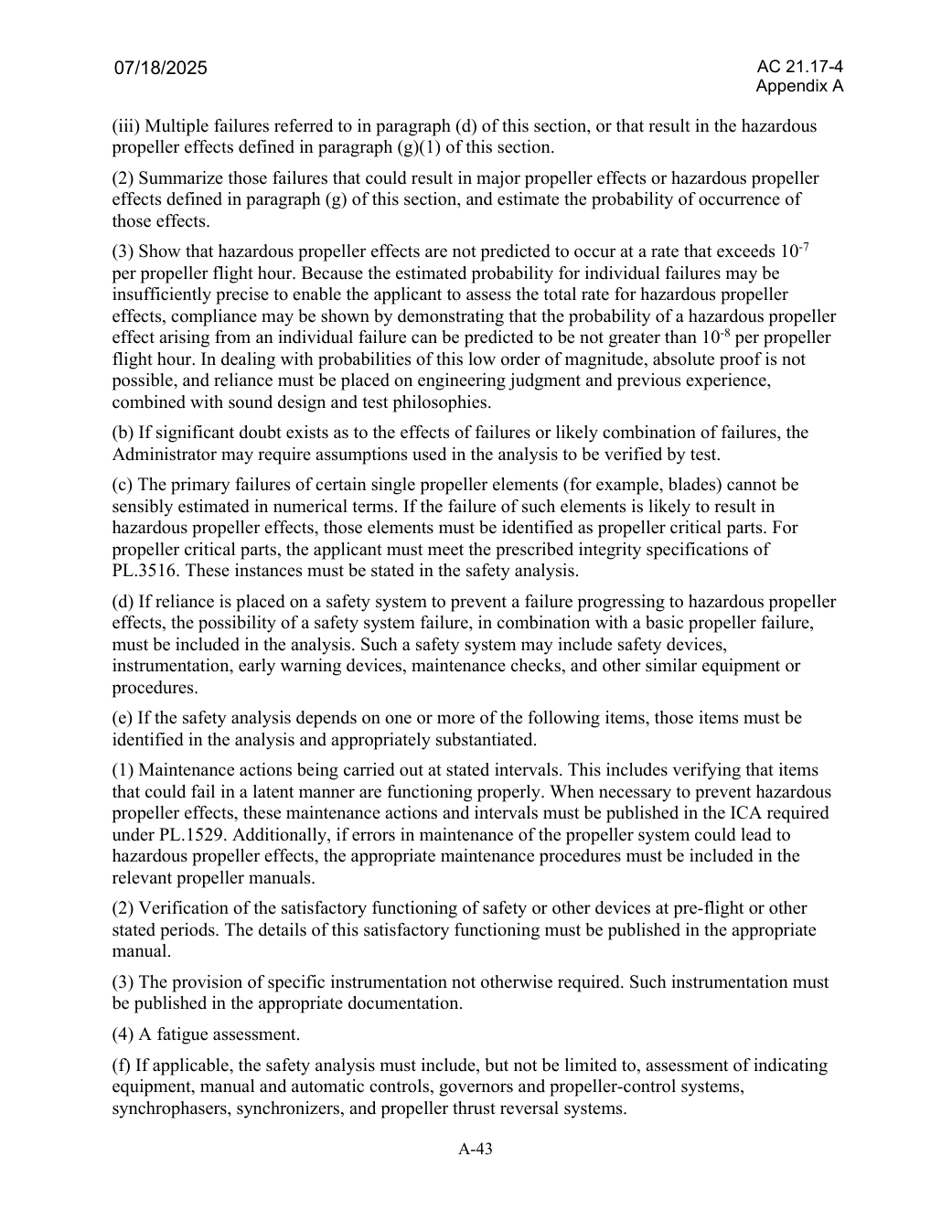
(3) Show that hazardous propeller effects are not predicted to occur at a rate that exceeds 10-7
per propeller flight hour. Because the estimated probability for individual failures may be
insufficiently precise to enable the applicant to assess the total rate for hazardous propeller
effects, compliance may be shown by demonstrating that the probability of a hazardous propeller
effect arising from an individual failure can be predicted to be not greater than 10-8 per propeller
flight hour. In dealing with probabilities of this low order of magnitude, absolute proof is not
possible, and reliance must be placed on engineering judgment and previous experience,
combined with sound design and test philosophies.
(b) If significant doubt exists as to the effects of failures or likely combination of failures, the
Administrator may require assumptions used in the analysis to be verified by test.
(c) The primary failures of certain single propeller elements (for example, blades) cannot be
sensibly estimated in numerical terms. If the failure of such elements is likely to result in
hazardous propeller effects, those elements must be identified as propeller critical parts. For
propeller critical parts, the applicant must meet the prescribed integrity specifications of
PL.3516. These instances must be stated in the safety analysis.
(d) If reliance is placed on a safety system to prevent a failure progressing to hazardous propeller
effects, the possibility of a safety system failure, in combination with a basic propeller failure,
must be included in the analysis. Such a safety system may include safety devices,
instrumentation, early warning devices, maintenance checks, and other similar equipment or
procedures.
(e) If the safety analysis depends on one or more of the following items, those items must be
identified in the analysis and appropriately substantiated.
(1) Maintenance actions being carried out at stated intervals. This includes verifying that items
that could fail in a latent manner are functioning properly. When necessary to prevent hazardous
propeller effects, these maintenance act ions and intervals must be published in the ICA required
under PL.1529. Additionally, if errors in maintenance of the propeller system could lead to
hazardous propeller effects, the appropriate maintenance procedures must be included in the
relevant propeller manuals.
(2) Verification of the satisfactory functioning of safety or other devices at pre-flight or other
stated periods. The details of this satisfactory functioning must be published in the appropriate
manual.
(3) The provision of specific instrumentation not otherwise required. Such instrumentation must
be published in the appropriate documentation.
(4) A fatigue assessment.
(f) If applicable, the safety analysis must include, but not be limited to, assessment of indicating
equipment, manual and automatic controls, governors and propeller-control systems,
synchrophasers, synchronizers, and propeller thrust reversal systems.

                                       A-43