Appendix A gives an acceptable means for certain powered-lift under §21.17(b). These criteria are not universally applicable CFR requirements; establish the basis for the particular aircraft.
The source, within reach.
Search within this AC, jump to a source page, or download the complete saved publication.
This extraction supports search. Read the original page for complete notation and layout.
07/18/2025                                               AC 21.17-4
                                                                        Appendix A

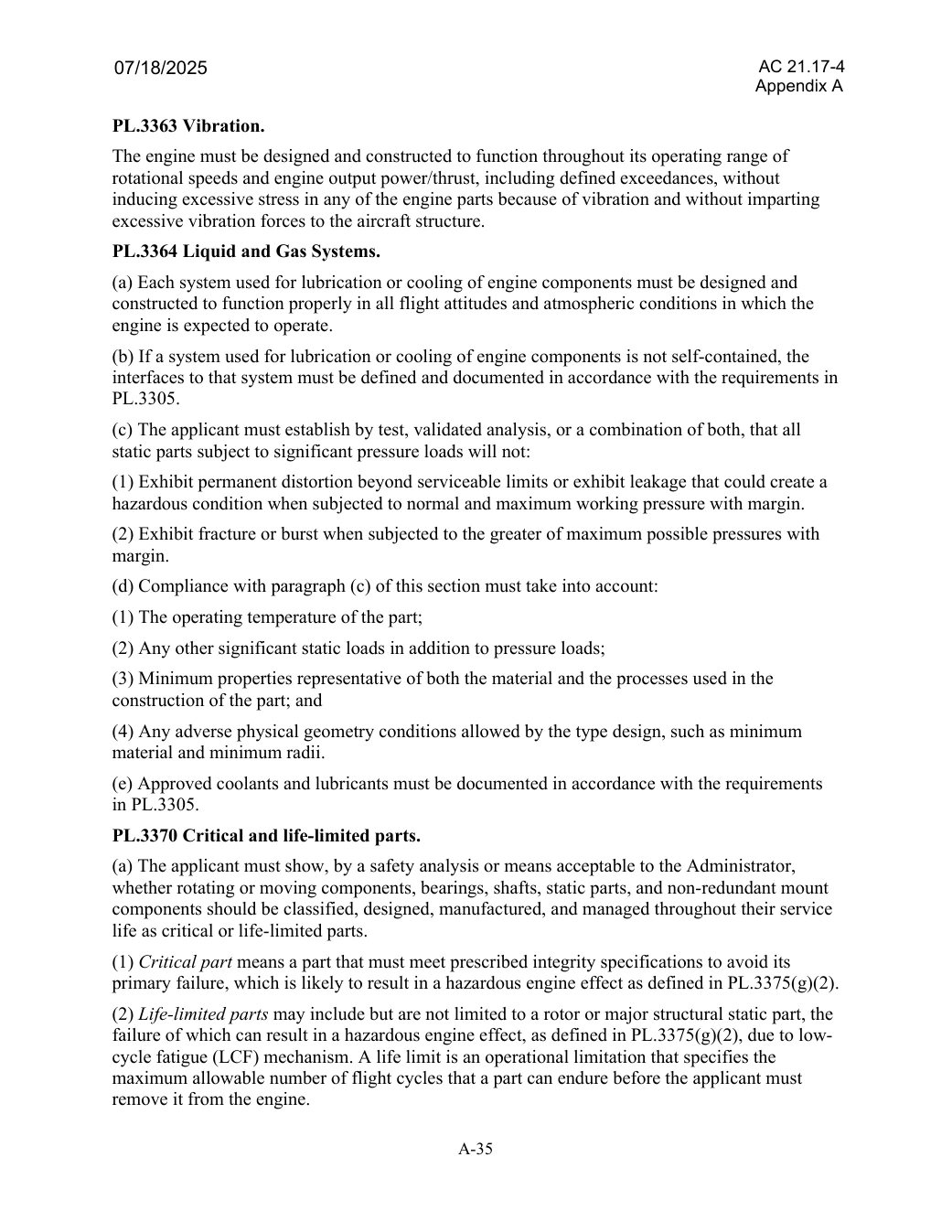
PL.3363 Vibration.
The engine must be designed and constructed to function throughout its operating range of
rotational speeds and engine output power/thrust, including defined exceedances, without
inducing excessive stress in any of the engine parts because of vibration and without imparting
excessive vibration forces to the aircraft structure.
PL.3364 Liquid and Gas Systems.
(a) Each system used for lubrication or cooling of engine components must be designed and
constructed to function properly in all flight attitudes and atmospheric conditions in which the
engine is expected to operate.
(b) If a system used for lubrication or cooling of engine components is not self-contained, the
interfaces to that system must be defined and documented in accordance with the requirements in
PL.3305.
(c) The applicant must establish by test, validated analysis, or a combination of both, that all
static parts subject to significant pressure loads will not:
(1) Exhibit permanent distortion beyond serviceable limits or exhibit leakage that could create a
hazardous condition when subjected to normal and maximum working pressure with margin.
(2) Exhibit fracture or burst when subjected to the greater of maximum possible pressures with
margin.
(d) Compliance with paragraph (c) of this section must take into account:
(1) The operating temperature of the part;
(2) Any other significant static loads in addition to pressure loads;
(3) Minimum properties representative of both the material and the processes used in the
construction of the part; and
(4) Any adverse physical geometry conditions allowed by the type design, such as minimum
material and minimum radii.
(e) Approved coolants and lubricants must be documented in accordance with the requirements
in PL.3305.
PL.3370 Critical and life-limited parts.
(a) The applicant must show, by a safety analysis or means acceptable to the Administrator,
whether rotating or moving components, bearings, shafts, static parts, and non-redundant mount
components should be classified, designed, manufactured, and managed throughout their service
life as critical or life-limited parts.
(1) Critical part means a part that must meet prescribed integrity specifications to avoid its
primary failure, which is likely to result in a hazardous engine effect as defined in PL.3375(g)(2).
(2) Life-limited parts may include but are not limited to a rotor or major structural static part, the
failure of which can result in a hazardous engine effect, as defined in PL.3375(g)(2), due to low-
cycle fatigue (LCF) mechanism. A life limit is an operational limitation that specifies the
maximum allowable number of flight cycles that a part can endure before the applicant must
remove it from the engine.

                                       A-35
Saved from the FAA on November 17, 2026. All original pages are retained. Engineering explanations are presented separately below.
Aerospace Consulting / Engineering perspective
Begin with the aircraft and the agreed basis.
Connect the operating concept, aircraft-level failure effects, system architecture and assurance planning. Keep FAA powered-lift criteria and EASA SC-VTOL provisions distinct when developing the safety and certification approach.
A focused review, an agreed assessment package or ongoing support alongside your team. We can agree the relevant inputs and scope in the initial conversation.
This opens your email application.
Start a conversation
Tell us about your programme, the system you are developing and the support you need.
We can agree a focused use-case review, a defined evidence package or ongoing programme support.
This opens your email application.
Specialist aerospace expertise
Aerospace Consulting is led by Hussein Khimji, an FAA Designated Engineering Representative in systems and equipment, with a focus on system safety, flight controls and avionics.
We work with aircraft developers and systems suppliers to connect technical decisions, safety assessments and certification evidence.
This is the proposed introduction. The full About page will add your approved biography and associate expertise.
Systems engineering & development assurance
Tell us about the aircraft or system, its intended function, stage of development and the support you need.