Appendix A gives an acceptable means for certain powered-lift under §21.17(b). These criteria are not universally applicable CFR requirements; establish the basis for the particular aircraft.
The source, within reach.
Search within this AC, jump to a source page, or download the complete saved publication.
This extraction supports search. Read the original page for complete notation and layout.
07/18/2025                                               AC 21.17-4
                                                                        Appendix A

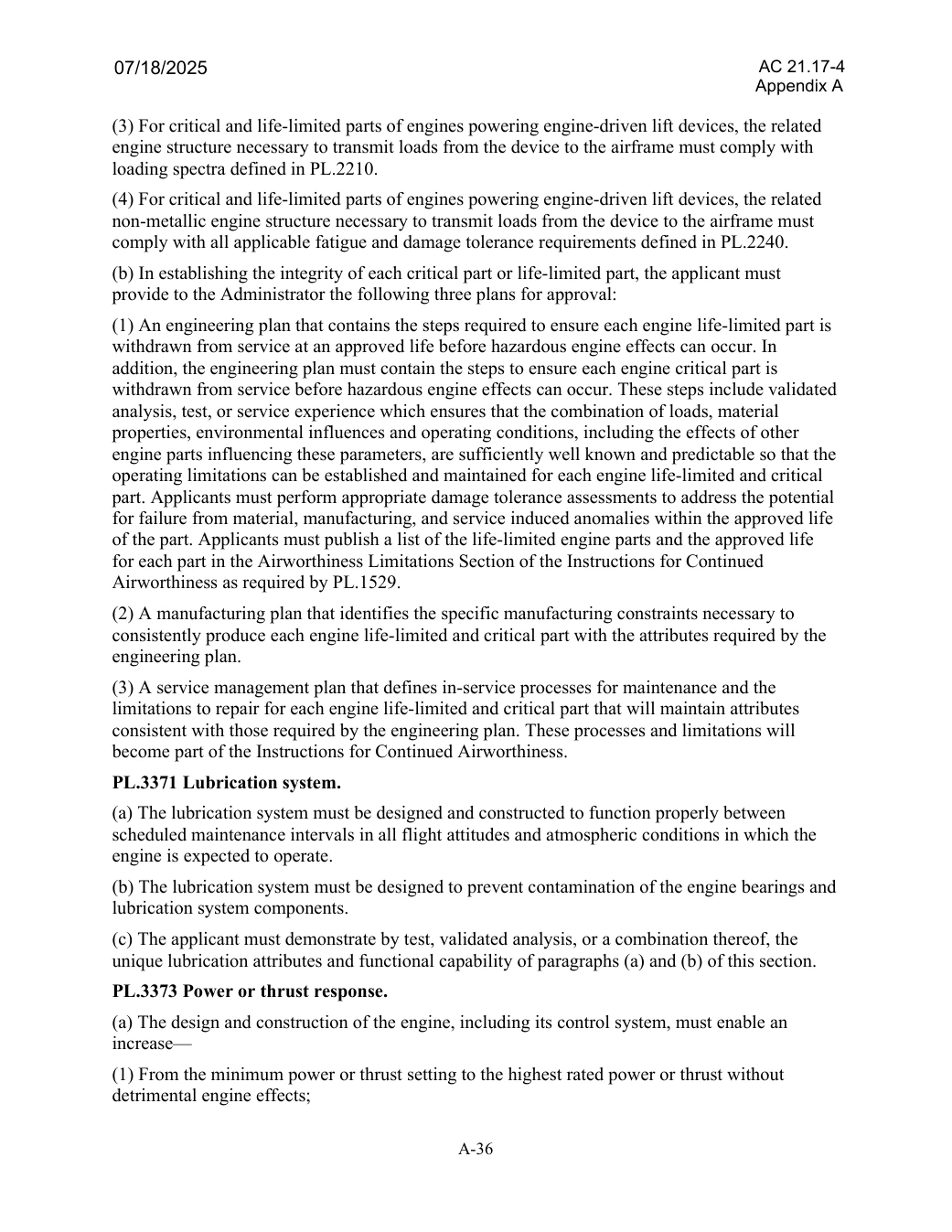
(3) For critical and life-limited parts of engines powering engine-driven lift devices, the related
engine structure necessary to transmit loads from the device to the airframe must comply with
loading spectra defined in PL.2210.
(4) For critical and life-limited parts of engines powering engine-driven lift devices, the related
non-metallic engine structure necessary to transmit loads from the device to the airframe must
comply with all applicable fatigue and damage tolerance requirements defined in PL.2240.
(b) In establishing the integrity of each critical part or life-limited part, the applicant must
provide to the Administrator the following three plans for approval:
(1) An engineering plan that contains the steps required to ensure each engine life-limited part is
withdrawn from service at an approved life before hazardous engine effects can occur. In
addition, the engineering plan must contain the steps to ensure each engine critical part is
withdrawn from service before hazardous engine effects can occur. These steps include validated
analysis, test, or service experience which ensures that the combination of loads, material
properties, environmental influences and operating conditions, including the effects of other
engine parts influencing these parameters, are sufficiently well known and predictable so that the
operating limitations can be established and maintained for each engine life-limited and critical
part. Applicants must perform appropriate damage tolerance assessments to address the potential
for failure from material, manufacturing, and service induced anomalies within the approved life
of the part. Applicants must publish a list of the life-limited engine parts and the approved life
for each part in the Airworthiness Limitations Section of the Instructions for Continued
Airworthiness as required by PL.1529.
(2) A manufacturing plan that identifies the specific manufacturing constraints necessary to
consistently produce each engine life-limited and critical part with the attributes required by the
engineering plan.
(3) A service management plan that defines in-service processes for maintenance and the
limitations to repair for each engine life-limited and critical part that will maintain attributes
consistent with those required by the engineering plan. These processes and limitations will
become part of the Instructions for Continued Airworthiness.
PL.3371 Lubrication system.
(a) The lubrication system must be designed and constructed to function properly between
scheduled maintenance intervals in all flight attitudes and atmospheric conditions in which the
engine is expected to operate.
(b) The lubrication system must be designed to prevent contamination of the engine bearings and
lubrication system components.
(c) The applicant must demonstrate by test, validated analysis, or a combination thereof, the
unique lubrication attributes and functional capability of paragraphs (a) and (b) of this section.
PL.3373 Power or thrust response.
(a) The design and construction of the engine, including its control system, must enable an
increase—
(1) From the minimum power or thrust setting to the highest rated power or thrust without
detrimental engine effects;

                                       A-36
Saved from the FAA on November 17, 2026. All original pages are retained. Engineering explanations are presented separately below.
Aerospace Consulting / Engineering perspective
Begin with the aircraft and the agreed basis.
Connect the operating concept, aircraft-level failure effects, system architecture and assurance planning. Keep FAA powered-lift criteria and EASA SC-VTOL provisions distinct when developing the safety and certification approach.
A focused review, an agreed assessment package or ongoing support alongside your team. We can agree the relevant inputs and scope in the initial conversation.
This opens your email application.
Start a conversation
Tell us about your programme, the system you are developing and the support you need.
We can agree a focused use-case review, a defined evidence package or ongoing programme support.
This opens your email application.
Specialist aerospace expertise
Aerospace Consulting is led by Hussein Khimji, an FAA Designated Engineering Representative in systems and equipment, with a focus on system safety, flight controls and avionics.
We work with aircraft developers and systems suppliers to connect technical decisions, safety assessments and certification evidence.
This is the proposed introduction. The full About page will add your approved biography and associate expertise.
Systems engineering & development assurance
Tell us about the aircraft or system, its intended function, stage of development and the support you need.