Appendix A gives an acceptable means for certain powered-lift under §21.17(b). These criteria are not universally applicable CFR requirements; establish the basis for the particular aircraft.
The source, within reach.
Search within this AC, jump to a source page, or download the complete saved publication.
This extraction supports search. Read the original page for complete notation and layout.
07/18/2025                                              AC 21.17-4
                                                                        Appendix A

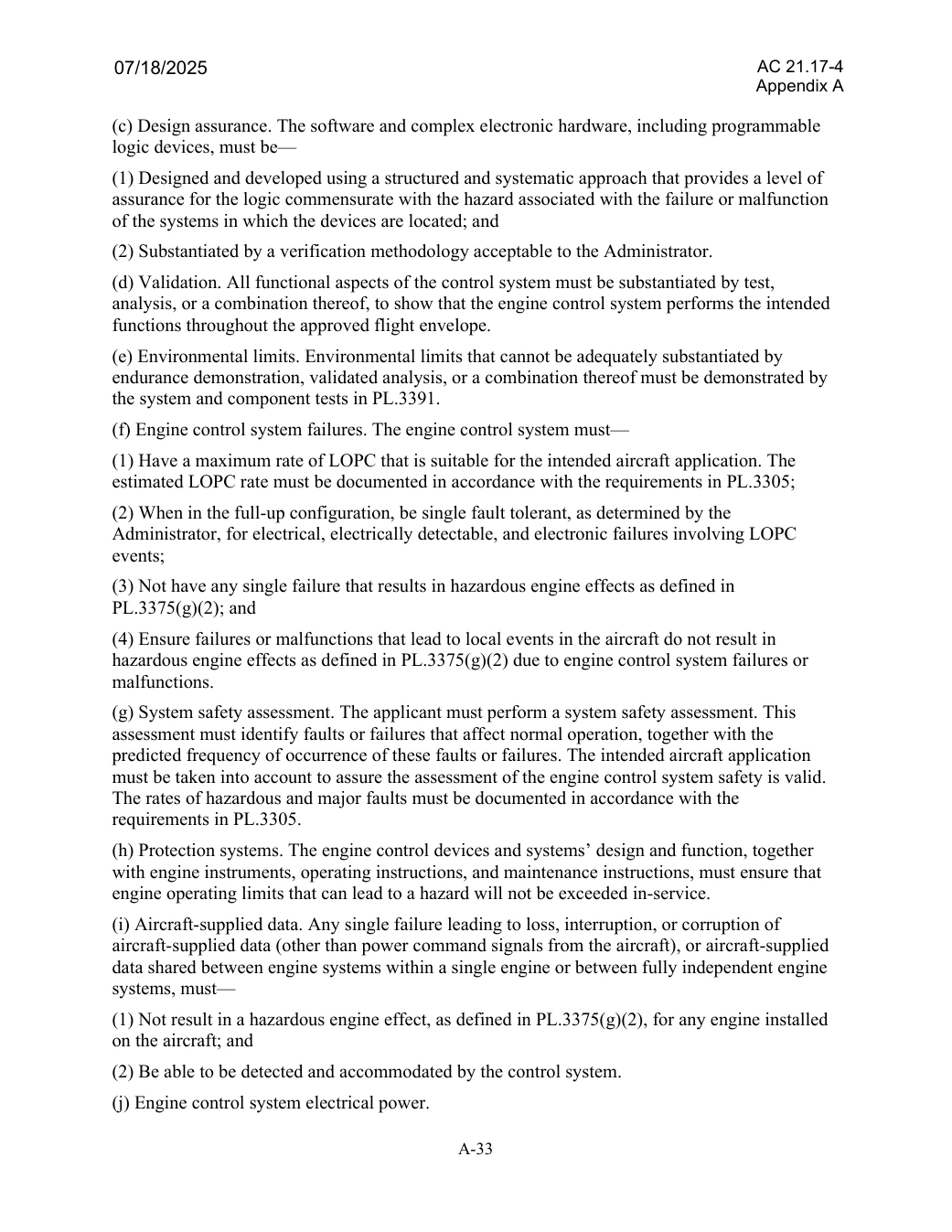
(c) Design assurance. The software and complex electronic hardware, including programmable
logic devices, must be—
(1) Designed and developed using a structured and systematic approach that provides a level of
assurance for the logic commensurate with the hazard associated with the failure or malfunction
of the systems in which the devices are located; and
(2) Substantiated by a verification methodology acceptable to the Administrator.
(d) Validation. All functional aspects of the control system must be substantiated by test,
analysis, or a combination thereof, to show that the engine control system performs the intended
functions throughout the approved flight envelope.
(e) Environmental limits. Environmental limits that cannot be adequately substantiated by
endurance demonstration, validated analysis, or a combination thereof must be demonstrated by
the system and component tests in PL.3391.
(f) Engine control system failures. The engine control system must—
(1) Have a maximum rate of LOPC that is suitable for the intended aircraft application. The
estimated LOPC rate must be documented in accordance with the requirements in PL.3305;
(2) When in the full-up configuration, be single fault tolerant, as determined by the
Administrator, for electrical, electrically detectable, and electronic failures involving LOPC
events;
(3) Not have any single failure that results in hazardous engine effects as defined in
PL.3375(g)(2); and
(4) Ensure failures or malfunctions that lead to local events in the aircraft do not result in
hazardous engine effects as defined in PL.3375(g)(2) due to engine control system failures or
malfunctions.
(g) System safety assessment. The applicant must perform a system safety assessment. This
assessment must identify faults or failures that affect normal operation, together with the
predicted frequency of occurrence of these faults or failures. The intended aircraft application
must be taken into account to assure the assessment of the engine control system safety is valid.
The rates of hazardous and major faults must be documented in accordance with the
requirements in PL.3305.
(h) Protection systems. The engine control devices and systems’ design and function, together
with engine instruments, operating instructions, and maintenance instructions, must ensure that
engine operating limits that can lead to a hazard will not be exceeded in-service.
(i) Aircraft-supplied data. Any single failure leading to loss, interruption, or corruption of
aircraft-supplied data (other than power command signals from the aircraft), or aircraft-supplied
data shared between engine systems within a single engine or between fully independent engine
systems, must—
(1) Not result in a hazardous engine effect, as defined in PL.3375(g)(2), for any engine installed
on the aircraft; and
(2) Be able to be detected and accommodated by the control system.
(j) Engine control system electrical power.

                                       A-33
Saved from the FAA on November 17, 2026. All original pages are retained. Engineering explanations are presented separately below.
Aerospace Consulting / Engineering perspective
Begin with the aircraft and the agreed basis.
Connect the operating concept, aircraft-level failure effects, system architecture and assurance planning. Keep FAA powered-lift criteria and EASA SC-VTOL provisions distinct when developing the safety and certification approach.
A focused review, an agreed assessment package or ongoing support alongside your team. We can agree the relevant inputs and scope in the initial conversation.
This opens your email application.
Start a conversation
Tell us about your programme, the system you are developing and the support you need.
We can agree a focused use-case review, a defined evidence package or ongoing programme support.
This opens your email application.
Specialist aerospace expertise
Aerospace Consulting is led by Hussein Khimji, an FAA Designated Engineering Representative in systems and equipment, with a focus on system safety, flight controls and avionics.
We work with aircraft developers and systems suppliers to connect technical decisions, safety assessments and certification evidence.
This is the proposed introduction. The full About page will add your approved biography and associate expertise.
Systems engineering & development assurance
Tell us about the aircraft or system, its intended function, stage of development and the support you need.