Appendix A gives an acceptable means for certain powered-lift under §21.17(b). These criteria are not universally applicable CFR requirements; establish the basis for the particular aircraft.
The source, within reach.
Search within this AC, jump to a source page, or download the complete saved publication.
This extraction supports search. Read the original page for complete notation and layout.
07/18/2025                                               AC 21.17-4
                                                                        Appendix A

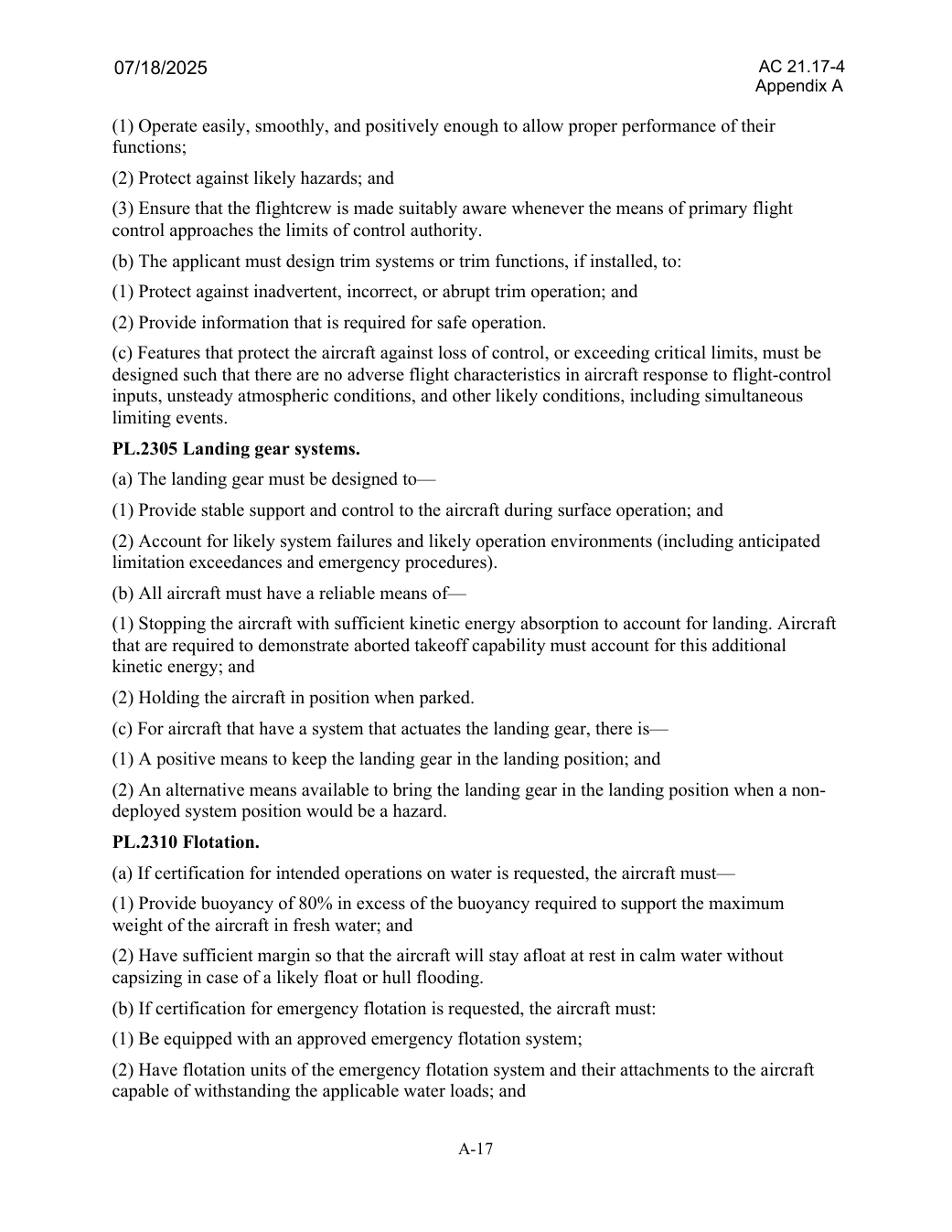
(1) Operate easily, smoothly, and positively enough to allow proper performance of their
functions;
(2) Protect against likely hazards; and
(3) Ensure that the flightcrew is made suitably aware whenever the means of primary flight
control approaches the limits of control authority.
(b) The applicant must design trim systems or trim functions, if installed, to:
(1) Protect against inadvertent, incorrect, or abrupt trim operation; and
(2) Provide information that is required for safe operation.
(c) Features that protect the aircraft against loss of control, or exceeding critical limits, must be
designed such that there are no adverse flight characteristics in aircraft response to flight-control
inputs, unsteady atmospheric conditions, and other likely conditions, including simultaneous
limiting events.
PL.2305 Landing gear systems.
(a) The landing gear must be designed to—
(1) Provide stable support and control to the aircraft during surface operation; and
(2) Account for likely system failures and likely operation environments (including anticipated
limitation exceedances and emergency procedures).
(b) All aircraft must have a reliable means of—
(1) Stopping the aircraft with sufficient kinetic energy absorption to account for landing. Aircraft
that are required to demonstrate aborted takeoff capability must account for this additional
kinetic energy; and
(2) Holding the aircraft in position when parked.
(c) For aircraft that have a system that actuates the landing gear, there is—
(1) A positive means to keep the landing gear in the landing position; and
(2) An alternative means available to bring the landing gear in the landing position when a non-
deployed system position would be a hazard.
PL.2310 Flotation.
(a) If certification for intended operations on water is requested, the aircraft must—
(1) Provide buoyancy of 80% in excess of the buoyancy required to support the maximum
weight of the aircraft in fresh water; and
(2) Have sufficient margin so that the aircraft will stay afloat at rest in calm water without
capsizing in case of a likely float or hull flooding.
(b) If certification for emergency flotation is requested, the aircraft must:
(1) Be equipped with an approved emergency flotation system;
(2) Have flotation units of the emergency flotation system and their attachments to the aircraft
capable of withstanding the applicable water loads; and

                                       A-17
Saved from the FAA on November 17, 2026. All original pages are retained. Engineering explanations are presented separately below.
Aerospace Consulting / Engineering perspective
Begin with the aircraft and the agreed basis.
Connect the operating concept, aircraft-level failure effects, system architecture and assurance planning. Keep FAA powered-lift criteria and EASA SC-VTOL provisions distinct when developing the safety and certification approach.
A focused review, an agreed assessment package or ongoing support alongside your team. We can agree the relevant inputs and scope in the initial conversation.
This opens your email application.
Start a conversation
Tell us about your programme, the system you are developing and the support you need.
We can agree a focused use-case review, a defined evidence package or ongoing programme support.
This opens your email application.
Specialist aerospace expertise
Aerospace Consulting is led by Hussein Khimji, an FAA Designated Engineering Representative in systems and equipment, with a focus on system safety, flight controls and avionics.
We work with aircraft developers and systems suppliers to connect technical decisions, safety assessments and certification evidence.
This is the proposed introduction. The full About page will add your approved biography and associate expertise.
Systems engineering & development assurance
Tell us about the aircraft or system, its intended function, stage of development and the support you need.