Appendix A gives an acceptable means for certain powered-lift under §21.17(b). These criteria are not universally applicable CFR requirements; establish the basis for the particular aircraft.
The source, within reach.
Search within this AC, jump to a source page, or download the complete saved publication.
This extraction supports search. Read the original page for complete notation and layout.
07/18/2025                                               AC 21.17-4
                                                                        Appendix A

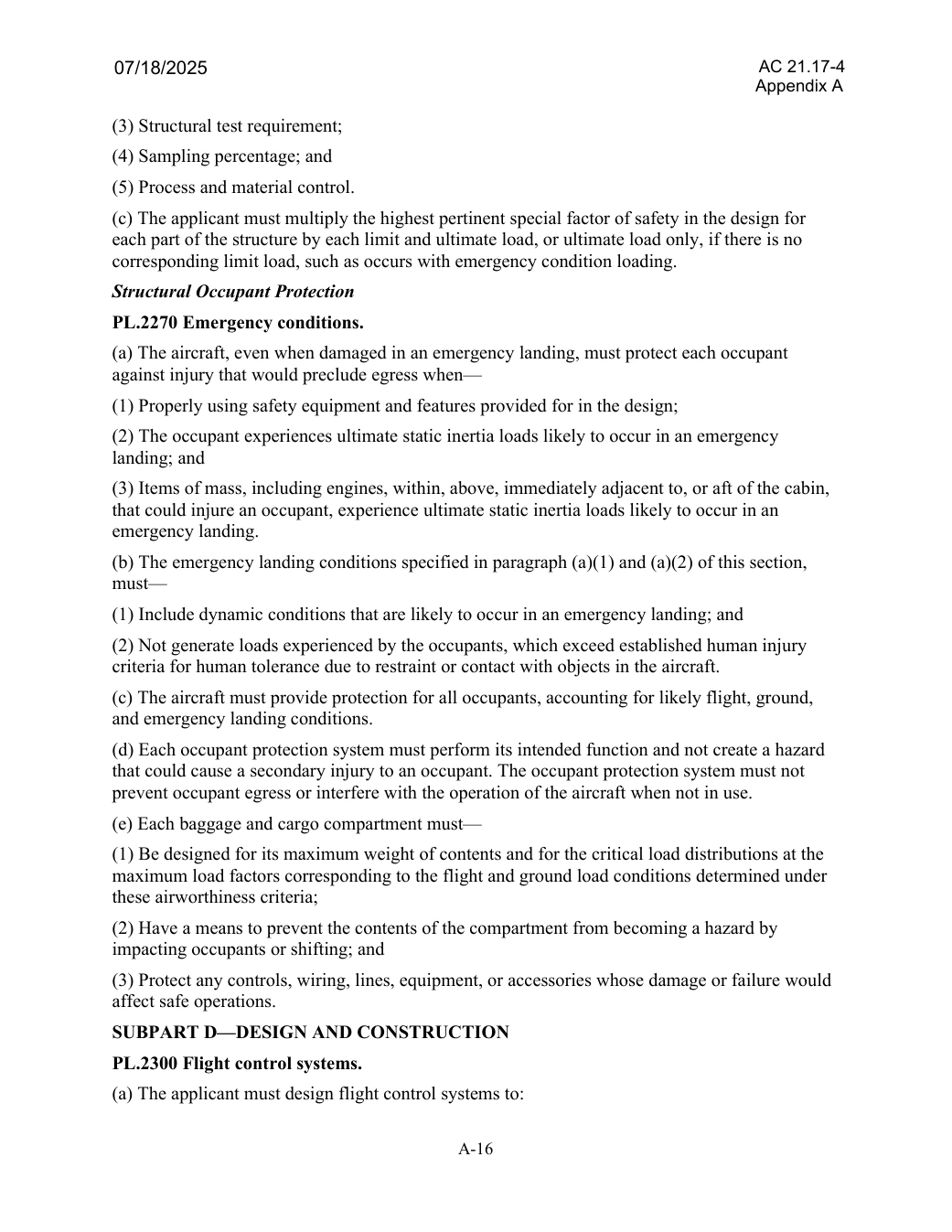
(3) Structural test requirement;
(4) Sampling percentage; and
(5) Process and material control.
(c) The applicant must multiply the highest pertinent special factor of safety in the design for
each part of the structure by each limit and ultimate load, or ultimate load only, if there is no
corresponding limit load, such as occurs with emergency condition loading.
Structural Occupant Protection
PL.2270 Emergency conditions.
(a) The aircraft, even when damaged in an emergency landing, must protect each occupant
against injury that would preclude egress when—
(1) Properly using safety equipment and features provided for in the design;
(2) The occupant experiences ultimate static inertia loads likely to occur in an emergency
landing; and
(3) Items of mass, including engines, within, a bove, immediately adjacent to, or aft of the cabin,
that could injure an occupant, experience ultimate static inertia loads likely to occur in an
emergency landing.
(b) The emergency landing conditions specified in paragraph (a)(1) and (a)(2) of this section,
must—
(1) Include dynamic conditions that are likely to occur in an emergency landing; and
(2) Not generate loads experienced by the occupants, which exceed established human injury
criteria for human tolerance due to restraint or contact with objects in the aircraft.
(c) The aircraft must provide protection for all occupants, accounting for likely flight, ground,
and emergency landing conditions.
(d) Each occupant protection system must perform its intended function and not create a hazard
that could cause a secondary injury to an occupant. The occupant protection system must not
prevent occupant egress or interfere with the operation of the aircraft when not in use.
(e) Each baggage and cargo compartment must—
(1) Be designed for its maximum weight of contents and for the critical load distributions at the
maximum load factors corresponding to the flight and ground load conditions determined under
these airworthiness criteria;
(2) Have a means to prevent the contents of the compartment from becoming a hazard by
impacting occupants or shifting; and
(3) Protect any controls, wiring, lines, equipment, or accessories whose damage or failure would
affect safe operations.
SUBPART D—DESIGN AND CONSTRUCTION
PL.2300 Flight control systems.
(a) The applicant must design flight control systems to:

                                       A-16
Saved from the FAA on November 17, 2026. All original pages are retained. Engineering explanations are presented separately below.
Aerospace Consulting / Engineering perspective
Begin with the aircraft and the agreed basis.
Connect the operating concept, aircraft-level failure effects, system architecture and assurance planning. Keep FAA powered-lift criteria and EASA SC-VTOL provisions distinct when developing the safety and certification approach.
A focused review, an agreed assessment package or ongoing support alongside your team. We can agree the relevant inputs and scope in the initial conversation.
This opens your email application.
Start a conversation
Tell us about your programme, the system you are developing and the support you need.
We can agree a focused use-case review, a defined evidence package or ongoing programme support.
This opens your email application.
Specialist aerospace expertise
Aerospace Consulting is led by Hussein Khimji, an FAA Designated Engineering Representative in systems and equipment, with a focus on system safety, flight controls and avionics.
We work with aircraft developers and systems suppliers to connect technical decisions, safety assessments and certification evidence.
This is the proposed introduction. The full About page will add your approved biography and associate expertise.
Systems engineering & development assurance
Tell us about the aircraft or system, its intended function, stage of development and the support you need.