
Original source view; text reflow has not yet been reviewed
AC 21.17-4 · A-14Open saved PDF here ↗
Extracted text for finding words
This extraction supports search. Read the original page for complete notation and layout.
07/18/2025                                              AC 21.17-4
                                                                        Appendix A

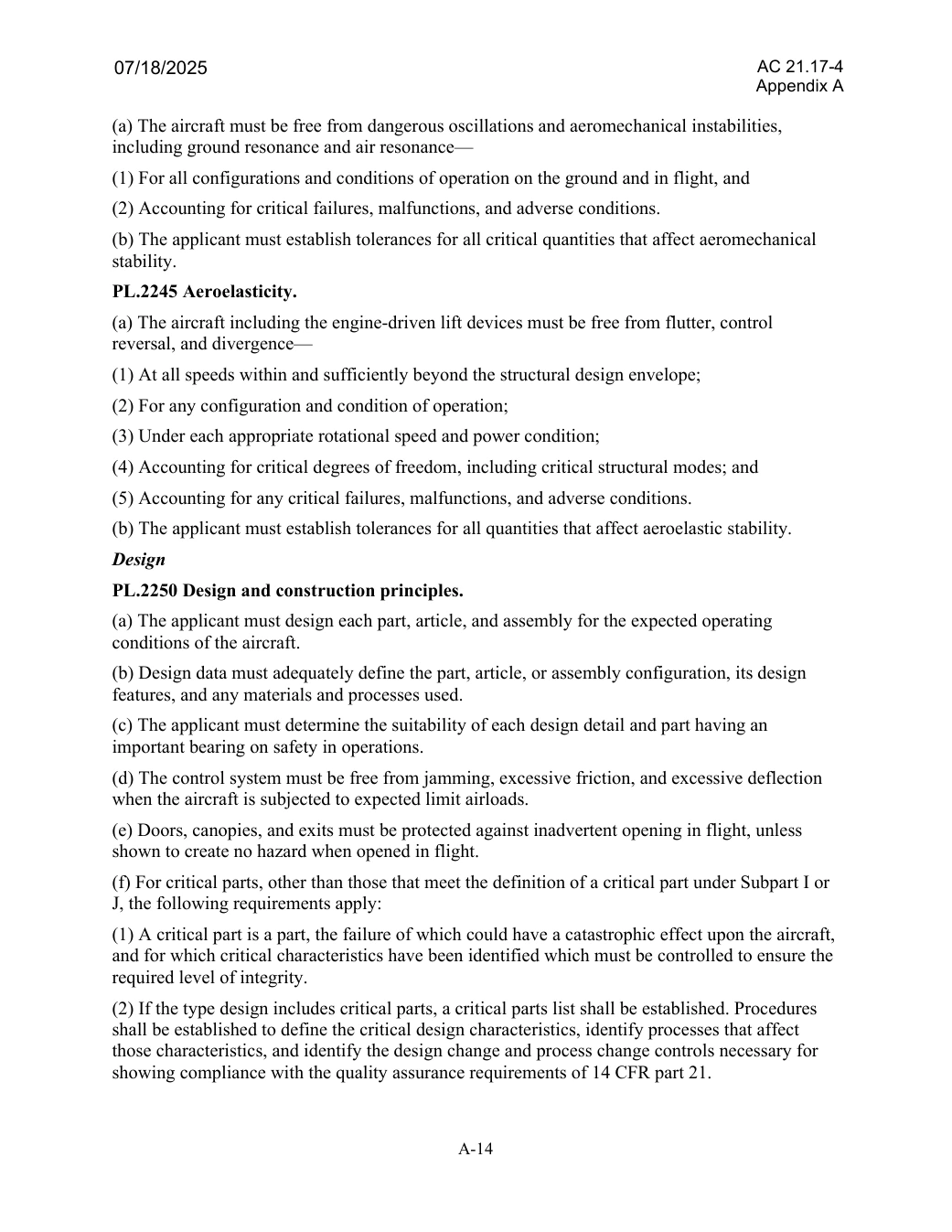
(a) The aircraft must be free from dangerous oscillations and aeromechanical instabilities,
including ground resonance and air resonance—
(1) For all configurations and conditions of operation on the ground and in flight, and
(2) Accounting for critical failures, malfunctions, and adverse conditions.
(b) The applicant must establish tolerances for all critical quantities that affect aeromechanical
stability.
PL.2245 Aeroelasticity.
(a) The aircraft including the engine-driven lift devices must be free from flutter, control
reversal, and divergence—
(1) At all speeds within and sufficiently beyond the structural design envelope;
(2) For any configuration and condition of operation;
(3) Under each appropriate rotational speed and power condition;
(4) Accounting for critical degrees of freedom, including critical structural modes; and
(5) Accounting for any critical failures, malfunctions, and adverse conditions.
(b) The applicant must establish tolerances for all quantities that affect aeroelastic stability.
Design
PL.2250 Design and construction principles.
(a) The applicant must design each part, article, and assembly for the expected operating
conditions of the aircraft.
(b) Design data must adequately define the part, article, or assembly configuration, its design
features, and any materials and processes used.
(c) The applicant must determine the suitability of each design detail and part having an
important bearing on safety in operations.
(d) The control system must be free from jamming, excessive friction, and excessive deflection
when the aircraft is subjected to expected limit airloads.
(e) Doors, canopies, and exits must be protected against inadvertent opening in flight, unless
shown to create no hazard when opened in flight.
(f) For critical parts, other than those that meet the definition of a critical part under Subpart I or
J, the following requirements apply:
(1) A critical part is a part, the failure of which could have a catastrophic effect upon the aircraft,
and for which critical characteristics have been identified which must be controlled to ensure the
required level of integrity.
(2) If the type design includes critical parts, a critical parts list shall be established. Procedures
shall be established to define the critical design characteristics, identify processes that affect
those characteristics, and identify the design change and process change controls necessary for
showing compliance with the quality assurance requirements of 14 CFR part 21.


                                       A-14