Appendix A gives an acceptable means for certain powered-lift under §21.17(b). These criteria are not universally applicable CFR requirements; establish the basis for the particular aircraft.
The source, within reach.
Search within this AC, jump to a source page, or download the complete saved publication.
This extraction supports search. Read the original page for complete notation and layout.
07/18/2025                                               AC 21.17-4
                                                                        Appendix A

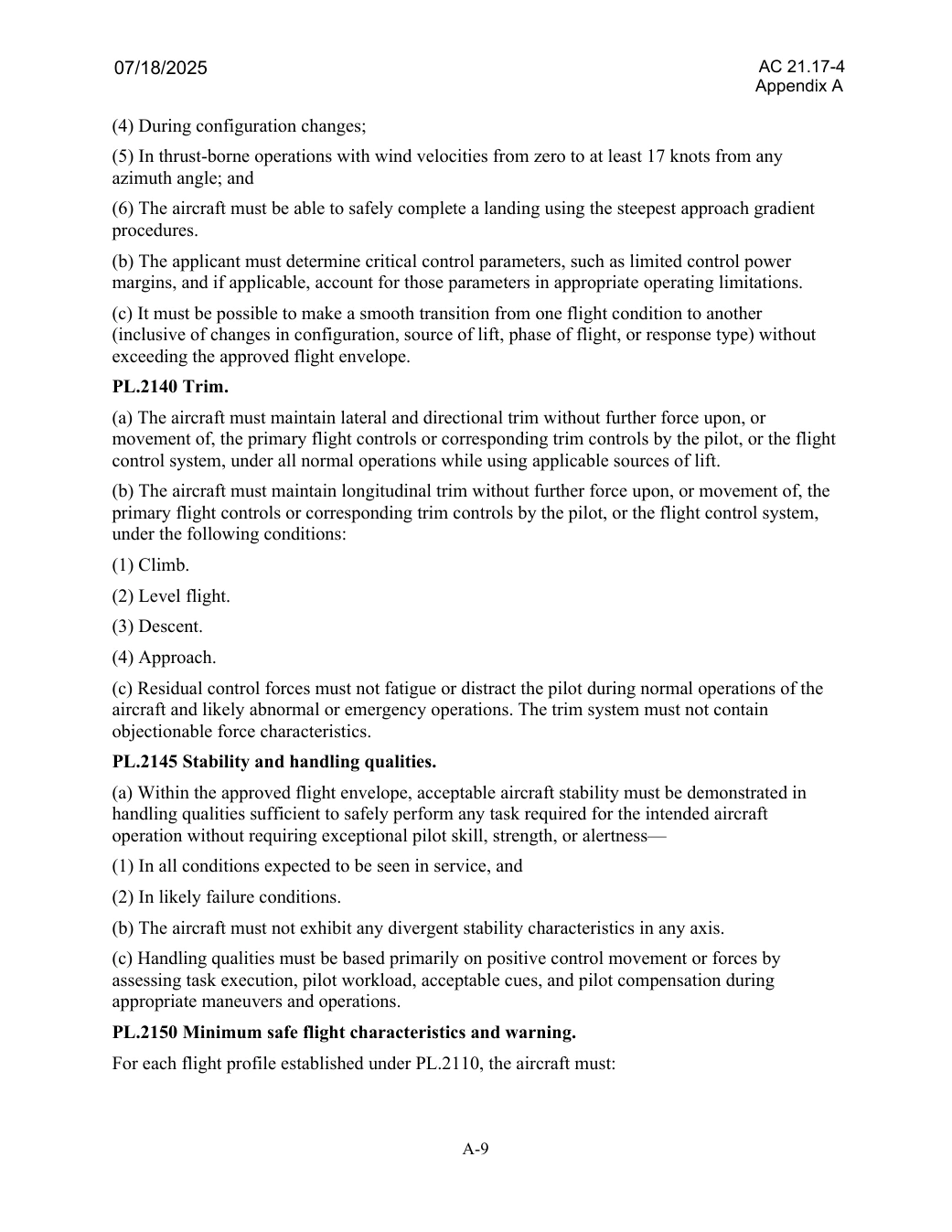
(4) During configuration changes;
(5) In thrust-borne operations with wind velocities from zero to at least 17 knots from any
azimuth angle; and
(6) The aircraft must be able to safely complete a landing using the steepest approach gradient
procedures.
(b) The applicant must determine critical control parameters, such as limited control power
margins, and if applicable, account for those parameters in appropriate operating limitations.
(c) It must be possible to make a smooth transition from one flight condition to another
(inclusive of changes in configuration, source of lift, phase of flight, or response type) without
exceeding the approved flight envelope.
PL.2140 Trim.
(a) The aircraft must maintain lateral and directional trim without further force upon, or
movement of, the primary flight controls or corresponding trim controls by the pilot, or the flight
control system, under all normal operations while using applicable sources of lift.
(b) The aircraft must maintain longitudinal trim without further force upon, or movement of, the
primary flight controls or corresponding trim controls by the pilot, or the flight control system,
under the following conditions:
(1) Climb.
(2) Level flight.
(3) Descent.
(4) Approach.
(c) Residual control forces must not fatigue or distract the pilot during normal operations of the
aircraft and likely abnormal or emergency operations. The trim system must not contain
objectionable force characteristics.
PL.2145 Stability and handling qualities.
(a) Within the approved flight envelope, acceptable aircraft stability must be demonstrated in
handling qualities sufficient to safely perform any task required for the intended aircraft
operation without requiring exceptional pilot skill, strength, or alertness—
(1) In all conditions expected to be seen in service, and
(2) In likely failure conditions.
(b) The aircraft must not exhibit any divergent stability characteristics in any axis.
(c) Handling qualities must be based primarily on positive control movement or forces by
assessing task execution, pilot workload, acceptable cues, and pilot compensation during
appropriate maneuvers and operations.
PL.2150 Minimum safe flight characteristics and warning.
For each flight profile established under PL.2110, the aircraft must:


                                        A-9
Saved from the FAA on November 17, 2026. All original pages are retained. Engineering explanations are presented separately below.
Aerospace Consulting / Engineering perspective
Begin with the aircraft and the agreed basis.
Connect the operating concept, aircraft-level failure effects, system architecture and assurance planning. Keep FAA powered-lift criteria and EASA SC-VTOL provisions distinct when developing the safety and certification approach.
A focused review, an agreed assessment package or ongoing support alongside your team. We can agree the relevant inputs and scope in the initial conversation.
This opens your email application.
Start a conversation
Tell us about your programme, the system you are developing and the support you need.
We can agree a focused use-case review, a defined evidence package or ongoing programme support.
This opens your email application.
Specialist aerospace expertise
Aerospace Consulting is led by Hussein Khimji, an FAA Designated Engineering Representative in systems and equipment, with a focus on system safety, flight controls and avionics.
We work with aircraft developers and systems suppliers to connect technical decisions, safety assessments and certification evidence.
This is the proposed introduction. The full About page will add your approved biography and associate expertise.
Systems engineering & development assurance
Tell us about the aircraft or system, its intended function, stage of development and the support you need.