Appendix A gives an acceptable means for certain powered-lift under §21.17(b). These criteria are not universally applicable CFR requirements; establish the basis for the particular aircraft.
The source, within reach.
Search within this AC, jump to a source page, or download the complete saved publication.
This extraction supports search. Read the original page for complete notation and layout.
07/18/2025                                              AC 21.17-4
                                                                        Appendix A

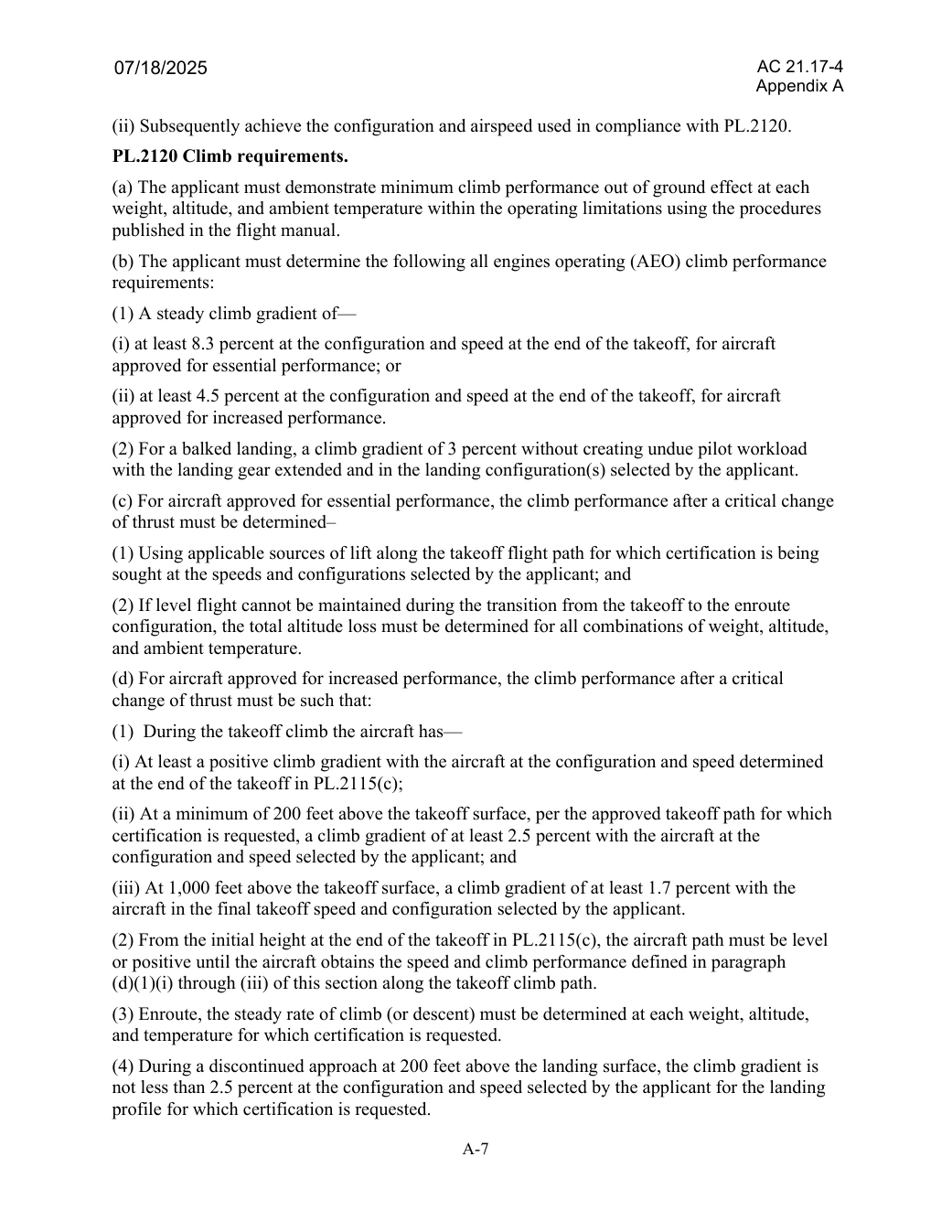
(ii) Subsequently achieve the configuration and airspeed used in compliance with PL.2120.
PL.2120 Climb requirements.
(a) The applicant must demonstrate minimum climb performance out of ground effect at each
weight, altitude, and ambient temperature within the operating limitations using the procedures
published in t he flight manual.
(b) The applicant must determine the following all engines operating (AEO) climb performance
requirements:
(1) A steady climb gradient of—
(i) at least 8.3 percent at the configuration and speed at the end of the takeoff, for aircraft
approved for essential performance; or
(ii) at least 4.5 percent at the configuration and speed at the end of the takeoff, for aircraft
approved for increased performance.
(2) For a balked landing, a climb gradient of 3 percent without creating undue pilot workload
with the landing gear extended and in the landing configuration(s) selected by the applicant.
(c) For aircraft approved for essential performance, the climb performance after a critical change
of thrust must be determined–
(1) Using applicable sources of lift along the takeoff flight path for which certification is being
sought at the speeds and configurations selected by the applicant; and
(2) If level flight cannot be maintained during the transition from the takeoff to the enroute
configuration, the total altitude loss must be determined for all combinations of weight, altitude,
and ambient temperature.
(d) For aircraft approved for increased performance, the climb performance after a critical
change of thrust must be such that:
(1) During the takeoff climb the aircraft has—
(i) At least a positive climb gradient with the aircraft at the configuration and speed determined
at the end of the takeoff in PL.2115(c);
(ii) At a minimum of 200 feet above the takeoff surface, per the approved takeoff path for which
certification is requested, a climb gradient of at least 2.5 percent with the aircraft at the
configuration and speed selected by the applicant; and
(iii) At 1,000 feet above the takeoff surface, a climb gradient of at least 1.7 percent with the
aircraft in the final takeoff speed and configuration selected by the applicant.
(2) From the initial height at the end of the takeoff in PL.2115(c), the aircraft path must be level
or positive until the aircraft obtains the speed and climb performance defined in paragraph
(d)(1)(i) through (iii) of this section along the takeoff climb path.
(3) Enroute, the steady rate of climb (or descent) must be determined at each weight, altitude,
and temperature for which certification is requested.
(4) During a discontinued approach at 200 feet above the landing surface, the climb gradient is
not less than 2.5 percent at the configuration and speed selected by the applicant for the landing
profile for which certification is requested.

                                        A-7
Saved from the FAA on November 17, 2026. All original pages are retained. Engineering explanations are presented separately below.
Aerospace Consulting / Engineering perspective
Begin with the aircraft and the agreed basis.
Connect the operating concept, aircraft-level failure effects, system architecture and assurance planning. Keep FAA powered-lift criteria and EASA SC-VTOL provisions distinct when developing the safety and certification approach.
A focused review, an agreed assessment package or ongoing support alongside your team. We can agree the relevant inputs and scope in the initial conversation.
This opens your email application.
Start a conversation
Tell us about your programme, the system you are developing and the support you need.
We can agree a focused use-case review, a defined evidence package or ongoing programme support.
This opens your email application.
Specialist aerospace expertise
Aerospace Consulting is led by Hussein Khimji, an FAA Designated Engineering Representative in systems and equipment, with a focus on system safety, flight controls and avionics.
We work with aircraft developers and systems suppliers to connect technical decisions, safety assessments and certification evidence.
This is the proposed introduction. The full About page will add your approved biography and associate expertise.
Systems engineering & development assurance
Tell us about the aircraft or system, its intended function, stage of development and the support you need.