Appendix A gives an acceptable means for certain powered-lift under §21.17(b). These criteria are not universally applicable CFR requirements; establish the basis for the particular aircraft.
The source, within reach.
Search within this AC, jump to a source page, or download the complete saved publication.
This extraction supports search. Read the original page for complete notation and layout.
07/18/2025                                               AC 21.17-4
                                                                        Appendix A

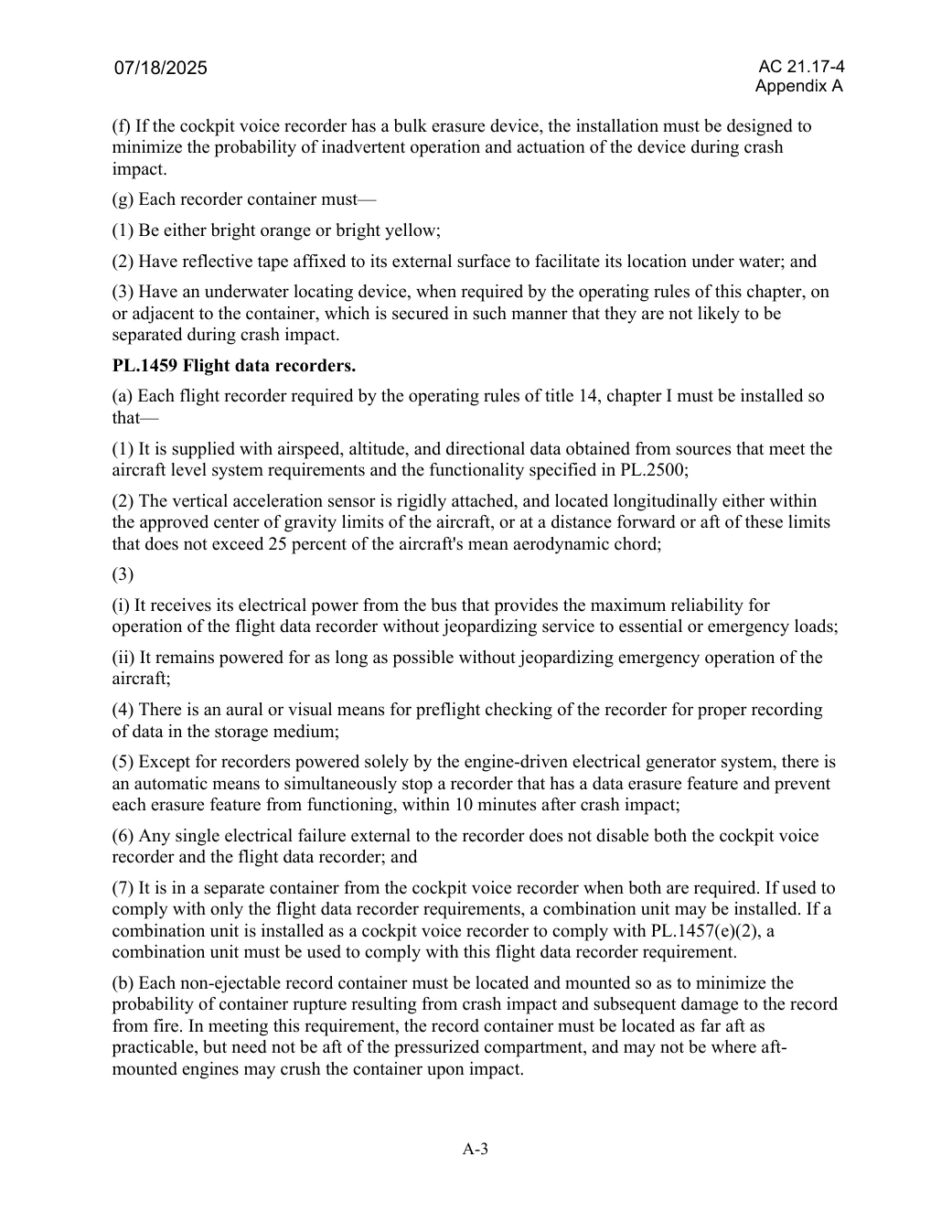
(f) If the cockpit voice recorder has a bulk erasure device, the installation must be designed to
minimize the probability of inadvertent operation and actuation of the device during crash
impact.
(g) Each recorder container must—
(1) Be either bright orange or bright yellow;
(2) Have reflective tape affixed to its external surface to facilitate its location under water; and
(3) Have an underwater locating device, when required by the operating rules of this chapter, on
or adjacent to the container, which is secured in such manner that they are not likely to be
separated during crash impact.
PL.1459 Flight data recorders.
(a) Each flight recorder required by the operating rules of title 14, chapter I must be installed so
that—
(1) It is supplied with airspeed, altitude, and directional data obtained from sources that meet the
aircraft level system requirements and the functionality specified in PL.2500;
(2) The vertical acceleration sensor is rigidly attached, and located longitudinally either within
the approved center of gravity limits of the aircraft, or at a distance forward or aft of these limits
that does not exceed 25 percent of the aircraft's mean aerodynamic chord;
(3)
(i) It receives its electrical power from the bus that provides the maximum reliability for
operation of the flight data recorder without jeopardizing service to essential or emergency loads;
(ii) It remains powered for as long as possible without jeopardizing emergency operation of the
aircraft;
(4) There is an aural or visual means for preflight checking of the recorder for proper recording
of data in the storage medium;
(5) Except for recorders powered solely by the engine-driven electrical generator system, there is
an automatic means to simultaneously stop a recorder that has a data erasure feature and prevent
each erasure feature from functioning, within 10 minutes after crash impact;
(6) Any single electrical failure external to the recorder does not disable both the cockpit voice
recorder and the flight data recorder; and
(7) It is in a separate container from the cockpit voice recorder when both are required. If used to
comply with only the flight data recorder requirements, a combination unit may be installed. If a
combination unit is installed as a cockpit voice recorder to comply with PL.1457(e)(2), a
combination unit must be used to comply with this flight data recorder requirement.
(b) Each non-ejectable record container must be located and mounted so as to minimize the
probability of container rupture resulting from crash impact and subsequent damage to the record
from fire. In meeting this requirement, the record container must be located as far aft as
practicable, but need not be aft of the pressurized compartment, and may not be where aft-
mounted engines may crush the container upon impact.


                                        A-3
Saved from the FAA on November 17, 2026. All original pages are retained. Engineering explanations are presented separately below.
Aerospace Consulting / Engineering perspective
Begin with the aircraft and the agreed basis.
Connect the operating concept, aircraft-level failure effects, system architecture and assurance planning. Keep FAA powered-lift criteria and EASA SC-VTOL provisions distinct when developing the safety and certification approach.
A focused review, an agreed assessment package or ongoing support alongside your team. We can agree the relevant inputs and scope in the initial conversation.
This opens your email application.
Start a conversation
Tell us about your programme, the system you are developing and the support you need.
We can agree a focused use-case review, a defined evidence package or ongoing programme support.
This opens your email application.
Specialist aerospace expertise
Aerospace Consulting is led by Hussein Khimji, an FAA Designated Engineering Representative in systems and equipment, with a focus on system safety, flight controls and avionics.
We work with aircraft developers and systems suppliers to connect technical decisions, safety assessments and certification evidence.
This is the proposed introduction. The full About page will add your approved biography and associate expertise.
Systems engineering & development assurance
Tell us about the aircraft or system, its intended function, stage of development and the support you need.