Appendix A gives an acceptable means for certain powered-lift under §21.17(b). These criteria are not universally applicable CFR requirements; establish the basis for the particular aircraft.
The source, within reach.
Search within this AC, jump to a source page, or download the complete saved publication.
This extraction supports search. Read the original page for complete notation and layout.
07/18/2025                                              AC 21.17-4
                                                                        Appendix A

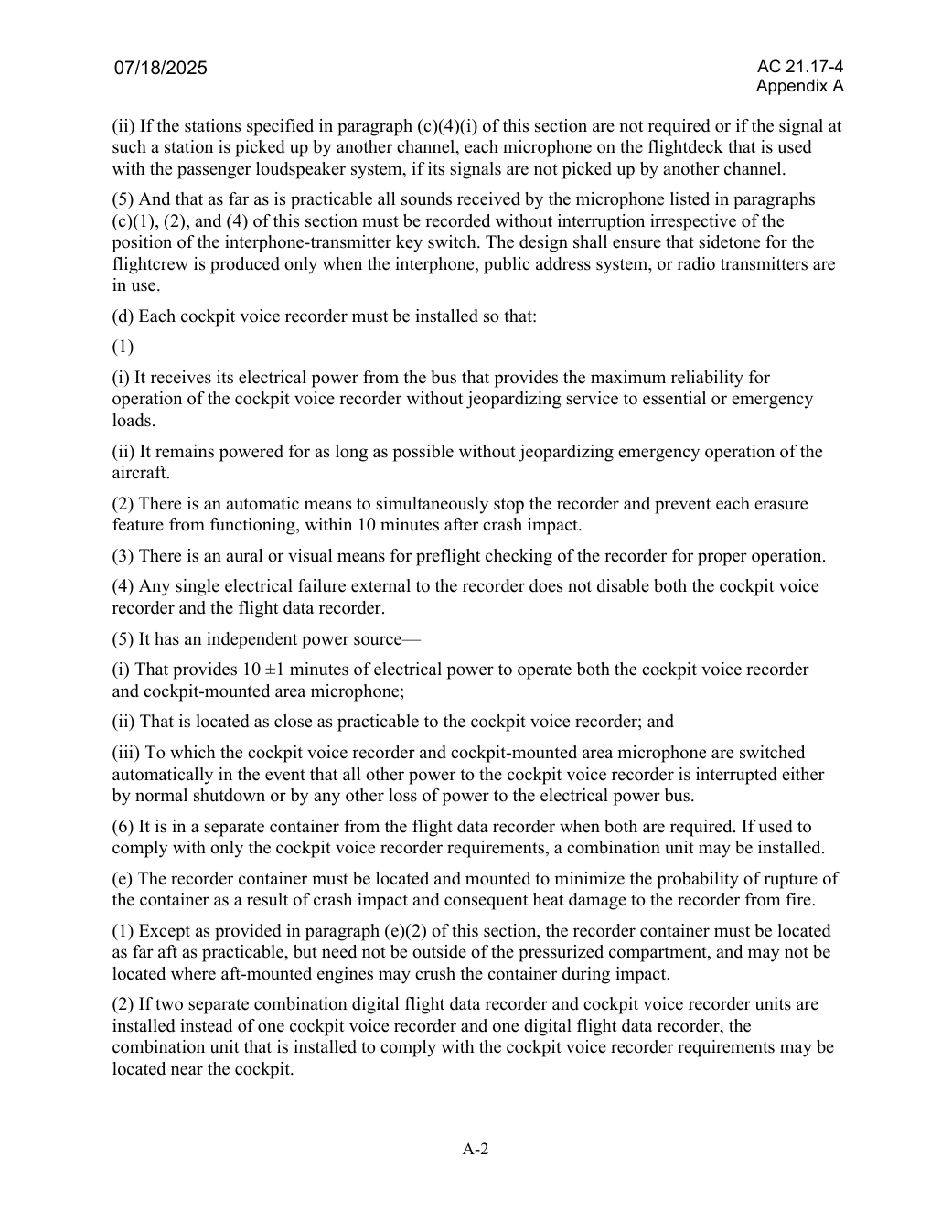
(ii) If the stations specified in paragraph (c)(4)(i) of this section are not required or if the signal at
such a station is picked up by another channel, each microphone on the flightdeck that is used
with the passenger loudspeaker system, if its signals are not picked up by another channel.
(5) And that as far as is practicable all sounds received by the microphone listed in paragraphs
(c)(1), (2), and (4) of this section must be recorded without interruption irrespective of the
position of the interphone-transmitter key switch. The design shall ensure that sidetone for the
flightcrew is produced only when the interphone, public address system, or radio transmitters are
in use.
(d) Each cockpit voice recorder must be installed so that:
(1)
(i) It receives its electrical power from the bus that provides the maximum reliability for
operation of the cockpit voice recorder without jeopardizing service to essential or emergency
loads.
(ii) It remains powered for as long as possible without jeopardizing emergency operation of the
aircraft.
(2) There is an automatic means to simultaneously stop the recorder and prevent each erasure
feature from functioning, within 10 minutes after crash impact.
(3) There is an aural or visual means for preflight checking of the recorder for proper operation.
(4) Any single electrical failure external to the recorder does not disable both the cockpit voice
recorder and the flight data recorder.
(5) It has an independent power source—
(i) That provides 10 ±1 minutes of electrical power to operate both the cockpit voice recorder
and cockpit-mounted area microphone;
(ii) That is located as close as practicable to the cockpit voice recorder; and
(iii) To which the cockpit voice recorder and cockpit-mounted area microphone are switched
automatically in the event that all other power to the cockpit voice recorder is interrupted either
by normal shutdown or by any other loss of power to the electrical power bus.
(6) It is in a separate container from the flight data recorder when both are required. If used to
comply with only the cockpit voice recorder requirements, a combination unit may be installed.
(e) The recorder container must be located and mounted to minimize the probability of rupture of
the container as a result of crash impact and consequent heat damage to the recorder from fire.
(1) Except as provided in paragraph (e)(2) of this section, the recorder container must be located
as far aft as practicable, but need not be outside of the pressurized compartment, and may not be
located where aft-mounted engines may crush the container during impact.
(2) If two separate combination digital flight data recorder and cockpit voice recorder units are
installed instead of one cockpit voice recorder and one digital flight data recorder, the
combination unit that is installed to comply with the cockpit voice recorder requirements may be
located near the cockpit.


                                        A-2
Saved from the FAA on November 17, 2026. All original pages are retained. Engineering explanations are presented separately below.
Aerospace Consulting / Engineering perspective
Begin with the aircraft and the agreed basis.
Connect the operating concept, aircraft-level failure effects, system architecture and assurance planning. Keep FAA powered-lift criteria and EASA SC-VTOL provisions distinct when developing the safety and certification approach.
A focused review, an agreed assessment package or ongoing support alongside your team. We can agree the relevant inputs and scope in the initial conversation.
This opens your email application.
Start a conversation
Tell us about your programme, the system you are developing and the support you need.
We can agree a focused use-case review, a defined evidence package or ongoing programme support.
This opens your email application.
Specialist aerospace expertise
Aerospace Consulting is led by Hussein Khimji, an FAA Designated Engineering Representative in systems and equipment, with a focus on system safety, flight controls and avionics.
We work with aircraft developers and systems suppliers to connect technical decisions, safety assessments and certification evidence.
This is the proposed introduction. The full About page will add your approved biography and associate expertise.
Systems engineering & development assurance
Tell us about the aircraft or system, its intended function, stage of development and the support you need.