FAA Transport Airplanes Issues List
Transport Airplanes Product Issues List
Q3 2026 · 30 September 2026 Source checked 2026-11-28
Scope, source and reading notes
Certification planning issues for domestic projects. Consult the applicable bilateral agreement for validation projects. Entries summarize issues and do not reproduce the underlying project issue papers. Public issue summaries only; complete project issue papers are not reproduced.
Aerospace Consulting reference note: Public certification topics that may require special conditions, agreed means of compliance or FAA coordination.
The complete selected publication is available in reading text and as the original PDF. Reading text is extracted from the official PDF; page layout is simplified, and figures and tables should be checked in the original page view. This is the FAA’s public summary of certification issues, not the full project issue papers.
Search covers extracted text. Words contained only in graphics may not be searchable. The original publication is available below.
Official source recordOriginal PDF on this siteSource: FAA. Reproduced with source acknowledgment; source edition and status are shown above. SHA-256: 6556493ec5bb833b574755ad8f2f5359a0acde15aee8fbdc4a10849dda339cea
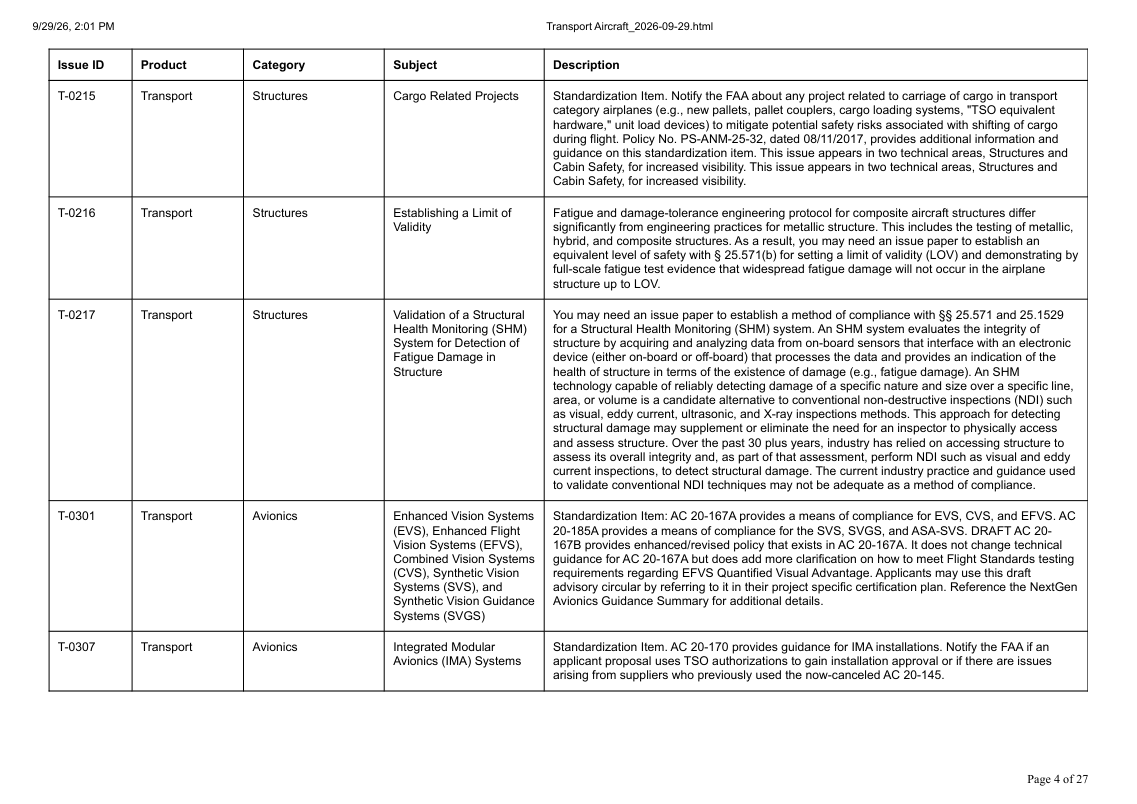
T-0215 Transport Structures Cargo Related Projects Standardization Item. Notify the FAA about any project related to carriage of cargo in transport category airplanes (e.g., new pallets, pallet couplers, cargo loading systems, "TSO equivalent hardware," unit load devices) to mitigate potential safety risks associated with shifting of cargo during flight. Policy No. PS-ANM-25-32, dated 08/11/2017, provides additional information and guidance on this standardization item. This issue appears in two technical areas, Structures and Cabin Safety, for increased visibility. This issue appears in two technical areas, Structures and Cabin Safety, for increased visibility.
T-0216 Transport Structures Establishing a Limit of Validity
Fatigue and damage-tolerance engineering protocol for composite aircraft structures differ significantly from engineering practices for metallic structure. This includes the testing of metallic, hybrid, and composite structures. As a result, you may need an issue paper to establish an equivalent level of safety with § 25.571(b) for setting a limit of validity (LOV) and demonstrating by full-scale fatigue test evidence that widespread fatigue damage will not occur in the airplane structure up to LOV.
T-0217 Transport Structures Validation of a Structural Health Monitoring (SHM) System for Detection of Fatigue Damage in Structure
You may need an issue paper to establish a method of compliance with §§ 25.571 and 25.1529 for a Structural Health Monitoring (SHM) system. An SHM system evaluates the integrity of structure by acquiring and analyzing data from on-board sensors that interface with an electronic device (either on-board or off-board) that processes the data and provides an indication of the health of structure in terms of the existence of damage (e.g., fatigue damage). An SHM technology capable of reliably detecting damage of a specific nature and size over a specific line, area, or volume is a candidate alternative to conventional non-destructive inspections (NDI) such as visual, eddy current, ultrasonic, and X-ray inspections methods. This approach for detecting structural damage may supplement or eliminate the need for an inspector to physically access and assess structure. Over the past 30 plus years, industry has relied on accessing structure to assess its overall integrity and, as part of that assessment, perform NDI such as visual and eddy current inspections, to detect structural damage. The current industry practice and guidance used to validate conventional NDI techniques may not be adequate as a method of compliance.
Standardization Item: AC 20-167A provides a means of compliance for EVS, CVS, and EFVS. AC 20-185A provides a means of compliance for the SVS, SVGS, and ASA-SVS. DRAFT AC 20- 167B provides enhanced/revised policy that exists in AC 20-167A. It does not change technical guidance for AC 20-167A but does add more clarification on how to meet Flight Standards testing requirements regarding EFVS Quantified Visual Advantage. Applicants may use this draft advisory circular by referring to it in their project specific certification plan. Reference the NextGen Avionics Guidance Summary for additional details.
T-0301 Transport Avionics Enhanced Vision Systems (EVS), Enhanced Flight Vision Systems (EFVS), Combined Vision Systems (CVS), Synthetic Vision Systems (SVS), and Synthetic Vision Guidance Systems (SVGS)
T-0307 Transport Avionics Integrated Modular Avionics (IMA) Systems
Standardization Item. AC 20-170 provides guidance for IMA installations. Notify the FAA if an applicant proposal uses TSO authorizations to gain installation approval or if there are issues arising from suppliers who previously used the now-canceled AC 20-145.
View figures, tables and original page layout