FAA Transport Airplanes Issues List
Transport Airplanes Product Issues List
Q3 2026 · 30 September 2026 Source checked 2026-11-28
Scope, source and reading notes
Certification planning issues for domestic projects. Consult the applicable bilateral agreement for validation projects. Entries summarize issues and do not reproduce the underlying project issue papers. Public issue summaries only; complete project issue papers are not reproduced.
Aerospace Consulting reference note: Public certification topics that may require special conditions, agreed means of compliance or FAA coordination.
The complete selected publication is available in reading text and as the original PDF. Reading text is extracted from the official PDF; page layout is simplified, and figures and tables should be checked in the original page view. This is the FAA’s public summary of certification issues, not the full project issue papers.
Search covers extracted text. Words contained only in graphics may not be searchable. The original publication is available below.
Official source recordOriginal PDF on this siteSource: FAA. Reproduced with source acknowledgment; source edition and status are shown above. SHA-256: 6556493ec5bb833b574755ad8f2f5359a0acde15aee8fbdc4a10849dda339cea
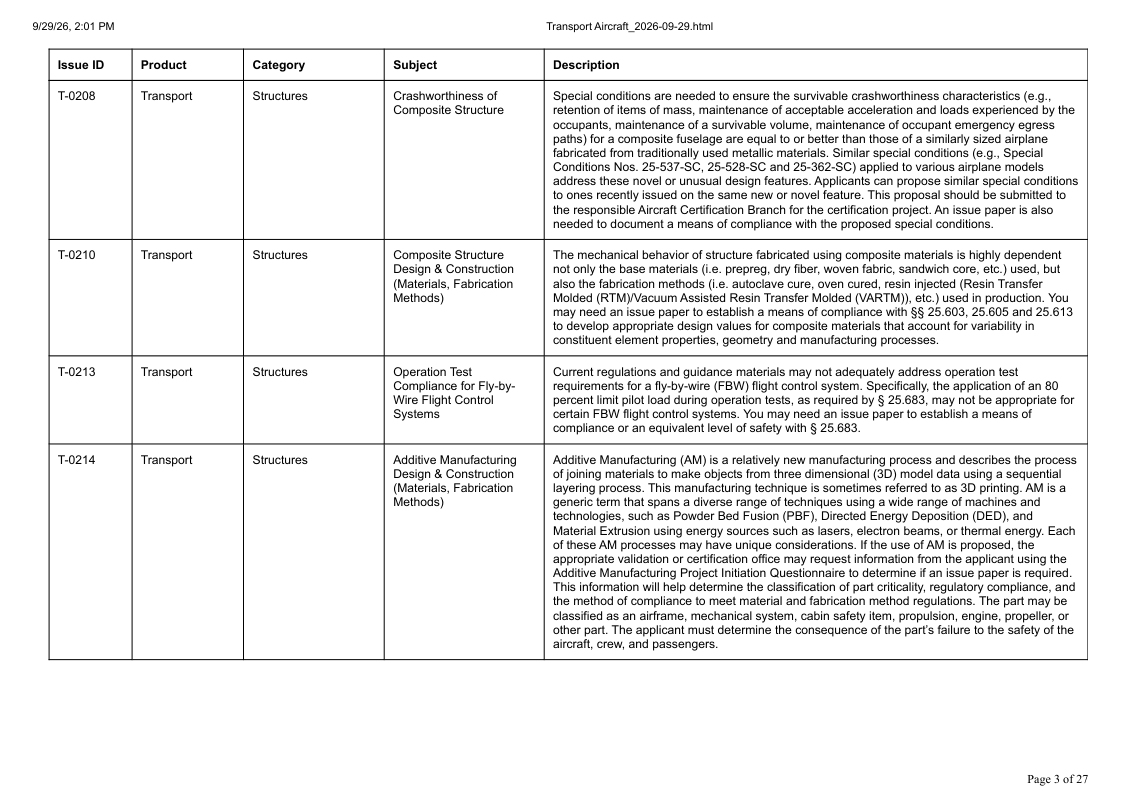
T-0208 Transport Structures Crashworthiness of Composite Structure
Special conditions are needed to ensure the survivable crashworthiness characteristics (e.g., retention of items of mass, maintenance of acceptable acceleration and loads experienced by the occupants, maintenance of a survivable volume, maintenance of occupant emergency egress paths) for a composite fuselage are equal to or better than those of a similarly sized airplane fabricated from traditionally used metallic materials. Similar special conditions (e.g., Special Conditions Nos. 25-537-SC, 25-528-SC and 25-362-SC) applied to various airplane models address these novel or unusual design features. Applicants can propose similar special conditions to ones recently issued on the same new or novel feature. This proposal should be submitted to the responsible Aircraft Certification Branch for the certification project. An issue paper is also needed to document a means of compliance with the proposed special conditions.
T-0210 Transport Structures Composite Structure Design & Construction (Materials, Fabrication Methods)
The mechanical behavior of structure fabricated using composite materials is highly dependent not only the base materials (i.e. prepreg, dry fiber, woven fabric, sandwich core, etc.) used, but also the fabrication methods (i.e. autoclave cure, oven cured, resin injected (Resin Transfer Molded (RTM)/Vacuum Assisted Resin Transfer Molded (VARTM)), etc.) used in production. You may need an issue paper to establish a means of compliance with §§ 25.603, 25.605 and 25.613 to develop appropriate design values for composite materials that account for variability in constituent element properties, geometry and manufacturing processes.
T-0213 Transport Structures Operation Test Compliance for Fly-by- Wire Flight Control Systems
Current regulations and guidance materials may not adequately address operation test requirements for a fly-by-wire (FBW) flight control system. Specifically, the application of an 80 percent limit pilot load during operation tests, as required by § 25.683, may not be appropriate for certain FBW flight control systems. You may need an issue paper to establish a means of compliance or an equivalent level of safety with § 25.683.
T-0214 Transport Structures Additive Manufacturing Design & Construction (Materials, Fabrication Methods)
Additive Manufacturing (AM) is a relatively new manufacturing process and describes the process of joining materials to make objects from three dimensional (3D) model data using a sequential layering process. This manufacturing technique is sometimes referred to as 3D printing. AM is a generic term that spans a diverse range of techniques using a wide range of machines and technologies, such as Powder Bed Fusion (PBF), Directed Energy Deposition (DED), and Material Extrusion using energy sources such as lasers, electron beams, or thermal energy. Each of these AM processes may have unique considerations. If the use of AM is proposed, the appropriate validation or certification office may request information from the applicant using the Additive Manufacturing Project Initiation Questionnaire to determine if an issue paper is required. This information will help determine the classification of part criticality, regulatory compliance, and the method of compliance to meet material and fabrication method regulations. The part may be classified as an airframe, mechanical system, cabin safety item, propulsion, engine, propeller, or other part. The applicant must determine the consequence of the part’s failure to the safety of the aircraft, crew, and passengers.
View figures, tables and original page layout