FAA Transport Airplanes Issues List
Transport Airplanes Product Issues List
Q3 2026 · 30 September 2026 Source checked 2026-11-28
Scope, source and reading notes
Certification planning issues for domestic projects. Consult the applicable bilateral agreement for validation projects. Entries summarize issues and do not reproduce the underlying project issue papers. Public issue summaries only; complete project issue papers are not reproduced.
Aerospace Consulting reference note: Public certification topics that may require special conditions, agreed means of compliance or FAA coordination.
The complete selected publication is available in reading text and as the original PDF. Reading text is extracted from the official PDF; page layout is simplified, and figures and tables should be checked in the original page view. This is the FAA’s public summary of certification issues, not the full project issue papers.
Search covers extracted text. Words contained only in graphics may not be searchable. The original publication is available below.
Official source recordOriginal PDF on this siteSource: FAA. Reproduced with source acknowledgment; source edition and status are shown above. SHA-256: 6556493ec5bb833b574755ad8f2f5359a0acde15aee8fbdc4a10849dda339cea
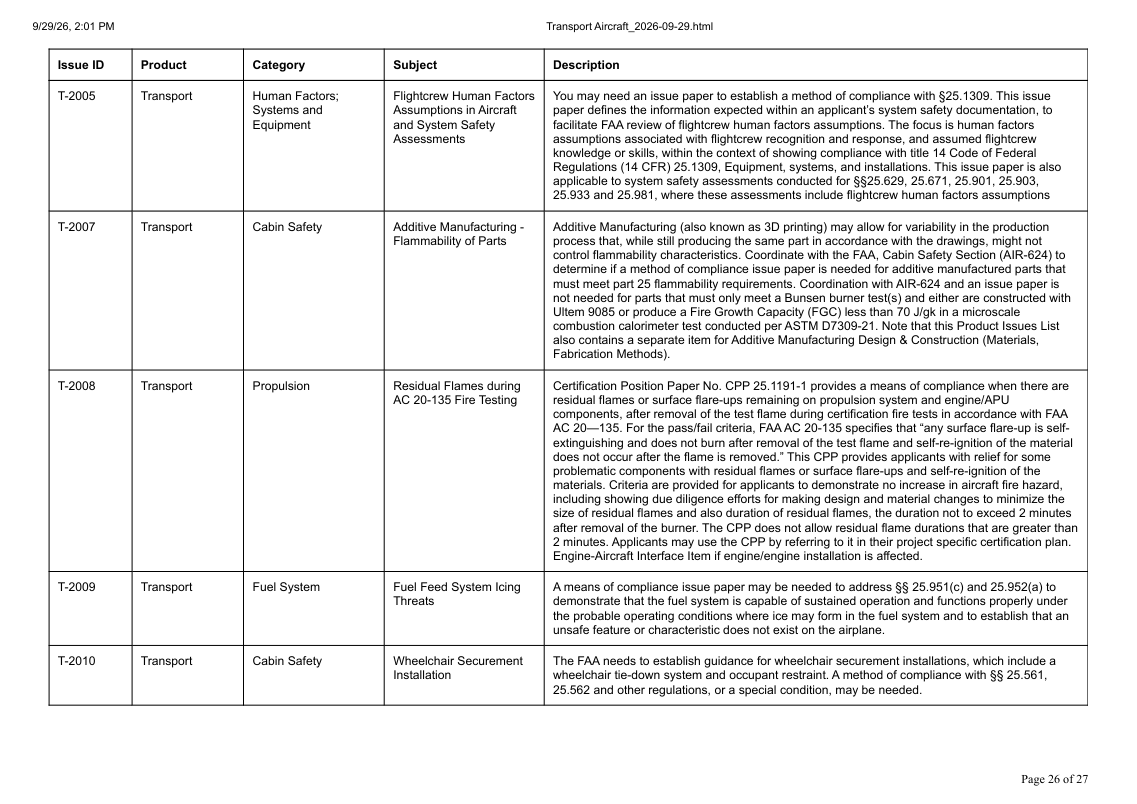
T-2005 Transport Human Factors; Systems and Equipment
Flightcrew Human Factors Assumptions in Aircraft and System Safety Assessments
You may need an issue paper to establish a method of compliance with §25.1309. This issue paper defines the information expected within an applicant’s system safety documentation, to facilitate FAA review of flightcrew human factors assumptions. The focus is human factors assumptions associated with flightcrew recognition and response, and assumed flightcrew knowledge or skills, within the context of showing compliance with title 14 Code of Federal Regulations (14 CFR) 25.1309, Equipment, systems, and installations. This issue paper is also applicable to system safety assessments conducted for §§25.629, 25.671, 25.901, 25.903, 25.933 and 25.981, where these assessments include flightcrew human factors assumptions
T-2007 Transport Cabin Safety Additive Manufacturing - Flammability of Parts
Additive Manufacturing (also known as 3D printing) may allow for variability in the production process that, while still producing the same part in accordance with the drawings, might not control flammability characteristics. Coordinate with the FAA, Cabin Safety Section (AIR-624) to determine if a method of compliance issue paper is needed for additive manufactured parts that must meet part 25 flammability requirements. Coordination with AIR-624 and an issue paper is not needed for parts that must only meet a Bunsen burner test(s) and either are constructed with Ultem 9085 or produce a Fire Growth Capacity (FGC) less than 70 J/gk in a microscale combustion calorimeter test conducted per ASTM D7309-21. Note that this Product Issues List also contains a separate item for Additive Manufacturing Design & Construction (Materials, Fabrication Methods).
T-2008 Transport Propulsion Residual Flames during AC 20-135 Fire Testing
Certification Position Paper No. CPP 25.1191-1 provides a means of compliance when there are residual flames or surface flare-ups remaining on propulsion system and engine/APU components, after removal of the test flame during certification fire tests in accordance with FAA AC 20—135. For the pass/fail criteria, FAA AC 20-135 specifies that “any surface flare-up is self- extinguishing and does not burn after removal of the test flame and self-re-ignition of the material does not occur after the flame is removed.” This CPP provides applicants with relief for some problematic components with residual flames or surface flare-ups and self-re-ignition of the materials. Criteria are provided for applicants to demonstrate no increase in aircraft fire hazard, including showing due diligence efforts for making design and material changes to minimize the size of residual flames and also duration of residual flames, the duration not to exceed 2 minutes after removal of the burner. The CPP does not allow residual flame durations that are greater than 2 minutes. Applicants may use the CPP by referring to it in their project specific certification plan. Engine-Aircraft Interface Item if engine/engine installation is affected.
T-2009 Transport Fuel System Fuel Feed System Icing Threats
A means of compliance issue paper may be needed to address §§ 25.951(c) and 25.952(a) to demonstrate that the fuel system is capable of sustained operation and functions properly under the probable operating conditions where ice may form in the fuel system and to establish that an unsafe feature or characteristic does not exist on the airplane.
T-2010 Transport Cabin Safety Wheelchair Securement Installation
The FAA needs to establish guidance for wheelchair securement installations, which include a wheelchair tie-down system and occupant restraint. A method of compliance with §§ 25.561, 25.562 and other regulations, or a special condition, may be needed.
View figures, tables and original page layout