FAA Small Airplanes Issues List
Small Airplanes Product Issues List
Q3 2026 · 30 September 2026 Source checked 2026-11-28
Scope, source and reading notes
Certification planning issues for domestic projects. Consult the applicable bilateral agreement for validation projects. Entries summarize issues and do not reproduce the underlying project issue papers. Public issue summaries only; complete project issue papers are not reproduced.
Aerospace Consulting reference note: Public certification topics that may require special conditions, agreed means of compliance or FAA coordination.
The complete selected publication is available in reading text and as the original PDF. Reading text is extracted from the official PDF; page layout is simplified, and figures and tables should be checked in the original page view. This is the FAA’s public summary of certification issues, not the full project issue papers.
Search covers extracted text. Words contained only in graphics may not be searchable. The original publication is available below.
Official source recordOriginal PDF on this siteSource: FAA. Reproduced with source acknowledgment; source edition and status are shown above. SHA-256: 62751f1b8c1bedde2c69ffaeb2a9164653f8b95bb1349c12e16e00532257ddcc
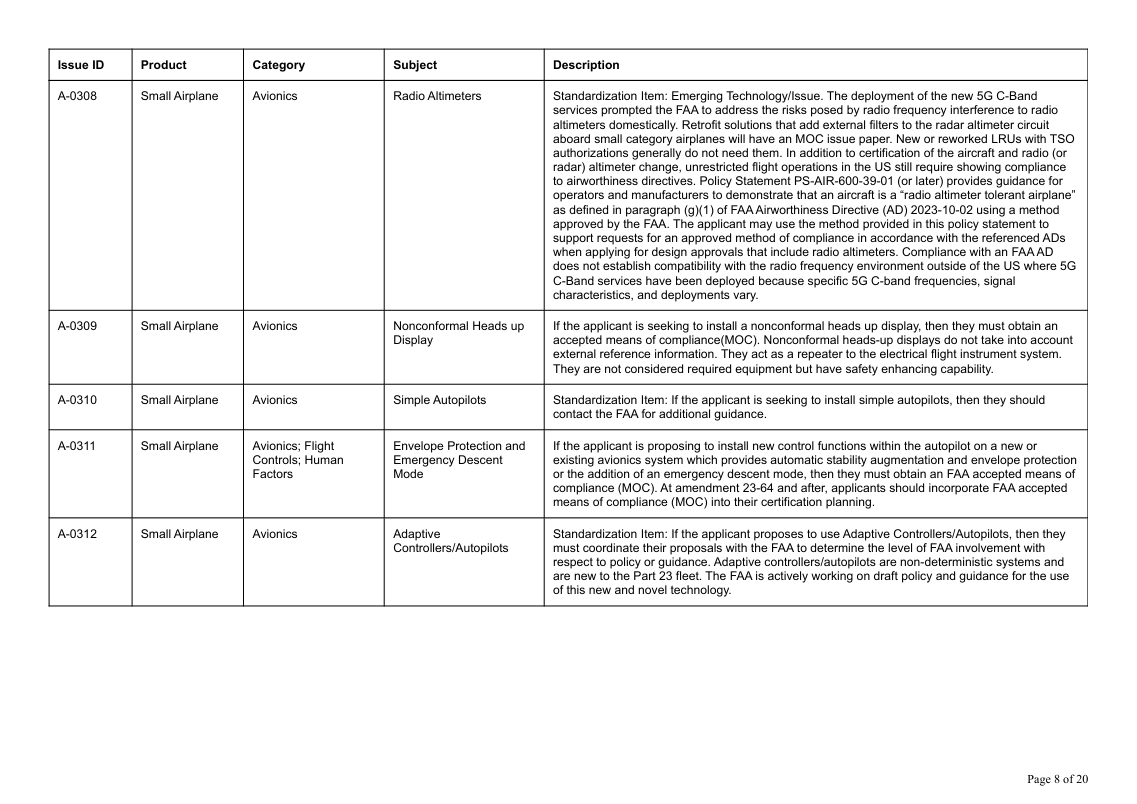
A-0308 Small Airplane Avionics Radio Altimeters Standardization Item: Emerging Technology/Issue. The deployment of the new 5G C-Band services prompted the FAA to address the risks posed by radio frequency interference to radio altimeters domestically. Retrofit solutions that add external filters to the radar altimeter circuit aboard small category airplanes will have an MOC issue paper. New or reworked LRUs with TSO authorizations generally do not need them. In addition to certification of the aircraft and radio (or radar) altimeter change, unrestricted flight operations in the US still require showing compliance to airworthiness directives. Policy Statement PS-AIR-600-39-01 (or later) provides guidance for operators and manufacturers to demonstrate that an aircraft is a “radio altimeter tolerant airplane” as defined in paragraph (g)(1) of FAA Airworthiness Directive (AD) 2023-10-02 using a method approved by the FAA. The applicant may use the method provided in this policy statement to support requests for an approved method of compliance in accordance with the referenced ADs when applying for design approvals that include radio altimeters. Compliance with an FAA AD does not establish compatibility with the radio frequency environment outside of the US where 5G C-Band services have been deployed because specific 5G C-band frequencies, signal characteristics, and deployments vary.
A-0309 Small Airplane Avionics Nonconformal Heads up Display
If the applicant is seeking to install a nonconformal heads up display, then they must obtain an accepted means of compliance(MOC). Nonconformal heads-up displays do not take into account external reference information. They act as a repeater to the electrical flight instrument system. They are not considered required equipment but have safety enhancing capability.
A-0310 Small Airplane Avionics Simple Autopilots Standardization Item: If the applicant is seeking to install simple autopilots, then they should contact the FAA for additional guidance.
A-0311 Small Airplane Avionics; Flight Controls; Human Factors
Envelope Protection and Emergency Descent Mode
If the applicant is proposing to install new control functions within the autopilot on a new or existing avionics system which provides automatic stability augmentation and envelope protection or the addition of an emergency descent mode, then they must obtain an FAA accepted means of compliance (MOC). At amendment 23-64 and after, applicants should incorporate FAA accepted means of compliance (MOC) into their certification planning.
A-0312 Small Airplane Avionics Adaptive Controllers/Autopilots
Standardization Item: If the applicant proposes to use Adaptive Controllers/Autopilots, then they must coordinate their proposals with the FAA to determine the level of FAA involvement with respect to policy or guidance. Adaptive controllers/autopilots are non-deterministic systems and are new to the Part 23 fleet. The FAA is actively working on draft policy and guidance for the use of this new and novel technology.
View figures, tables and original page layout