FAA Small Airplanes Issues List
Small Airplanes Product Issues List
Q3 2026 · 30 September 2026 Source checked 2026-11-28
Scope, source and reading notes
Certification planning issues for domestic projects. Consult the applicable bilateral agreement for validation projects. Entries summarize issues and do not reproduce the underlying project issue papers. Public issue summaries only; complete project issue papers are not reproduced.
Aerospace Consulting reference note: Public certification topics that may require special conditions, agreed means of compliance or FAA coordination.
The complete selected publication is available in reading text and as the original PDF. Reading text is extracted from the official PDF; page layout is simplified, and figures and tables should be checked in the original page view. This is the FAA’s public summary of certification issues, not the full project issue papers.
Search covers extracted text. Words contained only in graphics may not be searchable. The original publication is available below.
Official source recordOriginal PDF on this siteSource: FAA. Reproduced with source acknowledgment; source edition and status are shown above. SHA-256: 62751f1b8c1bedde2c69ffaeb2a9164653f8b95bb1349c12e16e00532257ddcc
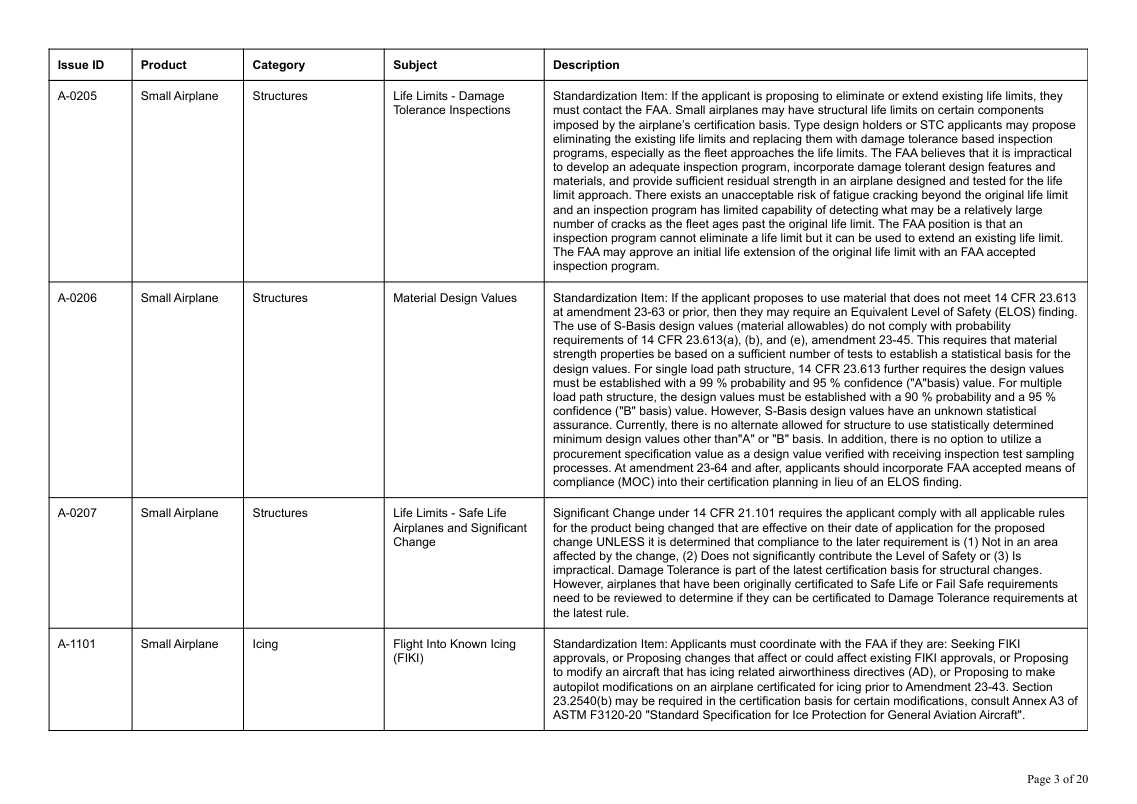
A-0205 Small Airplane Structures Life Limits - Damage Tolerance Inspections
Standardization Item: If the applicant is proposing to eliminate or extend existing life limits, they must contact the FAA. Small airplanes may have structural life limits on certain components imposed by the airplane’s certification basis. Type design holders or STC applicants may propose eliminating the existing life limits and replacing them with damage tolerance based inspection programs, especially as the fleet approaches the life limits. The FAA believes that it is impractical to develop an adequate inspection program, incorporate damage tolerant design features and materials, and provide sufficient residual strength in an airplane designed and tested for the life limit approach. There exists an unacceptable risk of fatigue cracking beyond the original life limit and an inspection program has limited capability of detecting what may be a relatively large number of cracks as the fleet ages past the original life limit. The FAA position is that an inspection program cannot eliminate a life limit but it can be used to extend an existing life limit. The FAA may approve an initial life extension of the original life limit with an FAA accepted inspection program.
A-0206 Small Airplane Structures Material Design Values Standardization Item: If the applicant proposes to use material that does not meet 14 CFR 23.613 at amendment 23-63 or prior, then they may require an Equivalent Level of Safety (ELOS) finding. The use of S-Basis design values (material allowables) do not comply with probability requirements of 14 CFR 23.613(a), (b), and (e), amendment 23-45. This requires that material strength properties be based on a sufficient number of tests to establish a statistical basis for the design values. For single load path structure, 14 CFR 23.613 further requires the design values must be established with a 99 % probability and 95 % confidence ("A"basis) value. For multiple load path structure, the design values must be established with a 90 % probability and a 95 % confidence ("B" basis) value. However, S-Basis design values have an unknown statistical assurance. Currently, there is no alternate allowed for structure to use statistically determined minimum design values other than"A" or "B" basis. In addition, there is no option to utilize a procurement specification value as a design value verified with receiving inspection test sampling processes. At amendment 23-64 and after, applicants should incorporate FAA accepted means of compliance (MOC) into their certification planning in lieu of an ELOS finding.
A-0207 Small Airplane Structures Life Limits - Safe Life Airplanes and Significant Change
Significant Change under 14 CFR 21.101 requires the applicant comply with all applicable rules for the product being changed that are effective on their date of application for the proposed change UNLESS it is determined that compliance to the later requirement is (1) Not in an area affected by the change, (2) Does not significantly contribute the Level of Safety or (3) Is impractical. Damage Tolerance is part of the latest certification basis for structural changes. However, airplanes that have been originally certificated to Safe Life or Fail Safe requirements need to be reviewed to determine if they can be certificated to Damage Tolerance requirements at the latest rule.
A-1101 Small Airplane Icing Flight Into Known Icing (FIKI)
Standardization Item: Applicants must coordinate with the FAA if they are: Seeking FIKI approvals, or Proposing changes that affect or could affect existing FIKI approvals, or Proposing to modify an aircraft that has icing related airworthiness directives (AD), or Proposing to make autopilot modifications on an airplane certificated for icing prior to Amendment 23-43. Section 23.2540(b) may be required in the certification basis for certain modifications, consult Annex A3 of ASTM F3120-20 "Standard Specification for Ice Protection for General Aviation Aircraft".
View figures, tables and original page layout