FAA Small Airplanes Issues List
Small Airplanes Product Issues List
Q3 2026 · 30 September 2026 Source checked 2026-11-28
Scope, source and reading notes
Certification planning issues for domestic projects. Consult the applicable bilateral agreement for validation projects. Entries summarize issues and do not reproduce the underlying project issue papers. Public issue summaries only; complete project issue papers are not reproduced.
Aerospace Consulting reference note: Public certification topics that may require special conditions, agreed means of compliance or FAA coordination.
The complete selected publication is available in reading text and as the original PDF. Reading text is extracted from the official PDF; page layout is simplified, and figures and tables should be checked in the original page view. This is the FAA’s public summary of certification issues, not the full project issue papers.
Search covers extracted text. Words contained only in graphics may not be searchable. The original publication is available below.
Official source recordOriginal PDF on this siteSource: FAA. Reproduced with source acknowledgment; source edition and status are shown above. SHA-256: 62751f1b8c1bedde2c69ffaeb2a9164653f8b95bb1349c12e16e00532257ddcc
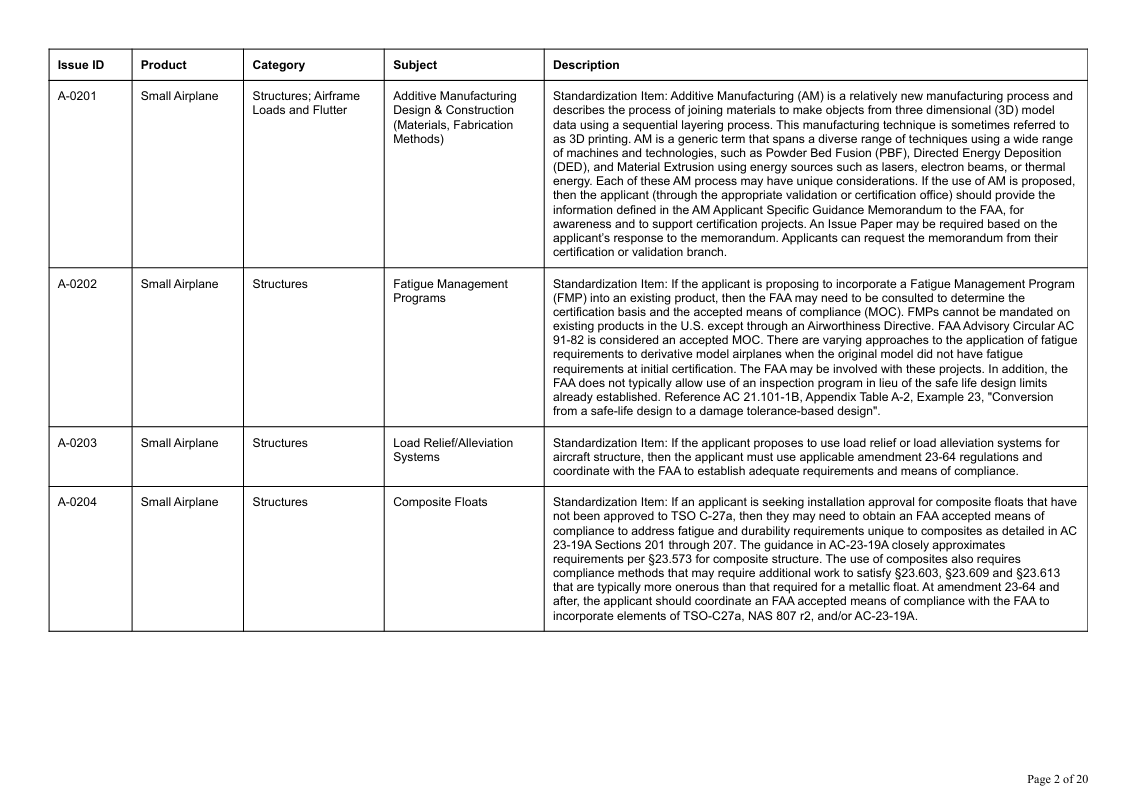
A-0201 Small Airplane Structures; Airframe Loads and Flutter
Additive Manufacturing Design & Construction (Materials, Fabrication Methods)
Standardization Item: Additive Manufacturing (AM) is a relatively new manufacturing process and describes the process of joining materials to make objects from three dimensional (3D) model data using a sequential layering process. This manufacturing technique is sometimes referred to as 3D printing. AM is a generic term that spans a diverse range of techniques using a wide range of machines and technologies, such as Powder Bed Fusion (PBF), Directed Energy Deposition (DED), and Material Extrusion using energy sources such as lasers, electron beams, or thermal energy. Each of these AM process may have unique considerations. If the use of AM is proposed, then the applicant (through the appropriate validation or certification office) should provide the information defined in the AM Applicant Specific Guidance Memorandum to the FAA, for awareness and to support certification projects. An Issue Paper may be required based on the applicant’s response to the memorandum. Applicants can request the memorandum from their certification or validation branch.
A-0202 Small Airplane Structures Fatigue Management Programs
Standardization Item: If the applicant is proposing to incorporate a Fatigue Management Program (FMP) into an existing product, then the FAA may need to be consulted to determine the certification basis and the accepted means of compliance (MOC). FMPs cannot be mandated on existing products in the U.S. except through an Airworthiness Directive. FAA Advisory Circular AC 91-82 is considered an accepted MOC. There are varying approaches to the application of fatigue requirements to derivative model airplanes when the original model did not have fatigue requirements at initial certification. The FAA may be involved with these projects. In addition, the FAA does not typically allow use of an inspection program in lieu of the safe life design limits already established. Reference AC 21.101-1B, Appendix Table A-2, Example 23, "Conversion from a safe-life design to a damage tolerance-based design".
A-0203 Small Airplane Structures Load Relief/Alleviation Systems
Standardization Item: If the applicant proposes to use load relief or load alleviation systems for aircraft structure, then the applicant must use applicable amendment 23-64 regulations and coordinate with the FAA to establish adequate requirements and means of compliance.
A-0204 Small Airplane Structures Composite Floats Standardization Item: If an applicant is seeking installation approval for composite floats that have not been approved to TSO C-27a, then they may need to obtain an FAA accepted means of compliance to address fatigue and durability requirements unique to composites as detailed in AC 23-19A Sections 201 through 207. The guidance in AC-23-19A closely approximates requirements per §23.573 for composite structure. The use of composites also requires compliance methods that may require additional work to satisfy §23.603, §23.609 and §23.613 that are typically more onerous than that required for a metallic float. At amendment 23-64 and after, the applicant should coordinate an FAA accepted means of compliance with the FAA to incorporate elements of TSO-C27a, NAS 807 r2, and/or AC-23-19A.
View figures, tables and original page layout