FAA Small Airplanes Issues List
Small Airplanes Product Issues List
Q3 2026 · 30 September 2026 Source checked 2026-11-28
Scope, source and reading notes
Certification planning issues for domestic projects. Consult the applicable bilateral agreement for validation projects. Entries summarize issues and do not reproduce the underlying project issue papers. Public issue summaries only; complete project issue papers are not reproduced.
Aerospace Consulting reference note: Public certification topics that may require special conditions, agreed means of compliance or FAA coordination.
The complete selected publication is available in reading text and as the original PDF. Reading text is extracted from the official PDF; page layout is simplified, and figures and tables should be checked in the original page view. This is the FAA’s public summary of certification issues, not the full project issue papers.
Search covers extracted text. Words contained only in graphics may not be searchable. The original publication is available below.
Official source recordOriginal PDF on this siteSource: FAA. Reproduced with source acknowledgment; source edition and status are shown above. SHA-256: 62751f1b8c1bedde2c69ffaeb2a9164653f8b95bb1349c12e16e00532257ddcc
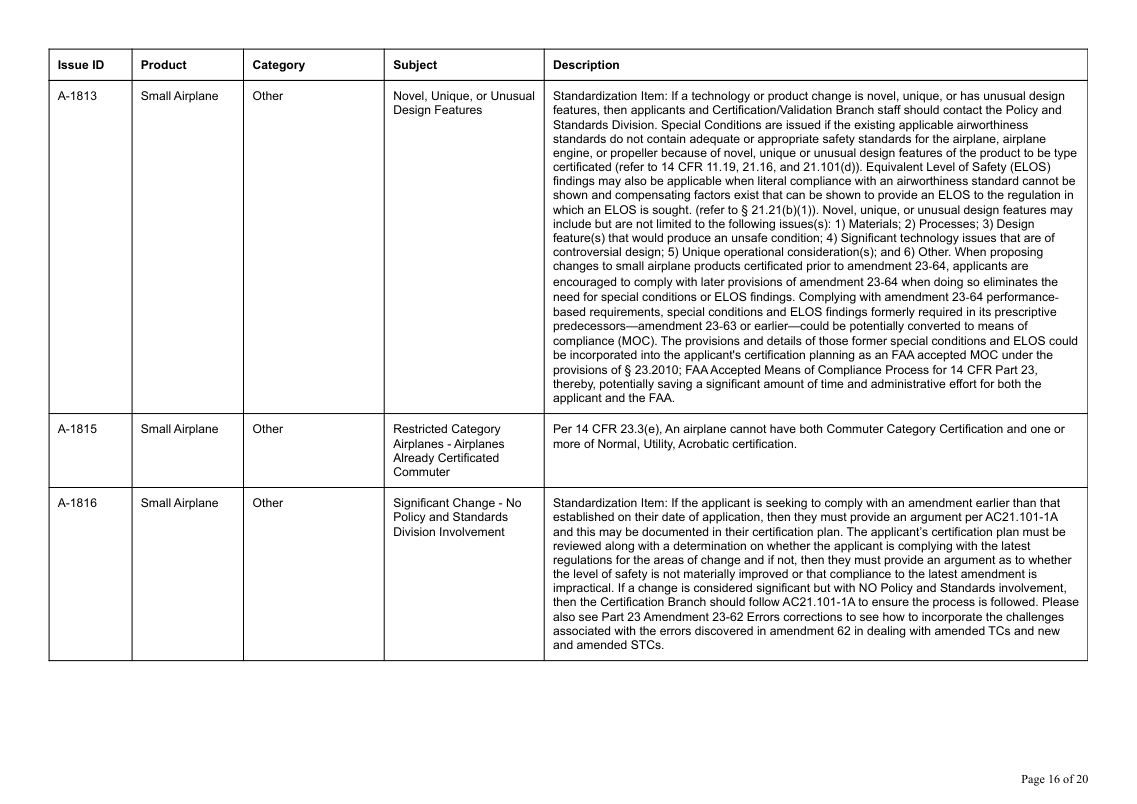
A-1813 Small Airplane Other Novel, Unique, or Unusual Design Features
Standardization Item: If a technology or product change is novel, unique, or has unusual design features, then applicants and Certification/Validation Branch staff should contact the Policy and Standards Division. Special Conditions are issued if the existing applicable airworthiness standards do not contain adequate or appropriate safety standards for the airplane, airplane engine, or propeller because of novel, unique or unusual design features of the product to be type certificated (refer to 14 CFR 11.19, 21.16, and 21.101(d)). Equivalent Level of Safety (ELOS) findings may also be applicable when literal compliance with an airworthiness standard cannot be shown and compensating factors exist that can be shown to provide an ELOS to the regulation in which an ELOS is sought. (refer to § 21.21(b)(1)). Novel, unique, or unusual design features may include but are not limited to the following issues(s): 1) Materials; 2) Processes; 3) Design feature(s) that would produce an unsafe condition; 4) Significant technology issues that are of controversial design; 5) Unique operational consideration(s); and 6) Other. When proposing changes to small airplane products certificated prior to amendment 23‐64, applicants are encouraged to comply with later provisions of amendment 23‐64 when doing so eliminates the need for special conditions or ELOS findings. Complying with amendment 23‐64 performance‐ based requirements, special conditions and ELOS findings formerly required in its prescriptive predecessors—amendment 23‐63 or earlier—could be potentially converted to means of compliance (MOC). The provisions and details of those former special conditions and ELOS could be incorporated into the applicant's certification planning as an FAA accepted MOC under the provisions of § 23.2010; FAA Accepted Means of Compliance Process for 14 CFR Part 23, thereby, potentially saving a significant amount of time and administrative effort for both the applicant and the FAA.
Per 14 CFR 23.3(e), An airplane cannot have both Commuter Category Certification and one or more of Normal, Utility, Acrobatic certification.
A-1815 Small Airplane Other Restricted Category Airplanes - Airplanes Already Certificated Commuter
A-1816 Small Airplane Other Significant Change - No Policy and Standards Division Involvement
Standardization Item: If the applicant is seeking to comply with an amendment earlier than that established on their date of application, then they must provide an argument per AC21.101-1A and this may be documented in their certification plan. The applicant’s certification plan must be reviewed along with a determination on whether the applicant is complying with the latest regulations for the areas of change and if not, then they must provide an argument as to whether the level of safety is not materially improved or that compliance to the latest amendment is impractical. If a change is considered significant but with NO Policy and Standards involvement, then the Certification Branch should follow AC21.101-1A to ensure the process is followed. Please also see Part 23 Amendment 23-62 Errors corrections to see how to incorporate the challenges associated with the errors discovered in amendment 62 in dealing with amended TCs and new and amended STCs.
View figures, tables and original page layout