FAA Small Airplanes Issues List
Small Airplanes Product Issues List
Q3 2026 · 30 September 2026 Source checked 2026-11-28
Scope, source and reading notes
Certification planning issues for domestic projects. Consult the applicable bilateral agreement for validation projects. Entries summarize issues and do not reproduce the underlying project issue papers. Public issue summaries only; complete project issue papers are not reproduced.
Aerospace Consulting reference note: Public certification topics that may require special conditions, agreed means of compliance or FAA coordination.
The complete selected publication is available in reading text and as the original PDF. Reading text is extracted from the official PDF; page layout is simplified, and figures and tables should be checked in the original page view. This is the FAA’s public summary of certification issues, not the full project issue papers.
Search covers extracted text. Words contained only in graphics may not be searchable. The original publication is available below.
Official source recordOriginal PDF on this siteSource: FAA. Reproduced with source acknowledgment; source edition and status are shown above. SHA-256: 62751f1b8c1bedde2c69ffaeb2a9164653f8b95bb1349c12e16e00532257ddcc
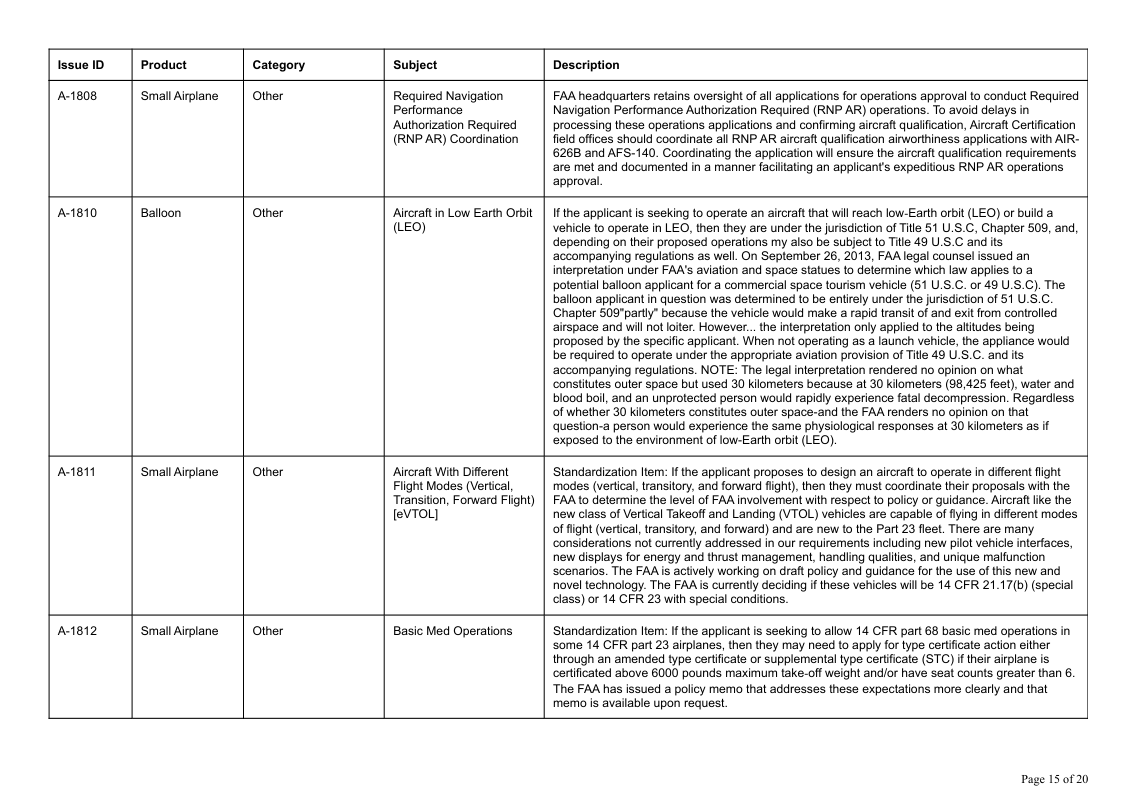
A-1808 Small Airplane Other Required Navigation Performance Authorization Required (RNP AR) Coordination
FAA headquarters retains oversight of all applications for operations approval to conduct Required Navigation Performance Authorization Required (RNP AR) operations. To avoid delays in processing these operations applications and confirming aircraft qualification, Aircraft Certification field offices should coordinate all RNP AR aircraft qualification airworthiness applications with AIR- 626B and AFS-140. Coordinating the application will ensure the aircraft qualification requirements are met and documented in a manner facilitating an applicant's expeditious RNP AR operations approval.
A-1810 Balloon Other Aircraft in Low Earth Orbit (LEO)
If the applicant is seeking to operate an aircraft that will reach low‐Earth orbit (LEO) or build a vehicle to operate in LEO, then they are under the jurisdiction of Title 51 U.S.C, Chapter 509, and, depending on their proposed operations my also be subject to Title 49 U.S.C and its accompanying regulations as well. On September 26, 2013, FAA legal counsel issued an interpretation under FAA's aviation and space statues to determine which law applies to a potential balloon applicant for a commercial space tourism vehicle (51 U.S.C. or 49 U.S.C). The balloon applicant in question was determined to be entirely under the jurisdiction of 51 U.S.C. Chapter 509"partly" because the vehicle would make a rapid transit of and exit from controlled airspace and will not loiter. However... the interpretation only applied to the altitudes being proposed by the specific applicant. When not operating as a launch vehicle, the appliance would be required to operate under the appropriate aviation provision of Title 49 U.S.C. and its accompanying regulations. NOTE: The legal interpretation rendered no opinion on what constitutes outer space but used 30 kilometers because at 30 kilometers (98,425 feet), water and blood boil, and an unprotected person would rapidly experience fatal decompression. Regardless of whether 30 kilometers constitutes outer space-and the FAA renders no opinion on that question-a person would experience the same physiological responses at 30 kilometers as if exposed to the environment of low-Earth orbit (LEO).
A-1811 Small Airplane Other Aircraft With Different Flight Modes (Vertical, Transition, Forward Flight) [eVTOL]
Standardization Item: If the applicant proposes to design an aircraft to operate in different flight modes (vertical, transitory, and forward flight), then they must coordinate their proposals with the FAA to determine the level of FAA involvement with respect to policy or guidance. Aircraft like the new class of Vertical Takeoff and Landing (VTOL) vehicles are capable of flying in different modes of flight (vertical, transitory, and forward) and are new to the Part 23 fleet. There are many considerations not currently addressed in our requirements including new pilot vehicle interfaces, new displays for energy and thrust management, handling qualities, and unique malfunction scenarios. The FAA is actively working on draft policy and guidance for the use of this new and novel technology. The FAA is currently deciding if these vehicles will be 14 CFR 21.17(b) (special class) or 14 CFR 23 with special conditions.
A-1812 Small Airplane Other Basic Med Operations Standardization Item: If the applicant is seeking to allow 14 CFR part 68 basic med operations in some 14 CFR part 23 airplanes, then they may need to apply for type certificate action either through an amended type certificate or supplemental type certificate (STC) if their airplane is certificated above 6000 pounds maximum take‐off weight and/or have seat counts greater than 6. The FAA has issued a policy memo that addresses these expectations more clearly and that memo is available upon request.
View figures, tables and original page layout