FAA Small Airplanes Issues List
Small Airplanes Product Issues List
Q3 2026 · 30 September 2026 Source checked 2026-11-28
Scope, source and reading notes
Certification planning issues for domestic projects. Consult the applicable bilateral agreement for validation projects. Entries summarize issues and do not reproduce the underlying project issue papers. Public issue summaries only; complete project issue papers are not reproduced.
Aerospace Consulting reference note: Public certification topics that may require special conditions, agreed means of compliance or FAA coordination.
The complete selected publication is available in reading text and as the original PDF. Reading text is extracted from the official PDF; page layout is simplified, and figures and tables should be checked in the original page view. This is the FAA’s public summary of certification issues, not the full project issue papers.
Search covers extracted text. Words contained only in graphics may not be searchable. The original publication is available below.
Official source recordOriginal PDF on this siteSource: FAA. Reproduced with source acknowledgment; source edition and status are shown above. SHA-256: 62751f1b8c1bedde2c69ffaeb2a9164653f8b95bb1349c12e16e00532257ddcc
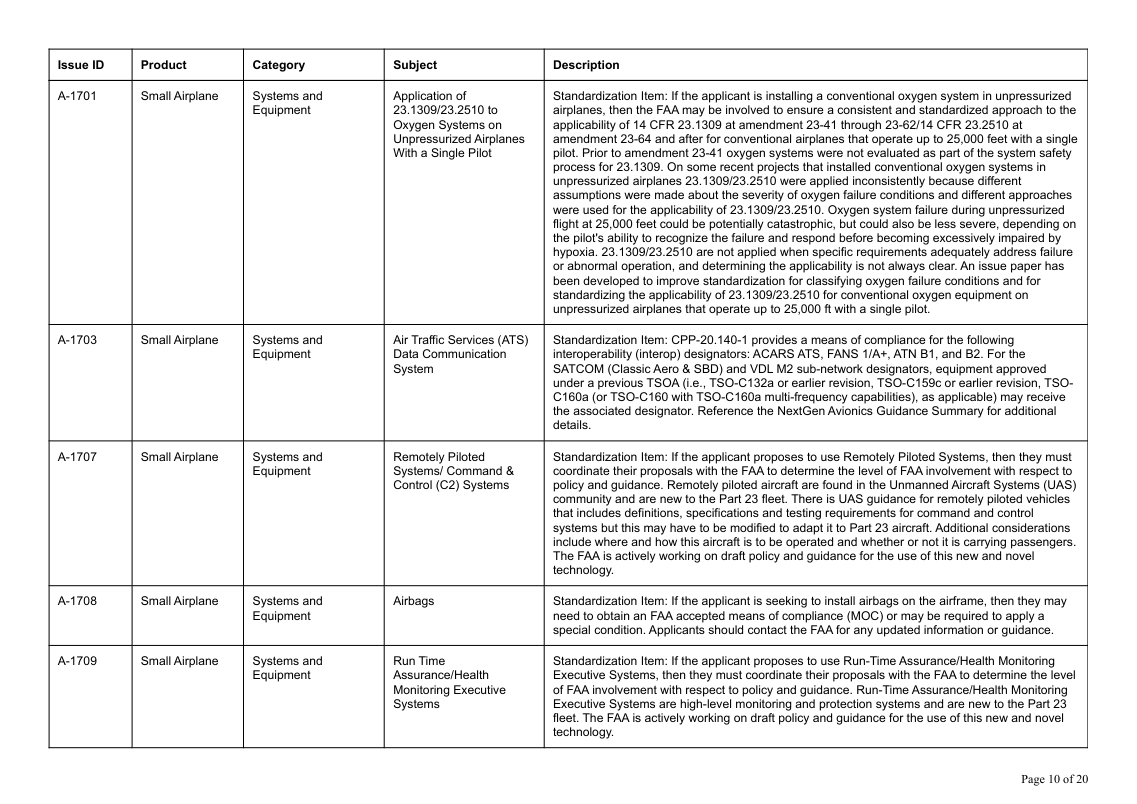
A-1701 Small Airplane Systems and Equipment
Application of 23.1309/23.2510 to Oxygen Systems on Unpressurized Airplanes With a Single Pilot
Standardization Item: If the applicant is installing a conventional oxygen system in unpressurized airplanes, then the FAA may be involved to ensure a consistent and standardized approach to the applicability of 14 CFR 23.1309 at amendment 23-41 through 23-62/14 CFR 23.2510 at amendment 23-64 and after for conventional airplanes that operate up to 25,000 feet with a single pilot. Prior to amendment 23-41 oxygen systems were not evaluated as part of the system safety process for 23.1309. On some recent projects that installed conventional oxygen systems in unpressurized airplanes 23.1309/23.2510 were applied inconsistently because different assumptions were made about the severity of oxygen failure conditions and different approaches were used for the applicability of 23.1309/23.2510. Oxygen system failure during unpressurized flight at 25,000 feet could be potentially catastrophic, but could also be less severe, depending on the pilot's ability to recognize the failure and respond before becoming excessively impaired by hypoxia. 23.1309/23.2510 are not applied when specific requirements adequately address failure or abnormal operation, and determining the applicability is not always clear. An issue paper has been developed to improve standardization for classifying oxygen failure conditions and for standardizing the applicability of 23.1309/23.2510 for conventional oxygen equipment on unpressurized airplanes that operate up to 25,000 ft with a single pilot.
A-1703 Small Airplane Systems and Equipment
Air Traffic Services (ATS) Data Communication System
Standardization Item: CPP-20.140-1 provides a means of compliance for the following interoperability (interop) designators: ACARS ATS, FANS 1/A+, ATN B1, and B2. For the SATCOM (Classic Aero & SBD) and VDL M2 sub-network designators, equipment approved under a previous TSOA (i.e., TSO-C132a or earlier revision, TSO-C159c or earlier revision, TSO- C160a (or TSO-C160 with TSO-C160a multi-frequency capabilities), as applicable) may receive the associated designator. Reference the NextGen Avionics Guidance Summary for additional details.
A-1707 Small Airplane Systems and Equipment
Remotely Piloted Systems/ Command & Control (C2) Systems
Standardization Item: If the applicant proposes to use Remotely Piloted Systems, then they must coordinate their proposals with the FAA to determine the level of FAA involvement with respect to policy and guidance. Remotely piloted aircraft are found in the Unmanned Aircraft Systems (UAS) community and are new to the Part 23 fleet. There is UAS guidance for remotely piloted vehicles that includes definitions, specifications and testing requirements for command and control systems but this may have to be modified to adapt it to Part 23 aircraft. Additional considerations include where and how this aircraft is to be operated and whether or not it is carrying passengers. The FAA is actively working on draft policy and guidance for the use of this new and novel technology.
A-1708 Small Airplane Systems and Equipment
Airbags Standardization Item: If the applicant is seeking to install airbags on the airframe, then they may need to obtain an FAA accepted means of compliance (MOC) or may be required to apply a special condition. Applicants should contact the FAA for any updated information or guidance.
A-1709 Small Airplane Systems and Equipment
Run Time Assurance/Health Monitoring Executive Systems
Standardization Item: If the applicant proposes to use Run-Time Assurance/Health Monitoring Executive Systems, then they must coordinate their proposals with the FAA to determine the level of FAA involvement with respect to policy and guidance. Run-Time Assurance/Health Monitoring Executive Systems are high-level monitoring and protection systems and are new to the Part 23 fleet. The FAA is actively working on draft policy and guidance for the use of this new and novel technology.
View figures, tables and original page layout