FAA Rotorcraft Issues List
Rotorcraft Product Issues List
Q3 2026 · 30 September 2026 Source checked 2026-11-28
Scope, source and reading notes
Certification planning issues for domestic projects. Consult the applicable bilateral agreement for validation projects. Entries summarize issues and do not reproduce the underlying project issue papers. Public issue summaries only; complete project issue papers are not reproduced.
Aerospace Consulting reference note: Public certification topics that may require special conditions, agreed means of compliance or FAA coordination.
The complete selected publication is available in reading text and as the original PDF. Reading text is extracted from the official PDF; page layout is simplified, and figures and tables should be checked in the original page view. This is the FAA’s public summary of certification issues, not the full project issue papers.
Search covers extracted text. Words contained only in graphics may not be searchable. The original publication is available below.
Official source recordOriginal PDF on this siteSource: FAA. Reproduced with source acknowledgment; source edition and status are shown above. SHA-256: a7493b2666179cc526f71c1d7119a1cea7e61a113a04957c96c4abe3fb7bd60f
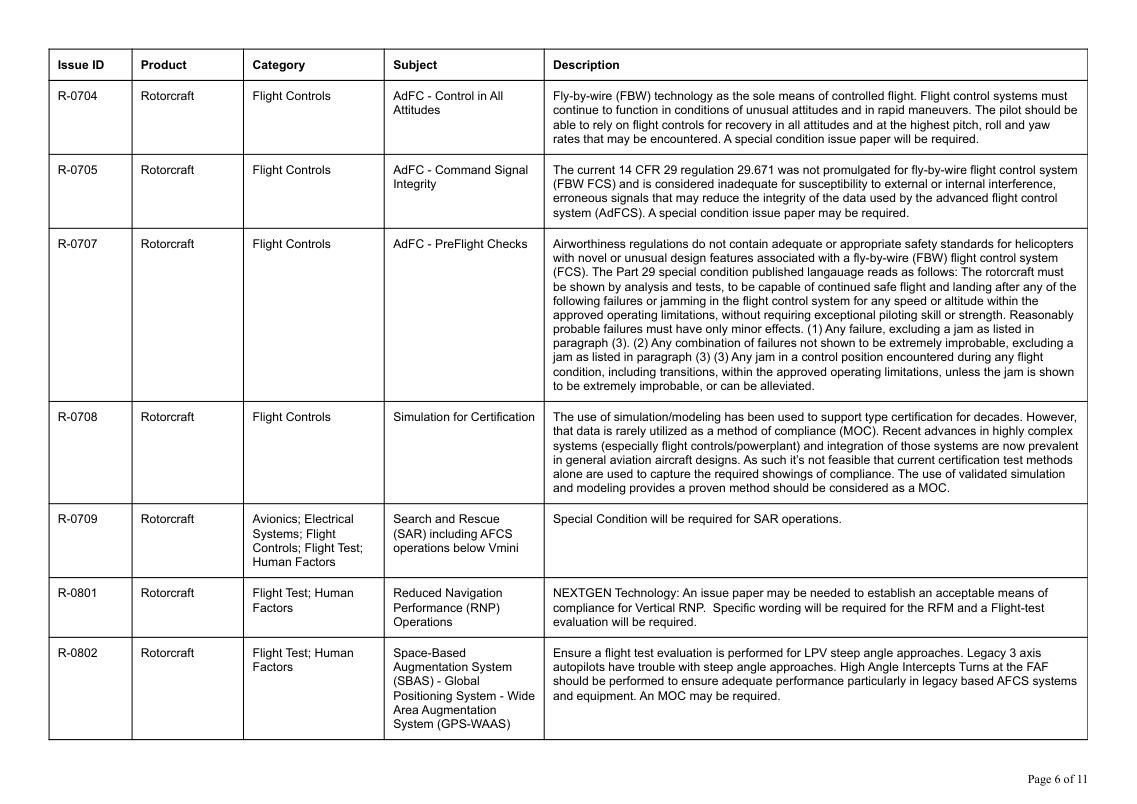
R-0704 Rotorcraft Flight Controls AdFC - Control in All Attitudes
Fly-by-wire (FBW) technology as the sole means of controlled flight. Flight control systems must continue to function in conditions of unusual attitudes and in rapid maneuvers. The pilot should be able to rely on flight controls for recovery in all attitudes and at the highest pitch, roll and yaw rates that may be encountered. A special condition issue paper will be required.
R-0705 Rotorcraft Flight Controls AdFC - Command Signal Integrity
The current 14 CFR 29 regulation 29.671 was not promulgated for fly-by-wire flight control system (FBW FCS) and is considered inadequate for susceptibility to external or internal interference, erroneous signals that may reduce the integrity of the data used by the advanced flight control system (AdFCS). A special condition issue paper may be required.
R-0707 Rotorcraft Flight Controls AdFC - PreFlight Checks Airworthiness regulations do not contain adequate or appropriate safety standards for helicopters with novel or unusual design features associated with a fly-by-wire (FBW) flight control system (FCS). The Part 29 special condition published langauage reads as follows: The rotorcraft must be shown by analysis and tests, to be capable of continued safe flight and landing after any of the following failures or jamming in the flight control system for any speed or altitude within the approved operating limitations, without requiring exceptional piloting skill or strength. Reasonably probable failures must have only minor effects. (1) Any failure, excluding a jam as listed in paragraph (3). (2) Any combination of failures not shown to be extremely improbable, excluding a jam as listed in paragraph (3) (3) Any jam in a control position encountered during any flight condition, including transitions, within the approved operating limitations, unless the jam is shown to be extremely improbable, or can be alleviated.
R-0708 Rotorcraft Flight Controls Simulation for Certification The use of simulation/modeling has been used to support type certification for decades. However, that data is rarely utilized as a method of compliance (MOC). Recent advances in highly complex systems (especially flight controls/powerplant) and integration of those systems are now prevalent in general aviation aircraft designs. As such it’s not feasible that current certification test methods alone are used to capture the required showings of compliance. The use of validated simulation and modeling provides a proven method should be considered as a MOC.
Special Condition will be required for SAR operations.
Search and Rescue (SAR) including AFCS operations below Vmini
R-0709 Rotorcraft Avionics; Electrical Systems; Flight Controls; Flight Test; Human Factors
R-0801 Rotorcraft Flight Test; Human Factors
Reduced Navigation Performance (RNP) Operations
NEXTGEN Technology: An issue paper may be needed to establish an acceptable means of compliance for Vertical RNP. Specific wording will be required for the RFM and a Flight-test evaluation will be required.
R-0802 Rotorcraft Flight Test; Human Factors
Ensure a flight test evaluation is performed for LPV steep angle approaches. Legacy 3 axis autopilots have trouble with steep angle approaches. High Angle Intercepts Turns at the FAF should be performed to ensure adequate performance particularly in legacy based AFCS systems and equipment. An MOC may be required.
Space-Based Augmentation System (SBAS) - Global Positioning System - Wide Area Augmentation System (GPS-WAAS)
View figures, tables and original page layout