FAA Rotorcraft Issues List
Rotorcraft Product Issues List
Q3 2026 · 30 September 2026 Source checked 2026-11-28
Scope, source and reading notes
Certification planning issues for domestic projects. Consult the applicable bilateral agreement for validation projects. Entries summarize issues and do not reproduce the underlying project issue papers. Public issue summaries only; complete project issue papers are not reproduced.
Aerospace Consulting reference note: Public certification topics that may require special conditions, agreed means of compliance or FAA coordination.
The complete selected publication is available in reading text and as the original PDF. Reading text is extracted from the official PDF; page layout is simplified, and figures and tables should be checked in the original page view. This is the FAA’s public summary of certification issues, not the full project issue papers.
Search covers extracted text. Words contained only in graphics may not be searchable. The original publication is available below.
Official source recordOriginal PDF on this siteSource: FAA. Reproduced with source acknowledgment; source edition and status are shown above. SHA-256: a7493b2666179cc526f71c1d7119a1cea7e61a113a04957c96c4abe3fb7bd60f
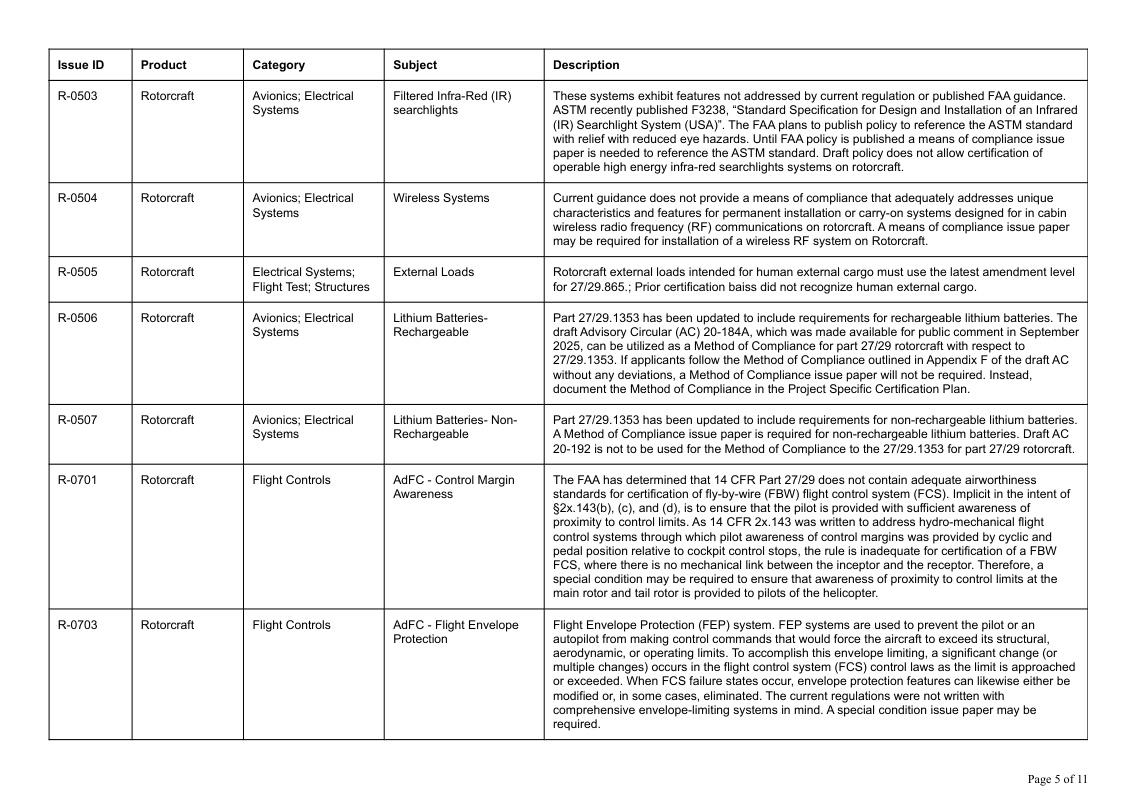
R-0503 Rotorcraft Avionics; Electrical Systems
Filtered Infra-Red (IR) searchlights
These systems exhibit features not addressed by current regulation or published FAA guidance. ASTM recently published F3238, “Standard Specification for Design and Installation of an Infrared (IR) Searchlight System (USA)”. The FAA plans to publish policy to reference the ASTM standard with relief with reduced eye hazards. Until FAA policy is published a means of compliance issue paper is needed to reference the ASTM standard. Draft policy does not allow certification of operable high energy infra-red searchlights systems on rotorcraft.
R-0504 Rotorcraft Avionics; Electrical Systems
Wireless Systems Current guidance does not provide a means of compliance that adequately addresses unique characteristics and features for permanent installation or carry-on systems designed for in cabin wireless radio frequency (RF) communications on rotorcraft. A means of compliance issue paper may be required for installation of a wireless RF system on Rotorcraft.
R-0505 Rotorcraft Electrical Systems; Flight Test; Structures
External Loads Rotorcraft external loads intended for human external cargo must use the latest amendment level for 27/29.865.; Prior certification baiss did not recognize human external cargo.
R-0506 Rotorcraft Avionics; Electrical Systems
Lithium Batteries- Rechargeable
Part 27/29.1353 has been updated to include requirements for rechargeable lithium batteries. The draft Advisory Circular (AC) 20-184A, which was made available for public comment in September 2025, can be utilized as a Method of Compliance for part 27/29 rotorcraft with respect to 27/29.1353. If applicants follow the Method of Compliance outlined in Appendix F of the draft AC without any deviations, a Method of Compliance issue paper will not be required. Instead, document the Method of Compliance in the Project Specific Certification Plan.
R-0507 Rotorcraft Avionics; Electrical Systems
Lithium Batteries- Non- Rechargeable
Part 27/29.1353 has been updated to include requirements for non-rechargeable lithium batteries. A Method of Compliance issue paper is required for non-rechargeable lithium batteries. Draft AC 20-192 is not to be used for the Method of Compliance to the 27/29.1353 for part 27/29 rotorcraft.
R-0701 Rotorcraft Flight Controls AdFC - Control Margin Awareness
The FAA has determined that 14 CFR Part 27/29 does not contain adequate airworthiness standards for certification of fly-by-wire (FBW) flight control system (FCS). Implicit in the intent of §2x.143(b), (c), and (d), is to ensure that the pilot is provided with sufficient awareness of proximity to control limits. As 14 CFR 2x.143 was written to address hydro-mechanical flight control systems through which pilot awareness of control margins was provided by cyclic and pedal position relative to cockpit control stops, the rule is inadequate for certification of a FBW FCS, where there is no mechanical link between the inceptor and the receptor. Therefore, a special condition may be required to ensure that awareness of proximity to control limits at the main rotor and tail rotor is provided to pilots of the helicopter.
R-0703 Rotorcraft Flight Controls AdFC - Flight Envelope Protection
Flight Envelope Protection (FEP) system. FEP systems are used to prevent the pilot or an autopilot from making control commands that would force the aircraft to exceed its structural, aerodynamic, or operating limits. To accomplish this envelope limiting, a significant change (or multiple changes) occurs in the flight control system (FCS) control laws as the limit is approached or exceeded. When FCS failure states occur, envelope protection features can likewise either be modified or, in some cases, eliminated. The current regulations were not written with comprehensive envelope-limiting systems in mind. A special condition issue paper may be required.
View figures, tables and original page layout