FAA Engines and Propellers Issues List
Engines and Propellers Product Issues List
Q3 2026 · 30 September 2026 Source checked 2026-11-28
Scope, source and reading notes
Certification planning issues for domestic projects. Consult the applicable bilateral agreement for validation projects. Entries summarize issues and do not reproduce the underlying project issue papers. Public issue summaries only; complete project issue papers are not reproduced.
Aerospace Consulting reference note: Public certification topics that may require special conditions, agreed means of compliance or FAA coordination.
The complete selected publication is available in reading text and as the original PDF. Reading text is extracted from the official PDF; page layout is simplified, and figures and tables should be checked in the original page view. This is the FAA’s public summary of certification issues, not the full project issue papers.
Search covers extracted text. Words contained only in graphics may not be searchable. The original publication is available below.
Official source recordOriginal PDF on this siteSource: FAA. Reproduced with source acknowledgment; source edition and status are shown above. SHA-256: 131abee5a56df0026b5b365798c13b146b23c2a8734f8f9fbc086d9ffb61c89b
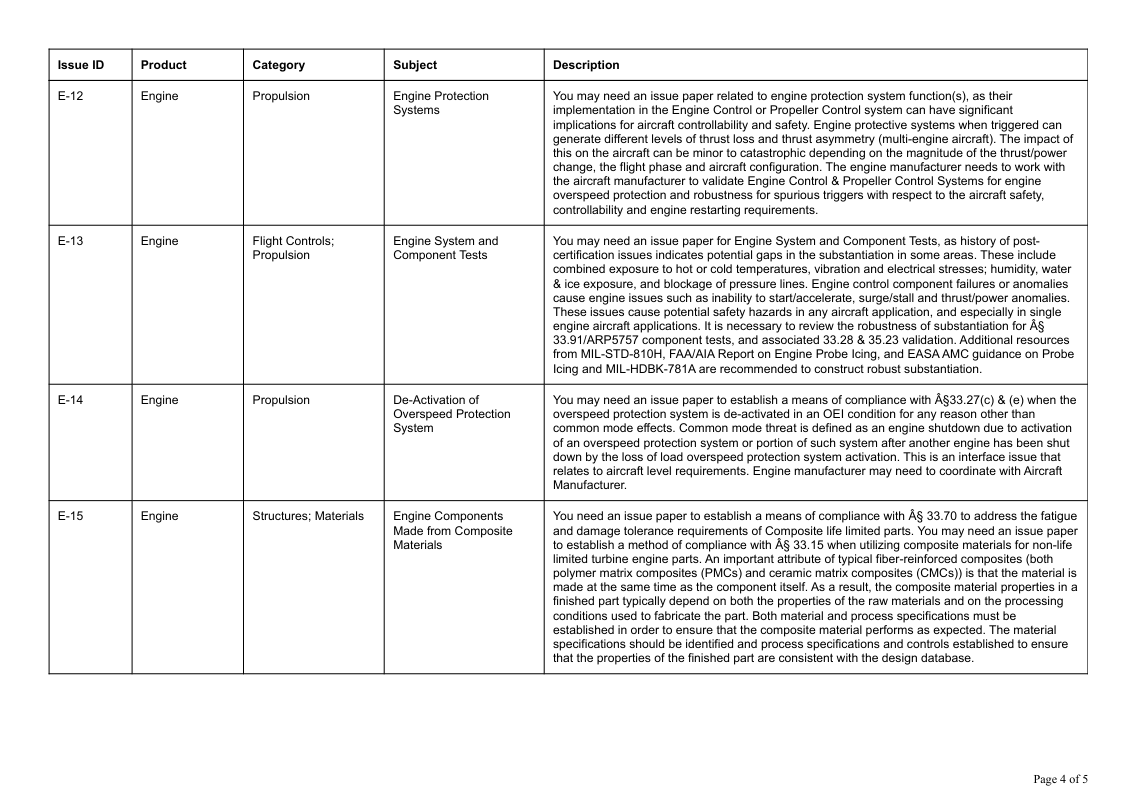
E-12 Engine Propulsion Engine Protection Systems
You may need an issue paper related to engine protection system function(s), as their implementation in the Engine Control or Propeller Control system can have significant implications for aircraft controllability and safety. Engine protective systems when triggered can generate different levels of thrust loss and thrust asymmetry (multi-engine aircraft). The impact of this on the aircraft can be minor to catastrophic depending on the magnitude of the thrust/power change, the flight phase and aircraft configuration. The engine manufacturer needs to work with the aircraft manufacturer to validate Engine Control & Propeller Control Systems for engine overspeed protection and robustness for spurious triggers with respect to the aircraft safety, controllability and engine restarting requirements.
E-13 Engine Flight Controls; Propulsion
Engine System and Component Tests
You may need an issue paper for Engine System and Component Tests, as history of post- certification issues indicates potential gaps in the substantiation in some areas. These include combined exposure to hot or cold temperatures, vibration and electrical stresses; humidity, water & ice exposure, and blockage of pressure lines. Engine control component failures or anomalies cause engine issues such as inability to start/accelerate, surge/stall and thrust/power anomalies. These issues cause potential safety hazards in any aircraft application, and especially in single engine aircraft applications. It is necessary to review the robustness of substantiation for § 33.91/ARP5757 component tests, and associated 33.28 & 35.23 validation. Additional resources from MIL-STD-810H, FAA/AIA Report on Engine Probe Icing, and EASA AMC guidance on Probe Icing and MIL-HDBK-781A are recommended to construct robust substantiation.
E-14 Engine Propulsion De-Activation of Overspeed Protection System
You may need an issue paper to establish a means of compliance with §33.27(c) & (e) when the overspeed protection system is de-activated in an OEI condition for any reason other than common mode effects. Common mode threat is defined as an engine shutdown due to activation of an overspeed protection system or portion of such system after another engine has been shut down by the loss of load overspeed protection system activation. This is an interface issue that relates to aircraft level requirements. Engine manufacturer may need to coordinate with Aircraft Manufacturer.
E-15 Engine Structures; Materials Engine Components Made from Composite Materials
You need an issue paper to establish a means of compliance with § 33.70 to address the fatigue and damage tolerance requirements of Composite life limited parts. You may need an issue paper to establish a method of compliance with § 33.15 when utilizing composite materials for non-life limited turbine engine parts. An important attribute of typical fiber-reinforced composites (both polymer matrix composites (PMCs) and ceramic matrix composites (CMCs)) is that the material is made at the same time as the component itself. As a result, the composite material properties in a finished part typically depend on both the properties of the raw materials and on the processing conditions used to fabricate the part. Both material and process specifications must be established in order to ensure that the composite material performs as expected. The material specifications should be identified and process specifications and controls established to ensure that the properties of the finished part are consistent with the design database.
View figures, tables and original page layout