FAA Engines and Propellers Issues List
Engines and Propellers Product Issues List
Q3 2026 · 30 September 2026 Source checked 2026-11-28
Scope, source and reading notes
Certification planning issues for domestic projects. Consult the applicable bilateral agreement for validation projects. Entries summarize issues and do not reproduce the underlying project issue papers. Public issue summaries only; complete project issue papers are not reproduced.
Aerospace Consulting reference note: Public certification topics that may require special conditions, agreed means of compliance or FAA coordination.
The complete selected publication is available in reading text and as the original PDF. Reading text is extracted from the official PDF; page layout is simplified, and figures and tables should be checked in the original page view. This is the FAA’s public summary of certification issues, not the full project issue papers.
Search covers extracted text. Words contained only in graphics may not be searchable. The original publication is available below.
Official source recordOriginal PDF on this siteSource: FAA. Reproduced with source acknowledgment; source edition and status are shown above. SHA-256: 131abee5a56df0026b5b365798c13b146b23c2a8734f8f9fbc086d9ffb61c89b
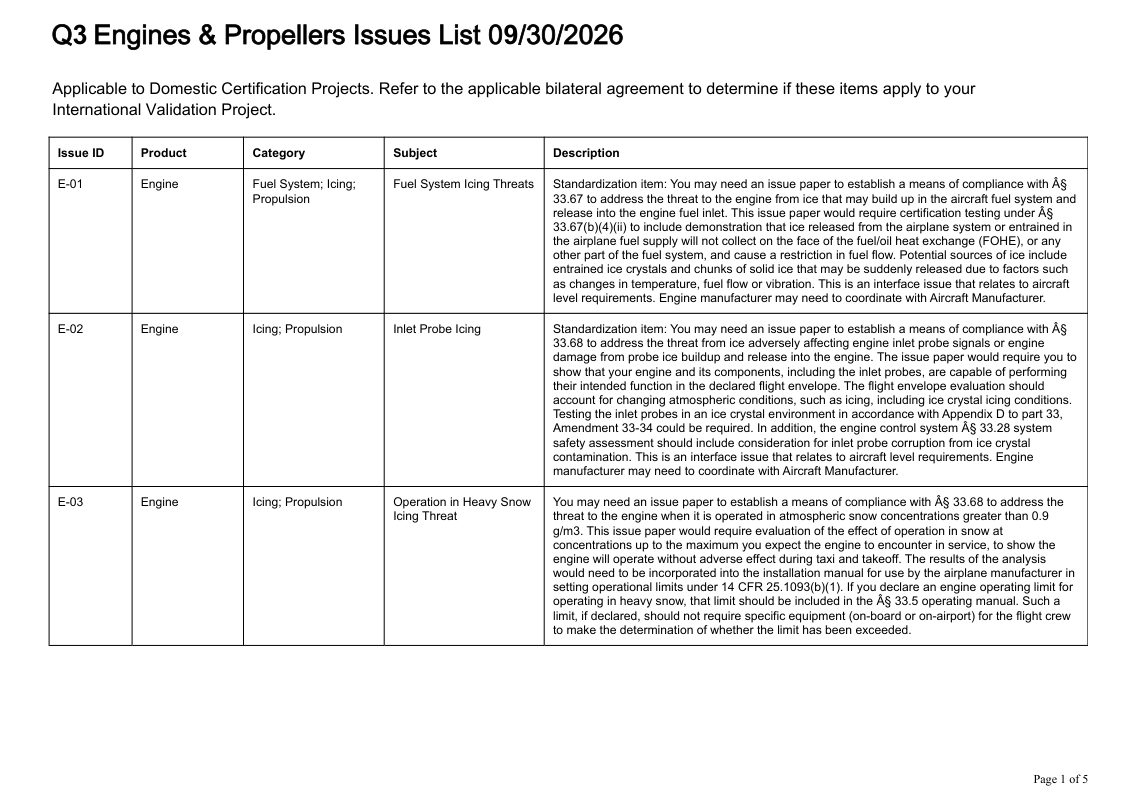
Q3 Engines & Propellers Issues List 09/30/2026
Applicable to Domestic Certification Projects. Refer to the applicable bilateral agreement to determine if these items apply to your International Validation Project.
Issue ID Product Category Subject Description
E-01 Engine Fuel System; Icing; Propulsion
Fuel System Icing Threats Standardization item: You may need an issue paper to establish a means of compliance with § 33.67 to address the threat to the engine from ice that may build up in the aircraft fuel system and release into the engine fuel inlet. This issue paper would require certification testing under § 33.67(b)(4)(ii) to include demonstration that ice released from the airplane system or entrained in the airplane fuel supply will not collect on the face of the fuel/oil heat exchange (FOHE), or any other part of the fuel system, and cause a restriction in fuel flow. Potential sources of ice include entrained ice crystals and chunks of solid ice that may be suddenly released due to factors such as changes in temperature, fuel flow or vibration. This is an interface issue that relates to aircraft level requirements. Engine manufacturer may need to coordinate with Aircraft Manufacturer.
E-02 Engine Icing; Propulsion Inlet Probe Icing Standardization item: You may need an issue paper to establish a means of compliance with § 33.68 to address the threat from ice adversely affecting engine inlet probe signals or engine damage from probe ice buildup and release into the engine. The issue paper would require you to show that your engine and its components, including the inlet probes, are capable of performing their intended function in the declared flight envelope. The flight envelope evaluation should account for changing atmospheric conditions, such as icing, including ice crystal icing conditions. Testing the inlet probes in an ice crystal environment in accordance with Appendix D to part 33, Amendment 33-34 could be required. In addition, the engine control system § 33.28 system safety assessment should include consideration for inlet probe corruption from ice crystal contamination. This is an interface issue that relates to aircraft level requirements. Engine manufacturer may need to coordinate with Aircraft Manufacturer.
E-03 Engine Icing; Propulsion Operation in Heavy Snow Icing Threat
You may need an issue paper to establish a means of compliance with § 33.68 to address the threat to the engine when it is operated in atmospheric snow concentrations greater than 0.9 g/m3. This issue paper would require evaluation of the effect of operation in snow at concentrations up to the maximum you expect the engine to encounter in service, to show the engine will operate without adverse effect during taxi and takeoff. The results of the analysis would need to be incorporated into the installation manual for use by the airplane manufacturer in setting operational limits under 14 CFR 25.1093(b)(1). If you declare an engine operating limit for operating in heavy snow, that limit should be included in the § 33.5 operating manual. Such a limit, if declared, should not require specific equipment (on-board or on-airport) for the flight crew to make the determination of whether the limit has been exceeded.
View figures, tables and original page layout