FAA Engines and Propellers Issues List
Engines and Propellers Product Issues List
Q3 2026 · 30 September 2026 Source checked 2026-11-28
Scope, source and reading notes
Certification planning issues for domestic projects. Consult the applicable bilateral agreement for validation projects. Entries summarize issues and do not reproduce the underlying project issue papers. Public issue summaries only; complete project issue papers are not reproduced.
Aerospace Consulting reference note: Public certification topics that may require special conditions, agreed means of compliance or FAA coordination.
The complete selected publication is available in reading text and as the original PDF. Reading text is extracted from the official PDF; page layout is simplified, and figures and tables should be checked in the original page view. This is the FAA’s public summary of certification issues, not the full project issue papers.
Search covers extracted text. Words contained only in graphics may not be searchable. The original publication is available below.
Official source recordOriginal PDF on this siteSource: FAA. Reproduced with source acknowledgment; source edition and status are shown above. SHA-256: 131abee5a56df0026b5b365798c13b146b23c2a8734f8f9fbc086d9ffb61c89b
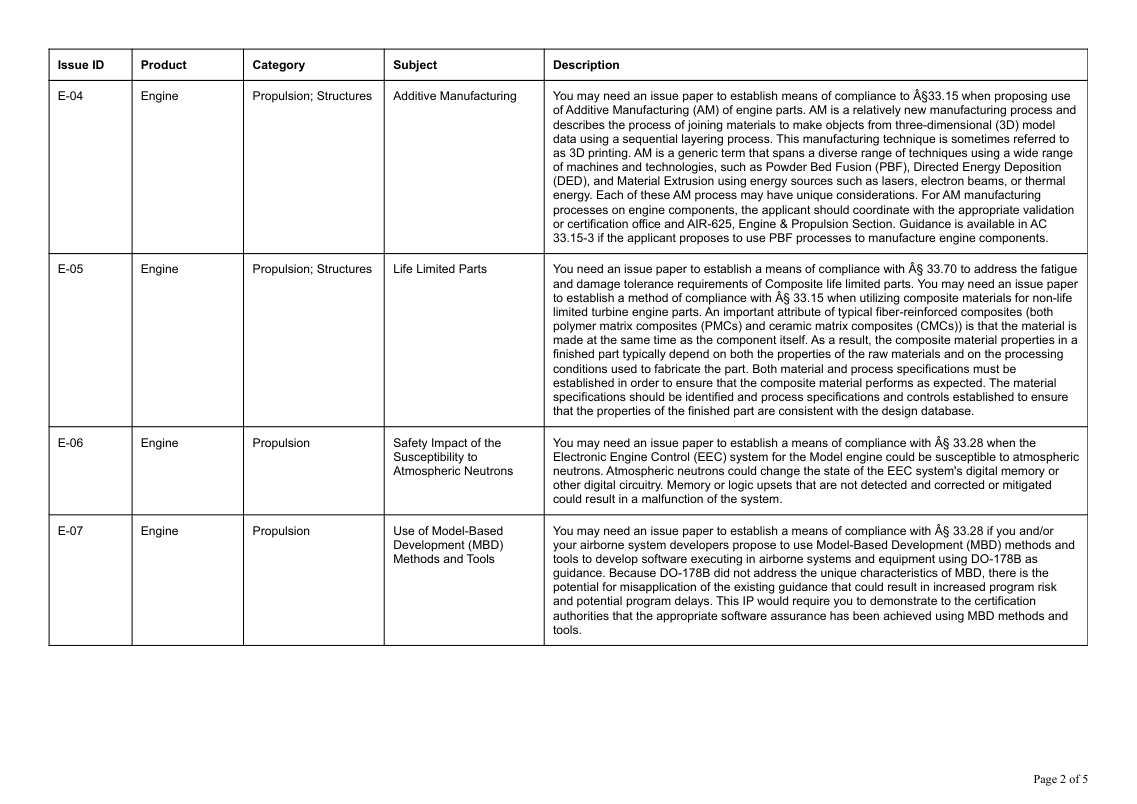
E-04 Engine Propulsion; Structures Additive Manufacturing You may need an issue paper to establish means of compliance to §33.15 when proposing use of Additive Manufacturing (AM) of engine parts. AM is a relatively new manufacturing process and describes the process of joining materials to make objects from three-dimensional (3D) model data using a sequential layering process. This manufacturing technique is sometimes referred to as 3D printing. AM is a generic term that spans a diverse range of techniques using a wide range of machines and technologies, such as Powder Bed Fusion (PBF), Directed Energy Deposition (DED), and Material Extrusion using energy sources such as lasers, electron beams, or thermal energy. Each of these AM process may have unique considerations. For AM manufacturing processes on engine components, the applicant should coordinate with the appropriate validation or certification office and AIR-625, Engine & Propulsion Section. Guidance is available in AC 33.15-3 if the applicant proposes to use PBF processes to manufacture engine components.
E-05 Engine Propulsion; Structures Life Limited Parts You need an issue paper to establish a means of compliance with § 33.70 to address the fatigue and damage tolerance requirements of Composite life limited parts. You may need an issue paper to establish a method of compliance with § 33.15 when utilizing composite materials for non-life limited turbine engine parts. An important attribute of typical fiber-reinforced composites (both polymer matrix composites (PMCs) and ceramic matrix composites (CMCs)) is that the material is made at the same time as the component itself. As a result, the composite material properties in a finished part typically depend on both the properties of the raw materials and on the processing conditions used to fabricate the part. Both material and process specifications must be established in order to ensure that the composite material performs as expected. The material specifications should be identified and process specifications and controls established to ensure that the properties of the finished part are consistent with the design database.
E-06 Engine Propulsion Safety Impact of the Susceptibility to Atmospheric Neutrons
You may need an issue paper to establish a means of compliance with § 33.28 when the Electronic Engine Control (EEC) system for the Model engine could be susceptible to atmospheric neutrons. Atmospheric neutrons could change the state of the EEC system's digital memory or other digital circuitry. Memory or logic upsets that are not detected and corrected or mitigated could result in a malfunction of the system.
E-07 Engine Propulsion Use of Model-Based Development (MBD) Methods and Tools
You may need an issue paper to establish a means of compliance with § 33.28 if you and/or your airborne system developers propose to use Model-Based Development (MBD) methods and tools to develop software executing in airborne systems and equipment using DO-178B as guidance. Because DO-178B did not address the unique characteristics of MBD, there is the potential for misapplication of the existing guidance that could result in increased program risk and potential program delays. This IP would require you to demonstrate to the certification authorities that the appropriate software assurance has been achieved using MBD methods and tools.
View figures, tables and original page layout