
AC 20-115D
Airborne Software Development Assurance Using EUROCAE ED-12( ) and RTCA DO-178( )
20-115D · 2017-07-21 Source checked 2026-11-28
Scope, source and reading notes
This AC recognises DO-178C/ED-12C, DO-330/ED-215 and the model-based, object-oriented and formal-methods supplements. Apply the relevant provisions to the software and certification context.
Aerospace Consulting reference note: Software development assurance and recognition of DO-178C/ED-12C, its supplements and tool qualification guidance.
The complete selected publication is available in reading text and as the original PDF. Reading text is extracted from the official PDF; page layout is simplified, and figures and tables should be checked in the original page view.
Search covers extracted text. Words contained only in graphics may not be searchable. The original publication is available below.
Official source recordOriginal PDF on this siteSource: FAA. Reproduced with source acknowledgment; source edition and status are shown above. SHA-256: 5597a1af49c872a1a843c05601742ddcc8e8a190642f31e3cb9ce8e0dc63d91e
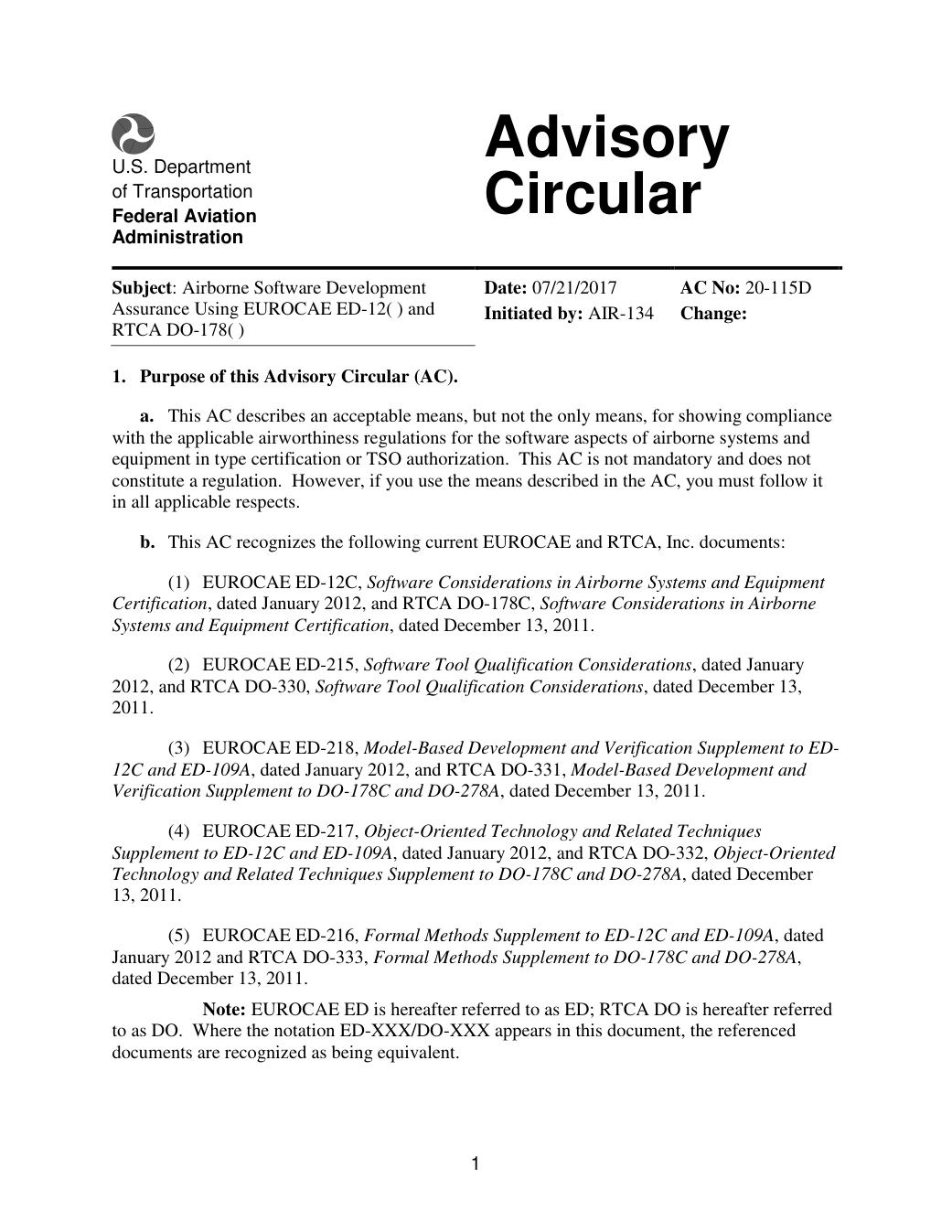
Advisory Circular
U.S. Department of Transportation Federal Aviation Administration
Date: 07/21/2017 Initiated by: AIR-134
AC No: 20-115D Change:
Subject: Airborne Software Development Assurance Using EUROCAE ED-12( ) and RTCA DO-178( )
1. Purpose of this Advisory Circular (AC).
a. This AC describes an acceptable means, but not the only means, for showing compliance with the applicable airworthiness regulations for the software aspects of airborne systems and equipment in type certification or TSO authorization. This AC is not mandatory and does not constitute a regulation. However, if you use the means described in the AC, you must follow it in all applicable respects.
b. This AC recognizes the following current EUROCAE and RTCA, Inc. documents:
(1) EUROCAE ED-12C, Software Considerations in Airborne Systems and Equipment Certification, dated January 2012, and RTCA DO-178C, Software Considerations in Airborne Systems and Equipment Certification, dated December 13, 2011.
(2) EUROCAE ED-215, Software Tool Qualification Considerations, dated January 2012, and RTCA DO-330, Software Tool Qualification Considerations, dated December 13, 2011.
(3) EUROCAE ED-218, Model-Based Development and Verification Supplement to ED- 12C and ED-109A, dated January 2012, and RTCA DO-331, Model-Based Development and Verification Supplement to DO-178C and DO-278A, dated December 13, 2011.
(4) EUROCAE ED-217, Object-Oriented Technology and Related Techniques Supplement to ED-12C and ED-109A, dated January 2012, and RTCA DO-332, Object-Oriented Technology and Related Techniques Supplement to DO-178C and DO-278A, dated December 13, 2011.
(5) EUROCAE ED-216, Formal Methods Supplement to ED-12C and ED-109A, dated January 2012 and RTCA DO-333, Formal Methods Supplement to DO-178C and DO-278A, dated December 13, 2011.
Note: EUROCAE ED is hereafter referred to as ED; RTCA DO is hereafter referred to as DO. Where the notation ED-XXX/DO-XXX appears in this document, the referenced documents are recognized as being equivalent.
View figures, tables and original page layout
Connected references
Source-backed citations and subject-based engineering context are labelled separately. These links do not establish equivalence or project acceptance.
Related technical context
Engineering contextEvidence and scope
AC 20-115D and AMC 20-115D — published scope
Aerospace Consulting navigation suggestion based on the subject and stated scope of the two publications.
This connection does not establish regulatory equivalence, acceptance of a newer edition, or applicability of a project-specific precedent to another programme.
Supporting source