Appendix A gives an acceptable means for certain powered-lift under §21.17(b). These criteria are not universally applicable CFR requirements; establish the basis for the particular aircraft.
The source, within reach.
Search within this AC, jump to a source page, or download the complete saved publication.
This extraction supports search. Read the original page for complete notation and layout.
07/18/2025                                               AC 21.17-4

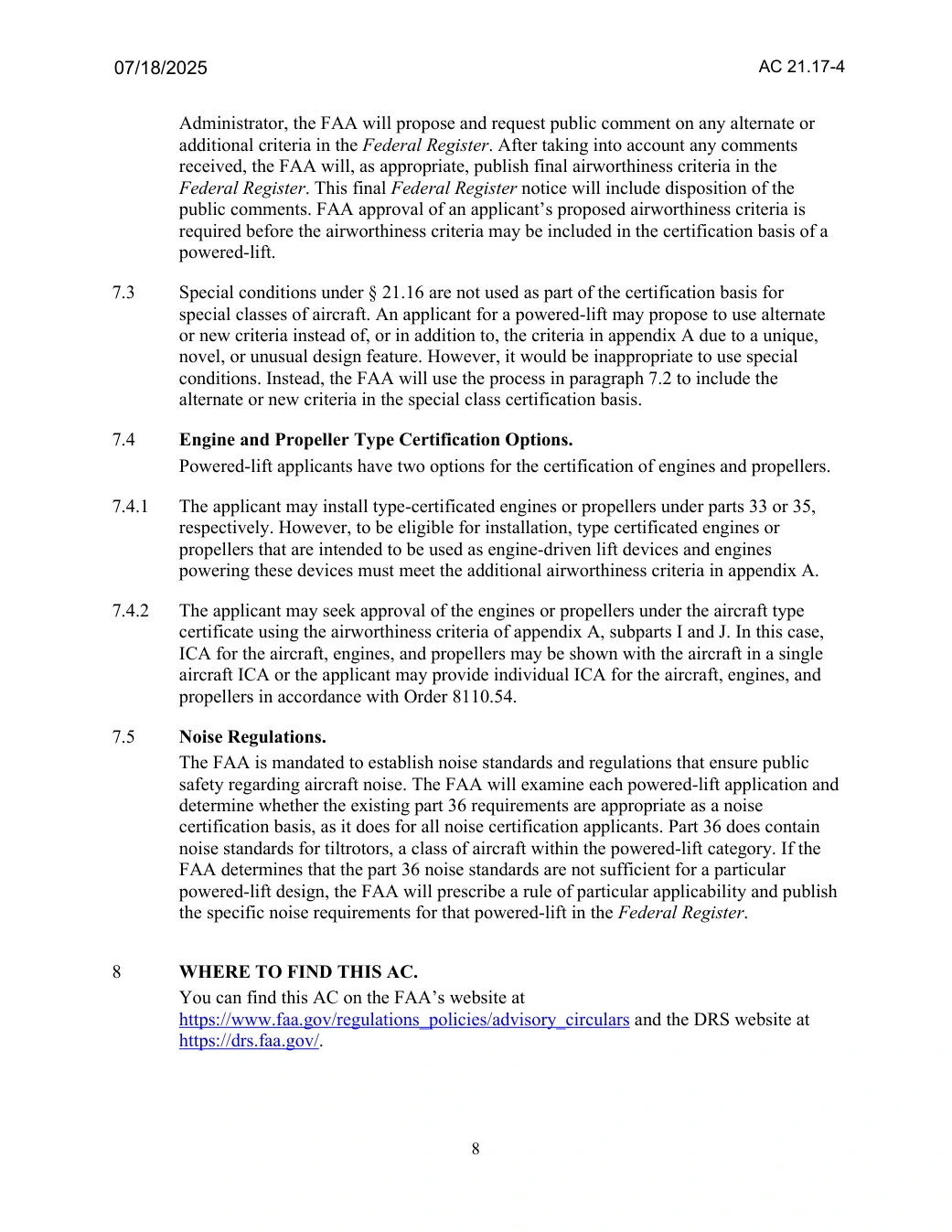
         Administrator, the FAA will propose and request public comment on any alternate or
         additional criteria in the Federal Register. After taking into account any comments
         received, the FAA will, as appropriate, publish final airworthiness criteria in the
        Federal Register. This final Federal Register notice will include disposition of the
         public comments. FAA approval of an applicant’s proposed airworthiness criteria is
         required before the airworthiness criteria may be included in the certification basis of a
         powered-lift.

7.3      Special conditions under § 21.16 are not used as part of the certification basis for
         special classes of aircraft. An applicant for a powered-lift may propose to use alternate
         or new criteria instead of, or in addition to, the criteria in appendix A due to a unique,
         novel, or unusual design feature. However, it would be inappropriate to use special
         conditions. Instead, the FAA will use the process in paragraph 7.2 to include the
         alternate or new criteria in the special class certification basis.

7.4     Engine and Propeller Type Certification Options.
         Powered-lift applicants have two options for the certification of engines and propellers.

7.4.1   The applicant may install type-certificated engines or propellers under parts 33 or 35,
         respectively. However, to be eligible for installation, type certificated engines or
         propellers that are intended to be used as engine-driven lift devices and engines
        powering these devices must meet the additional airworthiness criteria in appendix A.

7.4.2   The applicant may seek approval of the engines or propellers under the aircraft type
          certificate using the airworthiness criteria of appendix A, subparts I and J. In this case,
      ICA for the aircraft, engines, and propellers may be shown with the aircraft in a single
          aircraft ICA or the applicant may provide individual ICA for the aircraft, engines, and
         propellers in accordance with Order 8110.54.

7.5     Noise Regulations.
       The FAA is mandated to establish noise standards and regulations that ensure public
         safety regarding aircraft noise. The FAA will examine each powered-lift application and
        determine whether the existing part 36 requirements are appropriate as a noise
          certification basis, as it does for all noise certification applicants. Part 36 does contain
         noise standards for tiltrotors, a class of aircraft within the powered-lift category. If the
     FAA determines that the part 36 noise standards are not sufficient for a particular
         powered-lift design, the FAA will prescribe a rule of particular applicability and publish
         the specific noise requirements for that powered-lift in the Federal Register.

8    WHERE TO FIND THIS AC.
      You can find this AC on the FAA’s website at
         https://www.faa.gov/regulations_policies/advisory_circulars and the DRS website at
          https://drs.faa.gov/.


                                          8
Saved from the FAA on November 17, 2026. All original pages are retained. Engineering explanations are presented separately below.
Aerospace Consulting / Engineering perspective
Begin with the aircraft and the agreed basis.
Connect the operating concept, aircraft-level failure effects, system architecture and assurance planning. Keep FAA powered-lift criteria and EASA SC-VTOL provisions distinct when developing the safety and certification approach.
A focused review, an agreed assessment package or ongoing support alongside your team. We can agree the relevant inputs and scope in the initial conversation.
This opens your email application.
Start a conversation
Tell us about your programme, the system you are developing and the support you need.
We can agree a focused use-case review, a defined evidence package or ongoing programme support.
This opens your email application.
Specialist aerospace expertise
Aerospace Consulting is led by Hussein Khimji, an FAA Designated Engineering Representative in systems and equipment, with a focus on system safety, flight controls and avionics.
We work with aircraft developers and systems suppliers to connect technical decisions, safety assessments and certification evidence.
This is the proposed introduction. The full About page will add your approved biography and associate expertise.
Systems engineering & development assurance
Tell us about the aircraft or system, its intended function, stage of development and the support you need.