
Original source view; text reflow has not yet been reviewed
AC 21.17-4 · A-23Open saved PDF here ↗
Extracted text for finding words
This extraction supports search. Read the original page for complete notation and layout.
07/18/2025                                               AC 21.17-4
                                                                        Appendix A

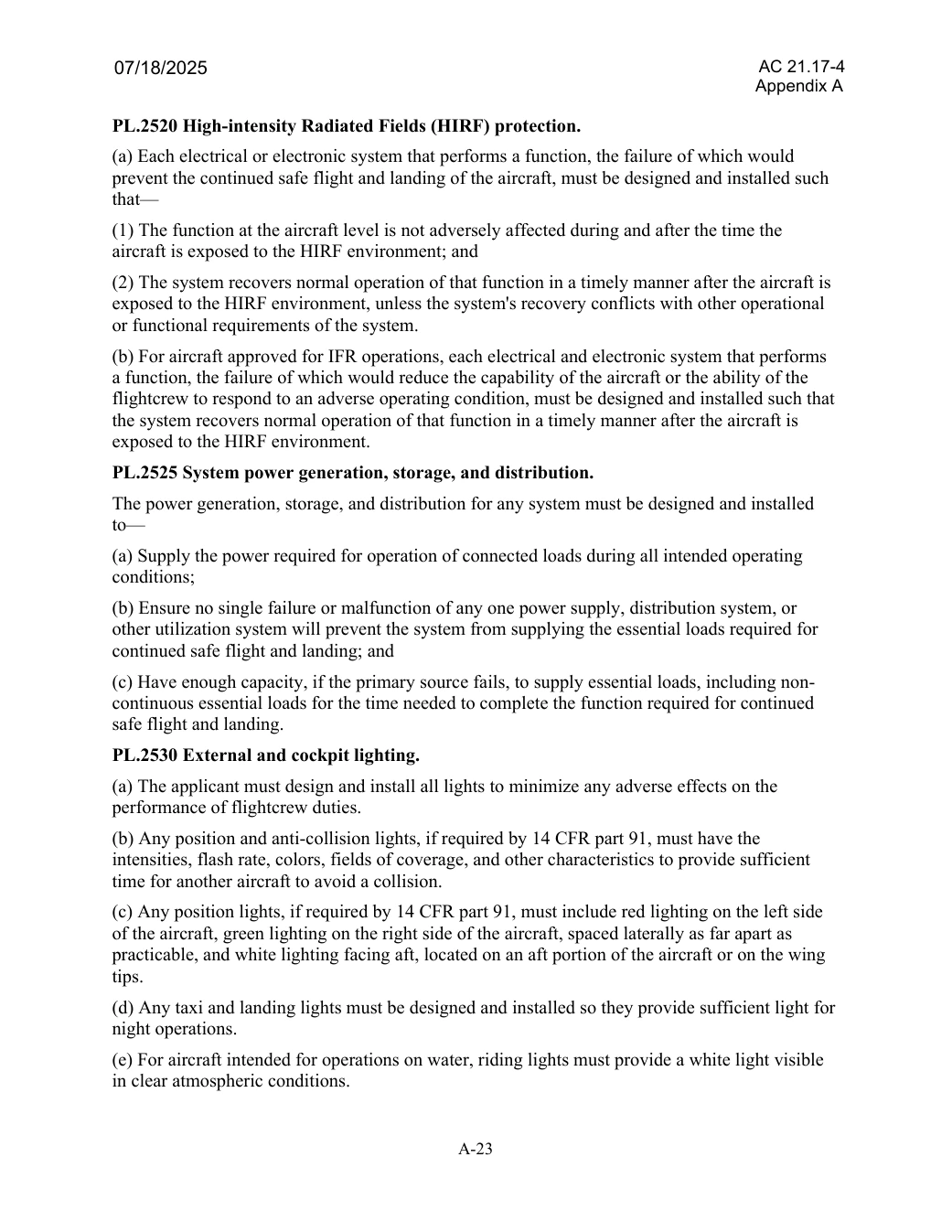
PL.2520 High-intensity Radiated Fields (HIRF) protection.
(a) Each electrical or electronic system that performs a function, the failure of which would
prevent the continued safe flight and landing of the aircraft, must be designed and installed such
that—
(1) The function at the aircraft level is not adversely affected during and after the time the
aircraft is exposed to the HIRF environment; and
(2) The system recovers normal operation of that function in a timely manner after the aircraft is
exposed to the HIRF environment, unless the system's recovery conflicts with other operational
or functional requirements of the system.
(b) For aircraft approved for IFR operations, each electrical and electronic system that performs
a function, the failure of which would reduce the capability of the aircraft or the ability of the
flightcrew to respond to an adverse operating condition, must be designed and installed such that
the system recovers normal operation of that function in a timely manner after the aircraft is
exposed to the HIRF environment.
PL.2525 System power generation, storage, and distribution.
The power generation, storage, and distribution for any system must be designed and installed
to—
(a) Supply the power required for operation of connected loads during all intended operating
conditions;
(b) Ensure no single failure or malfunction of any one power supply, distribution system, or
other utilization system will prevent the system from supplying the essential loads required for
continued safe flight and landing; and
(c) Have enough capacity, if the primary source fails, to supply essential loads, including non-
continuous essential loads for the time needed to complete the function required for continued
safe flight and landing.
PL.2530 External and cockpit lighting.
(a) The applicant must design and install all lights to minimize any adverse effects on the
performance of flightcrew duties.
(b) Any position and anti-collision lights, if required by 14 CFR part 91, must have the
intensities, flash rate, colors, fields of coverage, and other characteristics to provide sufficient
time for another aircraft to avoid a collision.
(c) Any position lights, if required by 14 CFR part 91, must include red lighting on the left side
of the aircraft, green lighting on the right side of the aircraft, spaced laterally as far apart as
practicable, and white lighting facing aft, located on an aft portion of the aircraft or on the wing
tips.
(d) Any taxi and landing lights must be designed and installed so they provide sufficient light for
night operations.
(e) For aircraft intended for operations on water, riding lights must provide a white light visible
in clear atmospheric conditions.


                                       A-23