Appendix A gives an acceptable means for certain powered-lift under §21.17(b). These criteria are not universally applicable CFR requirements; establish the basis for the particular aircraft.
The source, within reach.
Search within this AC, jump to a source page, or download the complete saved publication.
This extraction supports search. Read the original page for complete notation and layout.
07/18/2025                                               AC 21.17-4
                                                                        Appendix A

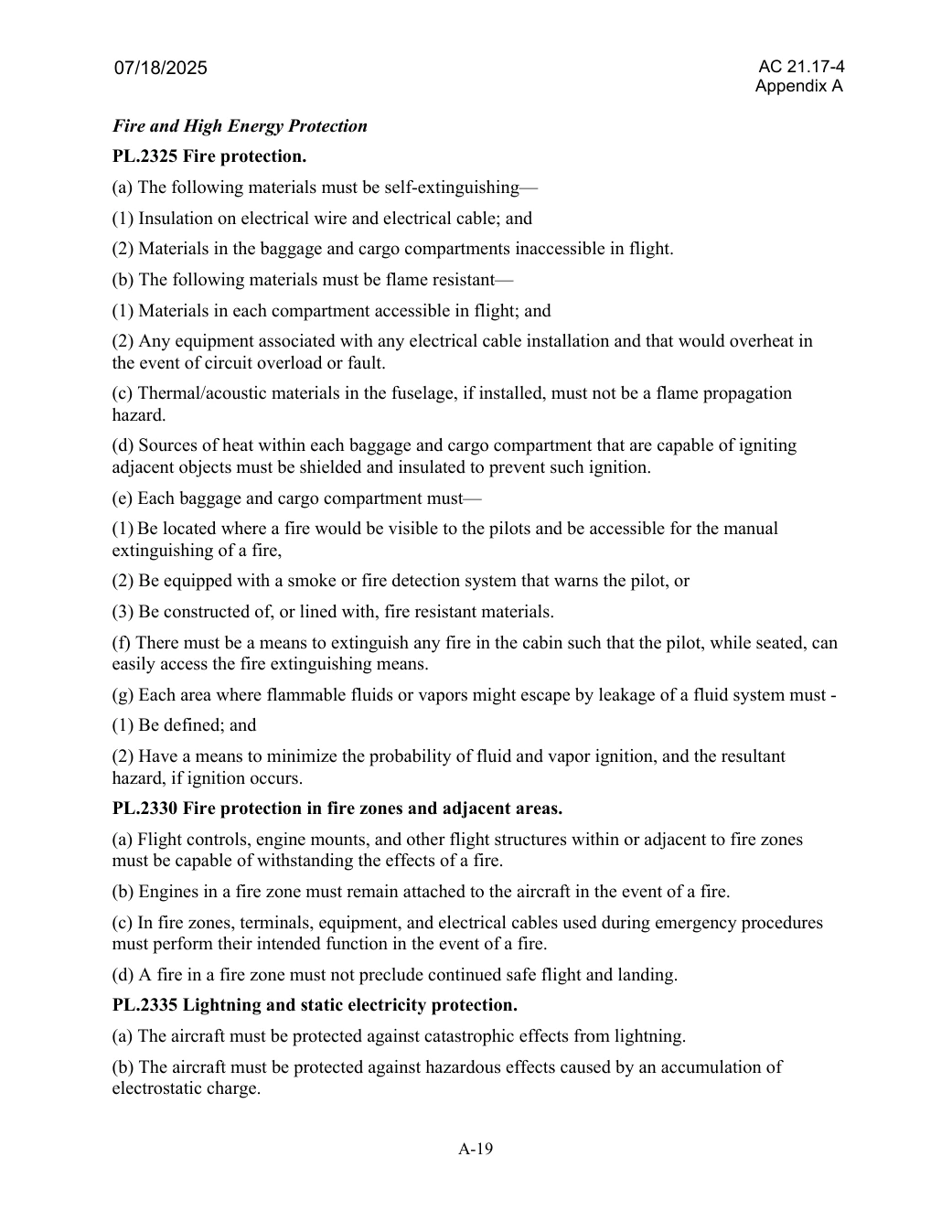
Fire and High Energy Protection
PL.2325 Fire protection.
(a) The following materials must be self-extinguishing—
(1) Insulation on electrical wire and electrical cable; and
(2) Materials in the baggage and cargo compartments inaccessible in flight.
(b) The following materials must be flame resistant—
(1) Materials in each compartment accessible in flight; and
(2) Any equipment associated with any electrical cable installation and that would overheat in
the event of circuit overload or fault.
(c) Thermal/acoustic materials in the fuselage, if installed, must not be a flame propagation
hazard.
(d) Sources of heat within each baggage and cargo compartment that are capable of igniting
adjacent objects must be shielded and insulated to prevent such ignition.
(e) Each baggage and cargo compartment must—
(1) Be located where a fire would be visible to the pilots and be accessible for the manual
extinguishing of a fire,
(2) Be equipped with a smoke or fire detection system that warns the pilot, or
(3) Be constructed of, or lined with, fire resistant materials.
(f) There must be a means to extinguish any fire in the cabin such that the pilot, while seated, can
easily access the fire extinguishing means.
(g) Each area where flammable fluids or vapors might escape by leakage of a fluid system must -
(1) Be defined; and
(2) Have a means to minimize the probability of fluid and vapor ignition, and the resultant
hazard, if ignition occurs.
PL.2330 Fire protection in fire zones and adjacent areas.
(a) Flight controls, engine mounts, and other flight structures within or adjacent to fire zones
must be capable of withstanding the effects of a fire.
(b) Engines in a fire zone must remain attached to the aircraft in the event of a fire.
(c) In fire zones, terminals, equipment, and electrical cables used during emergency procedures
must perform their intended function in the event of a fire.
(d) A fire in a fire zone must not preclude continued safe flight and landing.
PL.2335 Lightning and static electricity protection.
(a) The aircraft must be protected against catastrophic effects from lightning.
(b) The aircraft must be protected against hazardous effects caused by an accumulation of
electrostatic charge.


                                       A-19
Saved from the FAA on November 17, 2026. All original pages are retained. Engineering explanations are presented separately below.
Aerospace Consulting / Engineering perspective
Begin with the aircraft and the agreed basis.
Connect the operating concept, aircraft-level failure effects, system architecture and assurance planning. Keep FAA powered-lift criteria and EASA SC-VTOL provisions distinct when developing the safety and certification approach.
A focused review, an agreed assessment package or ongoing support alongside your team. We can agree the relevant inputs and scope in the initial conversation.
This opens your email application.
Start a conversation
Tell us about your programme, the system you are developing and the support you need.
We can agree a focused use-case review, a defined evidence package or ongoing programme support.
This opens your email application.
Specialist aerospace expertise
Aerospace Consulting is led by Hussein Khimji, an FAA Designated Engineering Representative in systems and equipment, with a focus on system safety, flight controls and avionics.
We work with aircraft developers and systems suppliers to connect technical decisions, safety assessments and certification evidence.
This is the proposed introduction. The full About page will add your approved biography and associate expertise.
Systems engineering & development assurance
Tell us about the aircraft or system, its intended function, stage of development and the support you need.