FAA Transport Airplanes Issues List
Transport Airplanes Product Issues List
Q3 2026 · 30 September 2026 Source checked 2026-11-28
Scope, source and reading notes
Certification planning issues for domestic projects. Consult the applicable bilateral agreement for validation projects. Entries summarize issues and do not reproduce the underlying project issue papers. Public issue summaries only; complete project issue papers are not reproduced.
Aerospace Consulting reference note: Public certification topics that may require special conditions, agreed means of compliance or FAA coordination.
The complete selected publication is available in reading text and as the original PDF. Reading text is extracted from the official PDF; page layout is simplified, and figures and tables should be checked in the original page view. This is the FAA’s public summary of certification issues, not the full project issue papers.
Search covers extracted text. Words contained only in graphics may not be searchable. The original publication is available below.
Official source recordOriginal PDF on this siteSource: FAA. Reproduced with source acknowledgment; source edition and status are shown above. SHA-256: 6556493ec5bb833b574755ad8f2f5359a0acde15aee8fbdc4a10849dda339cea
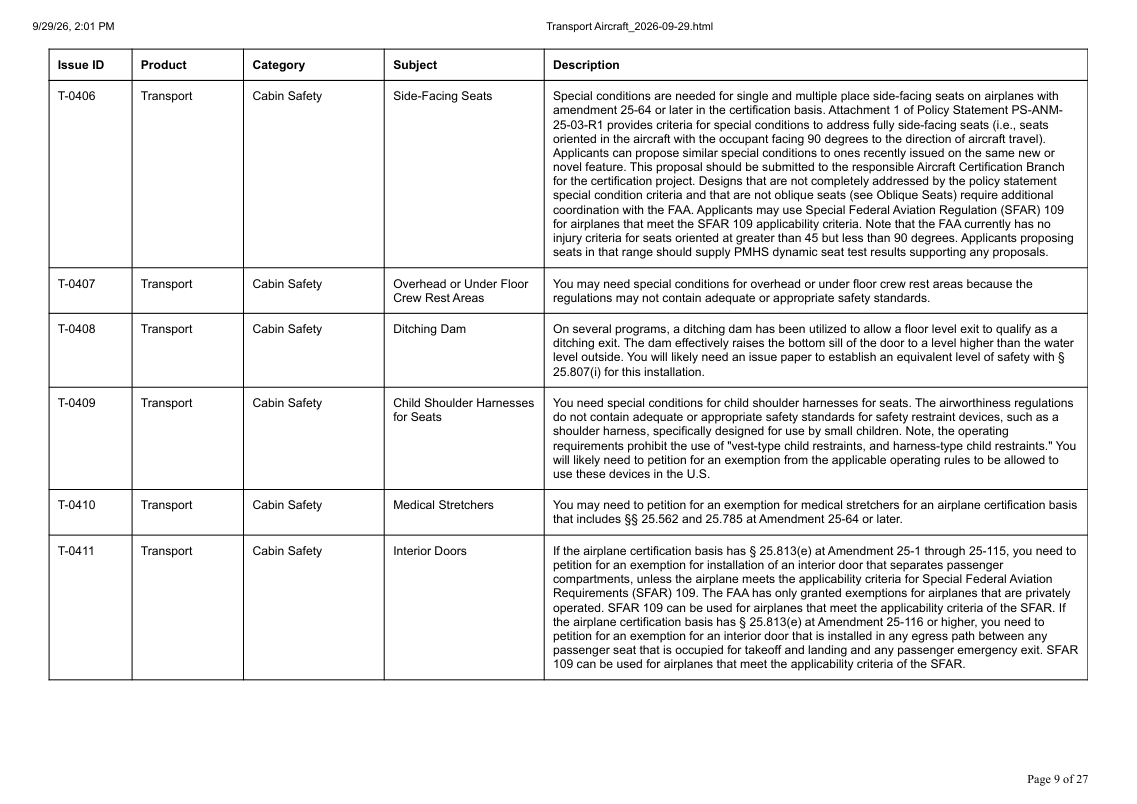
T-0406 Transport Cabin Safety Side-Facing Seats Special conditions are needed for single and multiple place side-facing seats on airplanes with amendment 25-64 or later in the certification basis. Attachment 1 of Policy Statement PS-ANM- 25-03-R1 provides criteria for special conditions to address fully side-facing seats (i.e., seats oriented in the aircraft with the occupant facing 90 degrees to the direction of aircraft travel). Applicants can propose similar special conditions to ones recently issued on the same new or novel feature. This proposal should be submitted to the responsible Aircraft Certification Branch for the certification project. Designs that are not completely addressed by the policy statement special condition criteria and that are not oblique seats (see Oblique Seats) require additional coordination with the FAA. Applicants may use Special Federal Aviation Regulation (SFAR) 109 for airplanes that meet the SFAR 109 applicability criteria. Note that the FAA currently has no injury criteria for seats oriented at greater than 45 but less than 90 degrees. Applicants proposing seats in that range should supply PMHS dynamic seat test results supporting any proposals.
T-0407 Transport Cabin Safety Overhead or Under Floor Crew Rest Areas
You may need special conditions for overhead or under floor crew rest areas because the regulations may not contain adequate or appropriate safety standards.
T-0408 Transport Cabin Safety Ditching Dam On several programs, a ditching dam has been utilized to allow a floor level exit to qualify as a ditching exit. The dam effectively raises the bottom sill of the door to a level higher than the water level outside. You will likely need an issue paper to establish an equivalent level of safety with § 25.807(i) for this installation.
T-0409 Transport Cabin Safety Child Shoulder Harnesses for Seats
You need special conditions for child shoulder harnesses for seats. The airworthiness regulations do not contain adequate or appropriate safety standards for safety restraint devices, such as a shoulder harness, specifically designed for use by small children. Note, the operating requirements prohibit the use of "vest-type child restraints, and harness-type child restraints." You will likely need to petition for an exemption from the applicable operating rules to be allowed to use these devices in the U.S.
T-0410 Transport Cabin Safety Medical Stretchers You may need to petition for an exemption for medical stretchers for an airplane certification basis that includes §§ 25.562 and 25.785 at Amendment 25-64 or later.
T-0411 Transport Cabin Safety Interior Doors If the airplane certification basis has § 25.813(e) at Amendment 25-1 through 25-115, you need to petition for an exemption for installation of an interior door that separates passenger compartments, unless the airplane meets the applicability criteria for Special Federal Aviation Requirements (SFAR) 109. The FAA has only granted exemptions for airplanes that are privately operated. SFAR 109 can be used for airplanes that meet the applicability criteria of the SFAR. If the airplane certification basis has § 25.813(e) at Amendment 25-116 or higher, you need to petition for an exemption for an interior door that is installed in any egress path between any passenger seat that is occupied for takeoff and landing and any passenger emergency exit. SFAR 109 can be used for airplanes that meet the applicability criteria of the SFAR.
View figures, tables and original page layout