FAA Small Airplanes Issues List
Small Airplanes Product Issues List
Q3 2026 · 30 September 2026 Source checked 2026-11-28
Scope, source and reading notes
Certification planning issues for domestic projects. Consult the applicable bilateral agreement for validation projects. Entries summarize issues and do not reproduce the underlying project issue papers. Public issue summaries only; complete project issue papers are not reproduced.
Aerospace Consulting reference note: Public certification topics that may require special conditions, agreed means of compliance or FAA coordination.
The complete selected publication is available in reading text and as the original PDF. Reading text is extracted from the official PDF; page layout is simplified, and figures and tables should be checked in the original page view. This is the FAA’s public summary of certification issues, not the full project issue papers.
Search covers extracted text. Words contained only in graphics may not be searchable. The original publication is available below.
Official source recordOriginal PDF on this siteSource: FAA. Reproduced with source acknowledgment; source edition and status are shown above. SHA-256: 62751f1b8c1bedde2c69ffaeb2a9164653f8b95bb1349c12e16e00532257ddcc
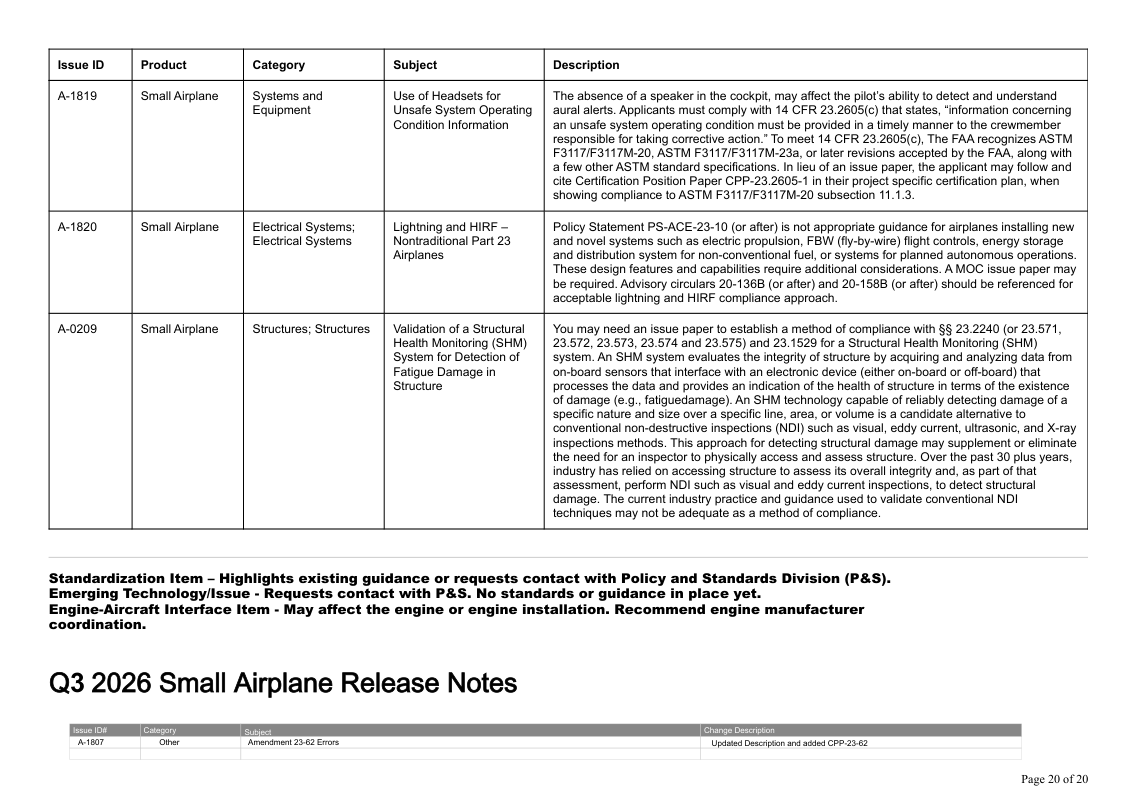
A-1819 Small Airplane Systems and Equipment
Use of Headsets for Unsafe System Operating Condition Information
The absence of a speaker in the cockpit, may affect the pilot’s ability to detect and understand aural alerts. Applicants must comply with 14 CFR 23.2605(c) that states, “information concerning an unsafe system operating condition must be provided in a timely manner to the crewmember responsible for taking corrective action.” To meet 14 CFR 23.2605(c), The FAA recognizes ASTM F3117/F3117M-20, ASTM F3117/F3117M-23a, or later revisions accepted by the FAA, along with a few other ASTM standard specifications. In lieu of an issue paper, the applicant may follow and cite Certification Position Paper CPP-23.2605-1 in their project specific certification plan, when showing compliance to ASTM F3117/F3117M-20 subsection 11.1.3.
A-1820 Small Airplane Electrical Systems; Electrical Systems
Lightning and HIRF – Nontraditional Part 23 Airplanes
Policy Statement PS-ACE-23-10 (or after) is not appropriate guidance for airplanes installing new and novel systems such as electric propulsion, FBW (fly-by-wire) flight controls, energy storage and distribution system for non-conventional fuel, or systems for planned autonomous operations. These design features and capabilities require additional considerations. A MOC issue paper may be required. Advisory circulars 20-136B (or after) and 20-158B (or after) should be referenced for acceptable lightning and HIRF compliance approach.
A-0209 Small Airplane Structures; Structures Validation of a Structural Health Monitoring (SHM) System for Detection of Fatigue Damage in Structure
You may need an issue paper to establish a method of compliance with §§ 23.2240 (or 23.571, 23.572, 23.573, 23.574 and 23.575) and 23.1529 for a Structural Health Monitoring (SHM) system. An SHM system evaluates the integrity of structure by acquiring and analyzing data from on-board sensors that interface with an electronic device (either on-board or off-board) that processes the data and provides an indication of the health of structure in terms of the existence of damage (e.g., fatiguedamage). An SHM technology capable of reliably detecting damage of a specific nature and size over a specific line, area, or volume is a candidate alternative to conventional non-destructive inspections (NDI) such as visual, eddy current, ultrasonic, and X-ray inspections methods. This approach for detecting structural damage may supplement or eliminate the need for an inspector to physically access and assess structure. Over the past 30 plus years, industry has relied on accessing structure to assess its overall integrity and, as part of that assessment, perform NDI such as visual and eddy current inspections, to detect structural damage. The current industry practice and guidance used to validate conventional NDI techniques may not be adequate as a method of compliance.
Standardization Item – Highlights existing guidance or requests contact with Policy and Standards Division (P&S). Emerging Technology/Issue - Requests contact with P&S. No standards or guidance in place yet. Engine-Aircraft Interface Item - May affect the engine or engine installation. Recommend engine manufacturer coordination.
Q3 2026 Small Airplane Release Notes
View figures, tables and original page layout