FAA Rotorcraft Issues List
Rotorcraft Product Issues List
Q3 2026 · 30 September 2026 Source checked 2026-11-28
Scope, source and reading notes
Certification planning issues for domestic projects. Consult the applicable bilateral agreement for validation projects. Entries summarize issues and do not reproduce the underlying project issue papers. Public issue summaries only; complete project issue papers are not reproduced.
Aerospace Consulting reference note: Public certification topics that may require special conditions, agreed means of compliance or FAA coordination.
The complete selected publication is available in reading text and as the original PDF. Reading text is extracted from the official PDF; page layout is simplified, and figures and tables should be checked in the original page view. This is the FAA’s public summary of certification issues, not the full project issue papers.
Search covers extracted text. Words contained only in graphics may not be searchable. The original publication is available below.
Official source recordOriginal PDF on this siteSource: FAA. Reproduced with source acknowledgment; source edition and status are shown above. SHA-256: a7493b2666179cc526f71c1d7119a1cea7e61a113a04957c96c4abe3fb7bd60f
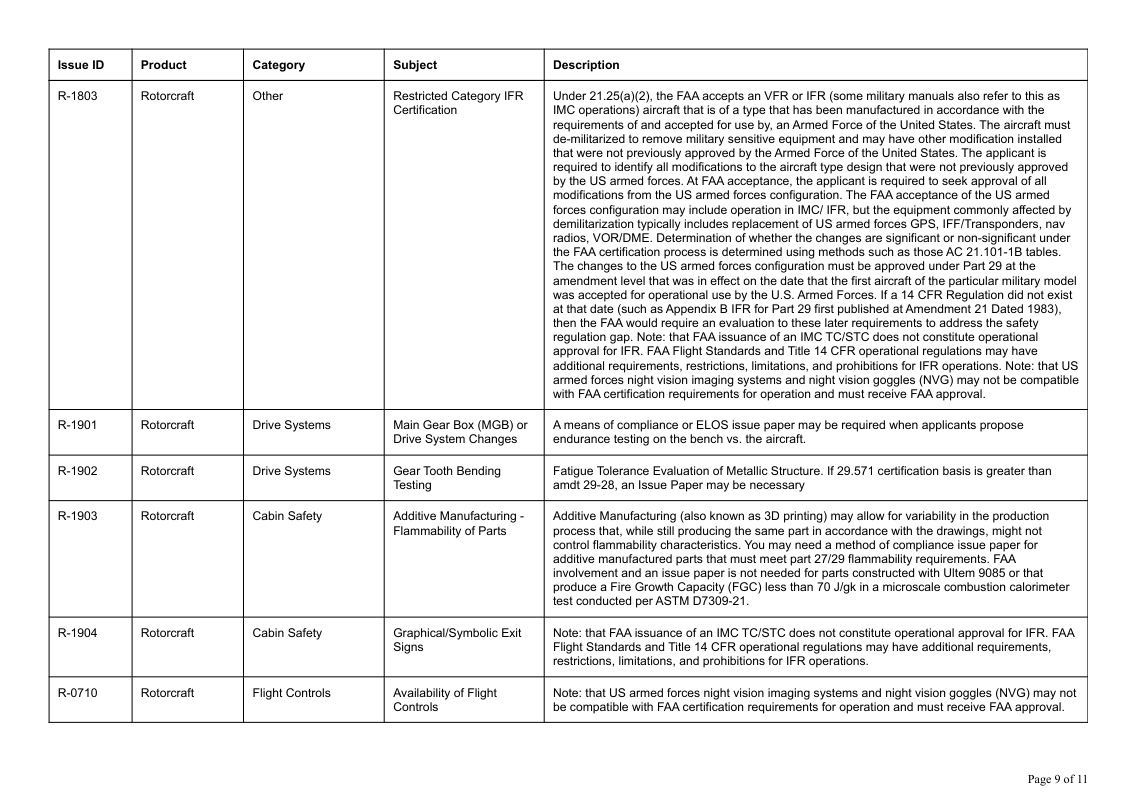
R-1803 Rotorcraft Other Restricted Category IFR Certification
Under 21.25(a)(2), the FAA accepts an VFR or IFR (some military manuals also refer to this as IMC operations) aircraft that is of a type that has been manufactured in accordance with the requirements of and accepted for use by, an Armed Force of the United States. The aircraft must de-militarized to remove military sensitive equipment and may have other modification installed that were not previously approved by the Armed Force of the United States. The applicant is required to identify all modifications to the aircraft type design that were not previously approved by the US armed forces. At FAA acceptance, the applicant is required to seek approval of all modifications from the US armed forces configuration. The FAA acceptance of the US armed forces configuration may include operation in IMC/ IFR, but the equipment commonly affected by demilitarization typically includes replacement of US armed forces GPS, IFF/Transponders, nav radios, VOR/DME. Determination of whether the changes are significant or non-significant under the FAA certification process is determined using methods such as those AC 21.101-1B tables. The changes to the US armed forces configuration must be approved under Part 29 at the amendment level that was in effect on the date that the first aircraft of the particular military model was accepted for operational use by the U.S. Armed Forces. If a 14 CFR Regulation did not exist at that date (such as Appendix B IFR for Part 29 first published at Amendment 21 Dated 1983), then the FAA would require an evaluation to these later requirements to address the safety regulation gap. Note: that FAA issuance of an IMC TC/STC does not constitute operational approval for IFR. FAA Flight Standards and Title 14 CFR operational regulations may have additional requirements, restrictions, limitations, and prohibitions for IFR operations. Note: that US armed forces night vision imaging systems and night vision goggles (NVG) may not be compatible with FAA certification requirements for operation and must receive FAA approval.
R-1901 Rotorcraft Drive Systems Main Gear Box (MGB) or Drive System Changes
A means of compliance or ELOS issue paper may be required when applicants propose endurance testing on the bench vs. the aircraft.
R-1902 Rotorcraft Drive Systems Gear Tooth Bending Testing
Fatigue Tolerance Evaluation of Metallic Structure. If 29.571 certification basis is greater than amdt 29-28, an Issue Paper may be necessary
R-1903 Rotorcraft Cabin Safety Additive Manufacturing - Flammability of Parts
Additive Manufacturing (also known as 3D printing) may allow for variability in the production process that, while still producing the same part in accordance with the drawings, might not control flammability characteristics. You may need a method of compliance issue paper for additive manufactured parts that must meet part 27/29 flammability requirements. FAA involvement and an issue paper is not needed for parts constructed with Ultem 9085 or that produce a Fire Growth Capacity (FGC) less than 70 J/gk in a microscale combustion calorimeter test conducted per ASTM D7309-21.
R-1904 Rotorcraft Cabin Safety Graphical/Symbolic Exit Signs
Note: that FAA issuance of an IMC TC/STC does not constitute operational approval for IFR. FAA Flight Standards and Title 14 CFR operational regulations may have additional requirements, restrictions, limitations, and prohibitions for IFR operations.
R-0710 Rotorcraft Flight Controls Availability of Flight Controls
Note: that US armed forces night vision imaging systems and night vision goggles (NVG) may not be compatible with FAA certification requirements for operation and must receive FAA approval.
View figures, tables and original page layout