FAA Rotorcraft Issues List
Rotorcraft Product Issues List
Q3 2026 · 30 September 2026 Source checked 2026-11-28
Scope, source and reading notes
Certification planning issues for domestic projects. Consult the applicable bilateral agreement for validation projects. Entries summarize issues and do not reproduce the underlying project issue papers. Public issue summaries only; complete project issue papers are not reproduced.
Aerospace Consulting reference note: Public certification topics that may require special conditions, agreed means of compliance or FAA coordination.
The complete selected publication is available in reading text and as the original PDF. Reading text is extracted from the official PDF; page layout is simplified, and figures and tables should be checked in the original page view. This is the FAA’s public summary of certification issues, not the full project issue papers.
Search covers extracted text. Words contained only in graphics may not be searchable. The original publication is available below.
Official source recordOriginal PDF on this siteSource: FAA. Reproduced with source acknowledgment; source edition and status are shown above. SHA-256: a7493b2666179cc526f71c1d7119a1cea7e61a113a04957c96c4abe3fb7bd60f
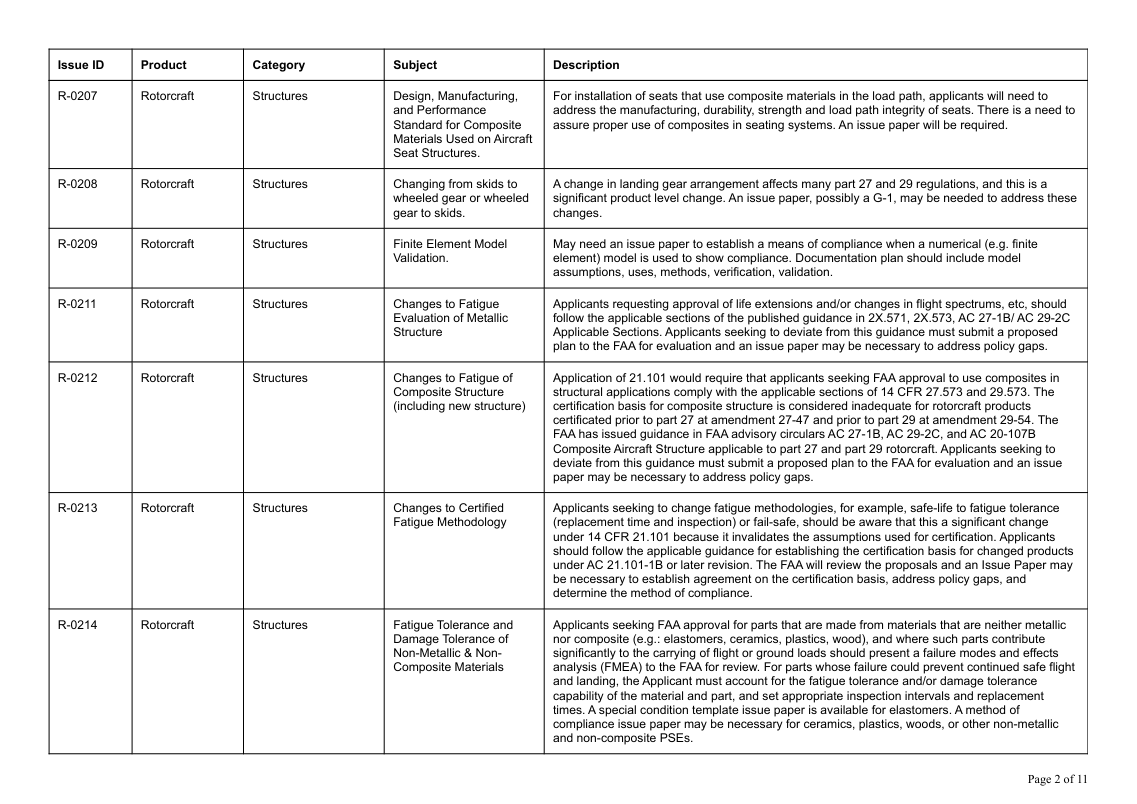
For installation of seats that use composite materials in the load path, applicants will need to address the manufacturing, durability, strength and load path integrity of seats. There is a need to assure proper use of composites in seating systems. An issue paper will be required.
R-0207 Rotorcraft Structures Design, Manufacturing, and Performance Standard for Composite Materials Used on Aircraft Seat Structures.
R-0208 Rotorcraft Structures Changing from skids to wheeled gear or wheeled gear to skids.
A change in landing gear arrangement affects many part 27 and 29 regulations, and this is a significant product level change. An issue paper, possibly a G-1, may be needed to address these changes.
R-0209 Rotorcraft Structures Finite Element Model Validation.
May need an issue paper to establish a means of compliance when a numerical (e.g. finite element) model is used to show compliance. Documentation plan should include model assumptions, uses, methods, verification, validation.
R-0211 Rotorcraft Structures Changes to Fatigue Evaluation of Metallic Structure
Applicants requesting approval of life extensions and/or changes in flight spectrums, etc, should follow the applicable sections of the published guidance in 2X.571, 2X.573, AC 27-1B/ AC 29-2C Applicable Sections. Applicants seeking to deviate from this guidance must submit a proposed plan to the FAA for evaluation and an issue paper may be necessary to address policy gaps.
R-0212 Rotorcraft Structures Changes to Fatigue of Composite Structure (including new structure)
Application of 21.101 would require that applicants seeking FAA approval to use composites in structural applications comply with the applicable sections of 14 CFR 27.573 and 29.573. The certification basis for composite structure is considered inadequate for rotorcraft products certificated prior to part 27 at amendment 27-47 and prior to part 29 at amendment 29-54. The FAA has issued guidance in FAA advisory circulars AC 27-1B, AC 29-2C, and AC 20-107B Composite Aircraft Structure applicable to part 27 and part 29 rotorcraft. Applicants seeking to deviate from this guidance must submit a proposed plan to the FAA for evaluation and an issue paper may be necessary to address policy gaps.
R-0213 Rotorcraft Structures Changes to Certified Fatigue Methodology
Applicants seeking to change fatigue methodologies, for example, safe-life to fatigue tolerance (replacement time and inspection) or fail-safe, should be aware that this a significant change under 14 CFR 21.101 because it invalidates the assumptions used for certification. Applicants should follow the applicable guidance for establishing the certification basis for changed products under AC 21.101-1B or later revision. The FAA will review the proposals and an Issue Paper may be necessary to establish agreement on the certification basis, address policy gaps, and determine the method of compliance.
R-0214 Rotorcraft Structures Fatigue Tolerance and Damage Tolerance of Non-Metallic & Non- Composite Materials
Applicants seeking FAA approval for parts that are made from materials that are neither metallic nor composite (e.g.: elastomers, ceramics, plastics, wood), and where such parts contribute significantly to the carrying of flight or ground loads should present a failure modes and effects analysis (FMEA) to the FAA for review. For parts whose failure could prevent continued safe flight and landing, the Applicant must account for the fatigue tolerance and/or damage tolerance capability of the material and part, and set appropriate inspection intervals and replacement times. A special condition template issue paper is available for elastomers. A method of compliance issue paper may be necessary for ceramics, plastics, woods, or other non-metallic and non-composite PSEs.
View figures, tables and original page layout