FAA Rotorcraft Issues List
Rotorcraft Product Issues List
Q3 2026 · 30 September 2026 Source checked 2026-11-28
Scope, source and reading notes
Certification planning issues for domestic projects. Consult the applicable bilateral agreement for validation projects. Entries summarize issues and do not reproduce the underlying project issue papers. Public issue summaries only; complete project issue papers are not reproduced.
Aerospace Consulting reference note: Public certification topics that may require special conditions, agreed means of compliance or FAA coordination.
The complete selected publication is available in reading text and as the original PDF. Reading text is extracted from the official PDF; page layout is simplified, and figures and tables should be checked in the original page view. This is the FAA’s public summary of certification issues, not the full project issue papers.
Search covers extracted text. Words contained only in graphics may not be searchable. The original publication is available below.
Official source recordOriginal PDF on this siteSource: FAA. Reproduced with source acknowledgment; source edition and status are shown above. SHA-256: a7493b2666179cc526f71c1d7119a1cea7e61a113a04957c96c4abe3fb7bd60f
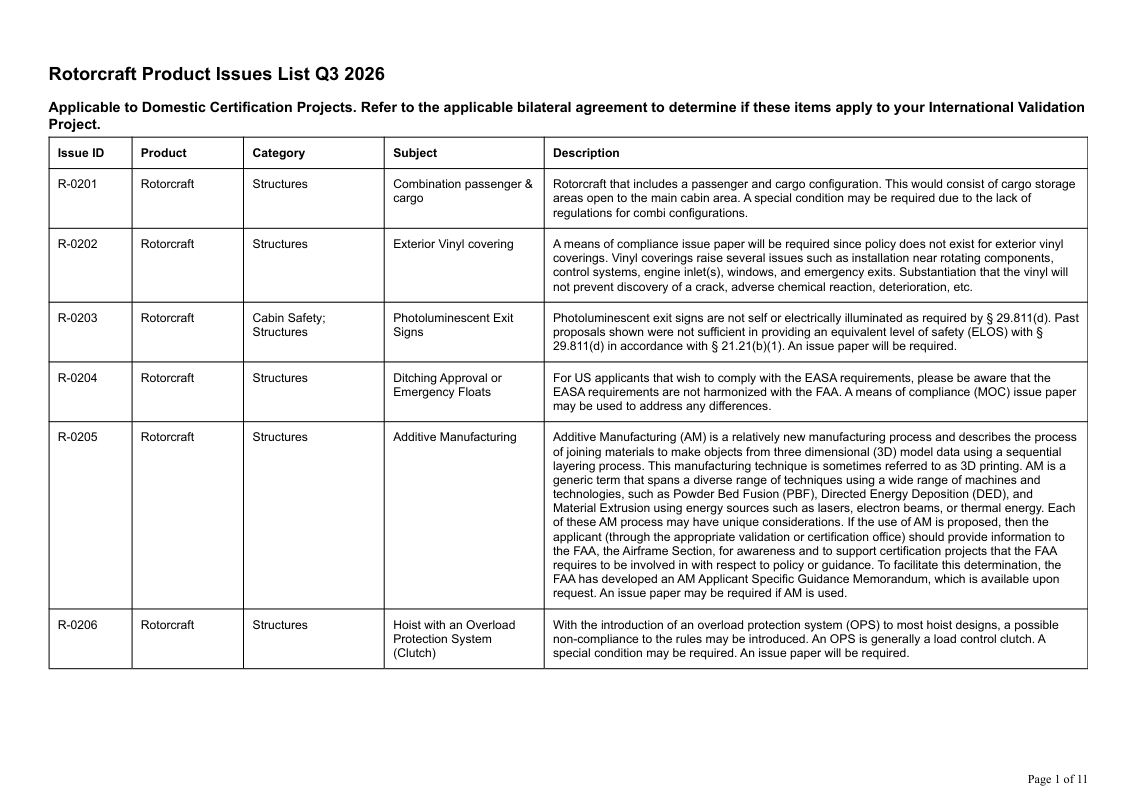
Rotorcraft Product Issues List Q3 2026
Applicable to Domestic Certification Projects. Refer to the applicable bilateral agreement to determine if these items apply to your International Validation Project.
Issue ID Product Category Subject Description
R-0201 Rotorcraft Structures Combination passenger & cargo
Rotorcraft that includes a passenger and cargo configuration. This would consist of cargo storage areas open to the main cabin area. A special condition may be required due to the lack of regulations for combi configurations.
R-0202 Rotorcraft Structures Exterior Vinyl covering A means of compliance issue paper will be required since policy does not exist for exterior vinyl coverings. Vinyl coverings raise several issues such as installation near rotating components, control systems, engine inlet(s), windows, and emergency exits. Substantiation that the vinyl will not prevent discovery of a crack, adverse chemical reaction, deterioration, etc.
R-0203 Rotorcraft Cabin Safety; Structures
Photoluminescent Exit Signs
Photoluminescent exit signs are not self or electrically illuminated as required by § 29.811(d). Past proposals shown were not sufficient in providing an equivalent level of safety (ELOS) with § 29.811(d) in accordance with § 21.21(b)(1). An issue paper will be required.
R-0204 Rotorcraft Structures Ditching Approval or Emergency Floats
For US applicants that wish to comply with the EASA requirements, please be aware that the EASA requirements are not harmonized with the FAA. A means of compliance (MOC) issue paper may be used to address any differences.
R-0205 Rotorcraft Structures Additive Manufacturing Additive Manufacturing (AM) is a relatively new manufacturing process and describes the process of joining materials to make objects from three dimensional (3D) model data using a sequential layering process. This manufacturing technique is sometimes referred to as 3D printing. AM is a generic term that spans a diverse range of techniques using a wide range of machines and technologies, such as Powder Bed Fusion (PBF), Directed Energy Deposition (DED), and Material Extrusion using energy sources such as lasers, electron beams, or thermal energy. Each of these AM process may have unique considerations. If the use of AM is proposed, then the applicant (through the appropriate validation or certification office) should provide information to the FAA, the Airframe Section, for awareness and to support certification projects that the FAA requires to be involved in with respect to policy or guidance. To facilitate this determination, the FAA has developed an AM Applicant Specific Guidance Memorandum, which is available upon request. An issue paper may be required if AM is used.
R-0206 Rotorcraft Structures Hoist with an Overload Protection System (Clutch)
With the introduction of an overload protection system (OPS) to most hoist designs, a possible non-compliance to the rules may be introduced. An OPS is generally a load control clutch. A special condition may be required. An issue paper will be required.
View figures, tables and original page layout