
AC 25.1329-1C
Approval of Flight Guidance Systems
25.1329-1C — Changes 1–2 incorporated (2026-02-13) Source checked 2026-11-28
Scope, source and reading notes
Flight-guidance-system compliance under § 25.1329 for transport category airplanes; includes autopilots, flight directors, automatic thrust control, and associated interactions. Base publication catalog date: 2014-10-27; latest included change: 2026-02-13.
Aerospace Consulting reference note: Guidance for flight-guidance design and approval, incorporating Changes 1 and 2, including 2026 clarifications concerning disengagement alerts, override hazards, and incompatible modes.
The complete selected publication is available in reading text and as the original PDF. Reading text is extracted from the official PDF; page layout is simplified, and figures and tables should be checked in the original page view.
Search covers extracted text. Words contained only in graphics may not be searchable. The original publication is available below.
Official source recordOriginal PDF on this siteSource: FAA. Reproduced with source acknowledgment; source edition and status are shown above. SHA-256: d1122e89d61663cc44456dd1ebff460127469027d8d667b0fd695bc8436357e0
AC 25.1329 1C CHG 2 Appendix B
Term
Definition
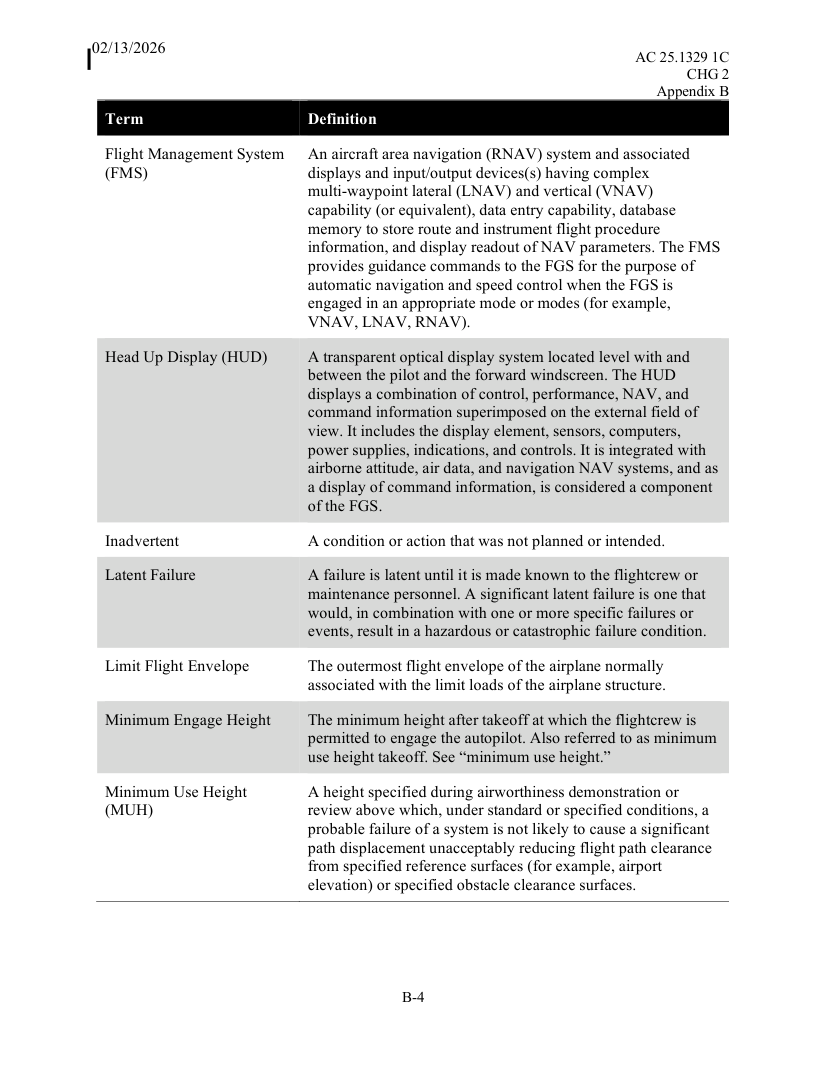
Flight Management System An aircraft area navigation (RNAV) system and associated (FMS) displays and input/output devices(s) having complex multi-waypoint lateral (LNAV) and vertical (VNAV) capability (or equivalent), data entry capability, database memory to store route and instrument flight procedure information, and display readout of NAV parameters. The FMS provides guidance commands to the FGS for the purpose of automatic navigation and speed control when the FGS is engaged in an appropriate mode or modes (for example, VNAV, LNAV, RNAV).
Head Up Display (HUD) A transparent optical display system located level with and between the pilot and the forward windscreen. The HUD displays a combination of control, performance, NAV, and command information superimposed on the external field of view. It includes the display element, sensors, computers, power supplies, indications, and controls. It is integrated with airborne attitude, air data, and navigation NAV systems, and as a display of command information, is considered a component of the FGS.
Inadvertent A condition or action that was not planned or intended.
Latent Failure A failure is latent until it is made known to the flightcrew or maintenance personnel. A significant latent failure is one that would, in combination with one or more specific failures or events, result in a hazardous or catastrophic failure condition.
Limit Flight Envelope The outermost flight envelope of the airplane normally associated with the limit loads of the airplane structure.
Minimum Engage Height The minimum height after takeoff at which the flightcrew is permitted to engage the autopilot. Also referred to as minimum use height takeoff. See “minimum use height.”
Minimum Use Height A height specified during airworthiness demonstration or (MUH) review above which, under standard or specified conditions, a probable failure of a system is not likely to cause a significant path displacement unacceptably reducing flight path clearance from specified reference surfaces (for example, airport elevation) or specified obstacle clearance surfaces.
View figures, tables and original page layout
Connected references
Source-backed citations and subject-based engineering context are labelled separately. These links do not establish equivalence or project acceptance.
Related technical context
Engineering contextEvidence and scope
AC 25.671-1 and AC 25.1329-1C — published scope
Aerospace Consulting navigation suggestion based on the subject and stated scope of the two publications.
This connection does not establish regulatory equivalence, acceptance of a newer edition, or applicability of a project-specific precedent to another programme.
Supporting source