
AC 25.1329-1C
Approval of Flight Guidance Systems
25.1329-1C — Changes 1–2 incorporated (2026-02-13) Source checked 2026-11-28
Scope, source and reading notes
Flight-guidance-system compliance under § 25.1329 for transport category airplanes; includes autopilots, flight directors, automatic thrust control, and associated interactions. Base publication catalog date: 2014-10-27; latest included change: 2026-02-13.
Aerospace Consulting reference note: Guidance for flight-guidance design and approval, incorporating Changes 1 and 2, including 2026 clarifications concerning disengagement alerts, override hazards, and incompatible modes.
The complete selected publication is available in reading text and as the original PDF. Reading text is extracted from the official PDF; page layout is simplified, and figures and tables should be checked in the original page view.
Search covers extracted text. Words contained only in graphics may not be searchable. The original publication is available below.
Official source recordOriginal PDF on this siteSource: FAA. Reproduced with source acknowledgment; source edition and status are shown above. SHA-256: d1122e89d61663cc44456dd1ebff460127469027d8d667b0fd695bc8436357e0
10/27/14 AC 25.1329-1C Appendix B
Term
Definition
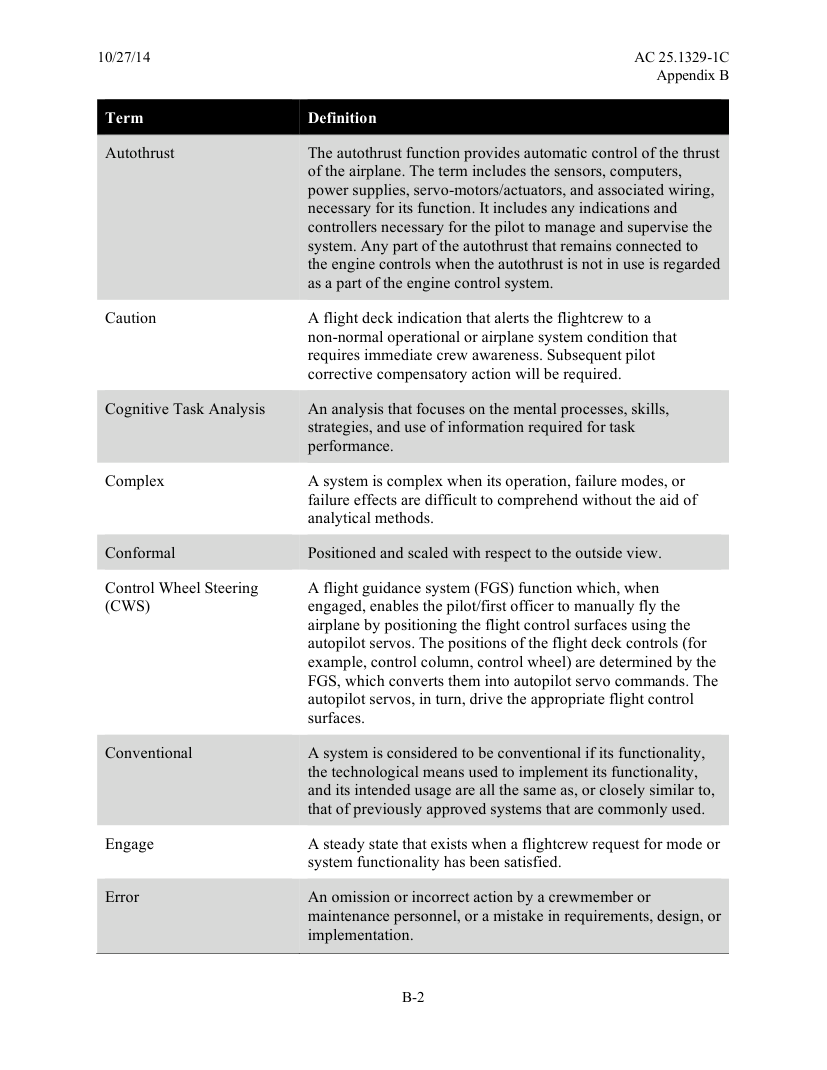
Autothrust The autothrust function provides automatic control of the thrust of the airplane. The term includes the sensors, computers, power supplies, servo-motors/actuators, and associated wiring, necessary for its function. It includes any indications and controllers necessary for the pilot to manage and supervise the system. Any part of the autothrust that remains connected to the engine controls when the autothrust is not in use is regarded as a part of the engine control system.
Caution A flight deck indication that alerts the flightcrew to a non-normal operational or airplane system condition that requires immediate crew awareness. Subsequent pilot corrective compensatory action will be required.
Cognitive Task Analysis An analysis that focuses on the mental processes, skills, strategies, and use of information required for task performance.
Complex A system is complex when its operation, failure modes, or failure effects are difficult to comprehend without the aid of analytical methods.
Conformal Positioned and scaled with respect to the outside view.
Control Wheel Steering A flight guidance system (FGS) function which, when (CWS) engaged, enables the pilot/first officer to manually fly the airplane by positioning the flight control surfaces using the autopilot servos. The positions of the flight deck controls (for example, control column, control wheel) are determined by the FGS, which converts them into autopilot servo commands. The autopilot servos, in turn, drive the appropriate flight control surfaces.
Conventional A system is considered to be conventional if its functionality, the technological means used to implement its functionality, and its intended usage are all the same as, or closely similar to, that of previously approved systems that are commonly used.
Engage A steady state that exists when a flightcrew request for mode or system functionality has been satisfied.
Error An omission or incorrect action by a crewmember or maintenance personnel, or a mistake in requirements, design, or implementation.
View figures, tables and original page layout
Connected references
Source-backed citations and subject-based engineering context are labelled separately. These links do not establish equivalence or project acceptance.
Related technical context
Engineering contextEvidence and scope
AC 25.671-1 and AC 25.1329-1C — published scope
Aerospace Consulting navigation suggestion based on the subject and stated scope of the two publications.
This connection does not establish regulatory equivalence, acceptance of a newer edition, or applicability of a project-specific precedent to another programme.
Supporting source