Appendix A gives an acceptable means for certain powered-lift under §21.17(b). These criteria are not universally applicable CFR requirements; establish the basis for the particular aircraft.
The source, within reach.
Search within this AC, jump to a source page, or download the complete saved publication.
This extraction supports search. Read the original page for complete notation and layout.
07/18/2025                                               AC 21.17-4
                                                                        Appendix A

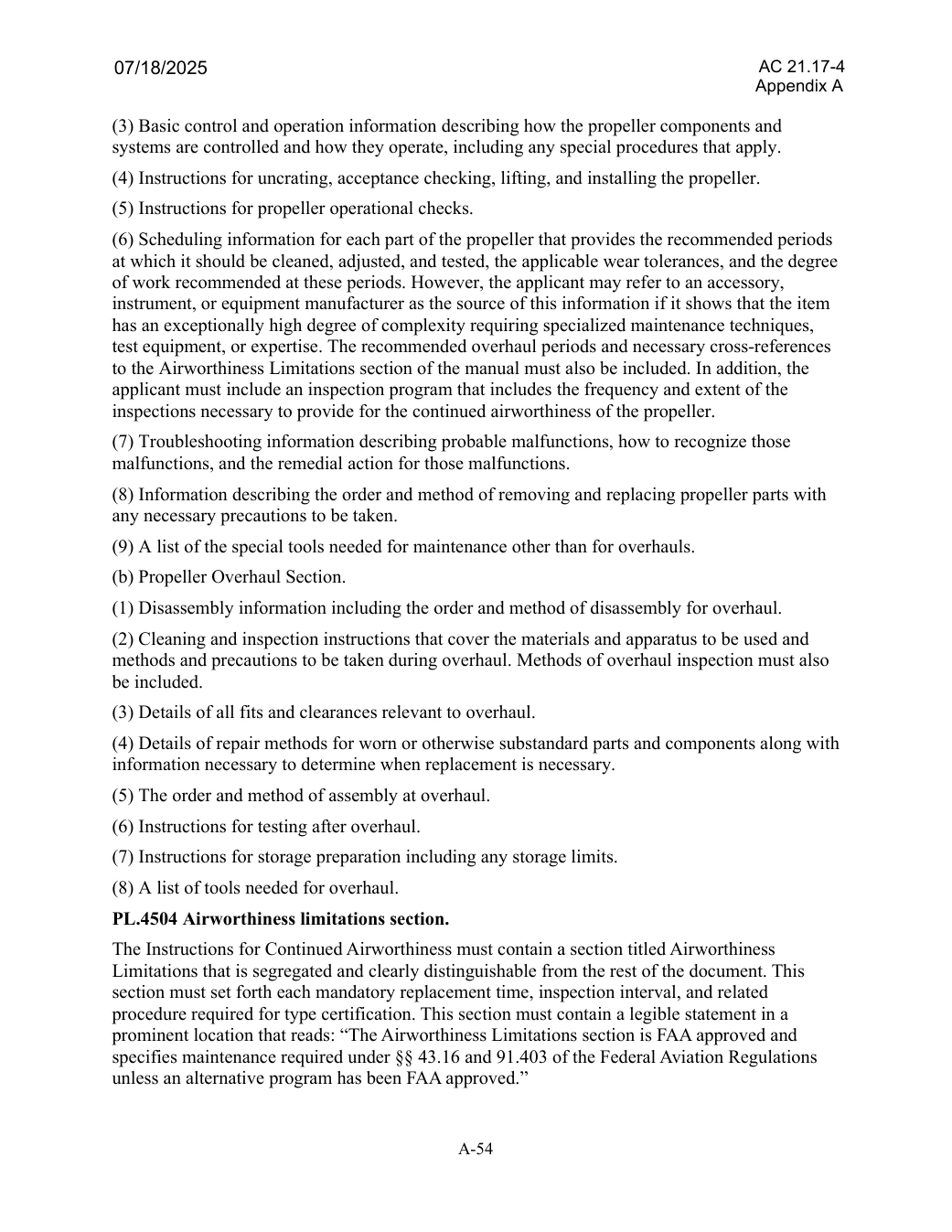
(3) Basic control and operation information describing how the propeller components and
systems are controlled and how they operate, including any special procedures that apply.
(4) Instructions for uncrating, acceptance checking, lifting, and installing the propeller.
(5) Instructions for propeller operational checks.
(6) Scheduling information for each part of the propeller that provides the recommended periods
at which it should be cleaned, adjusted, and tested, the applicable wear tolerances, and the degree
of work recommended at these periods. However, the applicant may refer to an accessory,
instrument, or equipment manufacturer as the source of this information if it shows that the item
has an exceptionally high degree of complexity requiring specialized maintenance techniques,
test equipment, or expertise. The recommended overhaul periods and necessary cross-references
to the Airworthiness Limitations section of the manual must also be included. In addition, the
applicant must include an inspection program that includes the frequency and extent of the
inspections necessary to provide for the continued airworthiness of the propeller.
(7) Troubleshooting information describing probable malfunctions, how to recognize those
malfunctions, and the remedial action for those malfunctions.
(8) Information describing the order and method of removing and replacing propeller parts with
any necessary precautions to be taken.
(9) A list of the special tools needed for maintenance other than for overhauls.
(b) Propeller Overhaul Section.
(1) Disassembly information including the order and method of disassembly for overhaul.
(2) Cleaning and inspection instructions that cover the materials and apparatus to be used and
methods and precautions to be taken during overhaul. Methods of overhaul inspection must also
be included.
(3) Details of all fits and clearances relevant to overhaul.
(4) Details of repair methods for worn or otherwise substandard parts and components along with
information necessary to determine when replacement is necessary.
(5) The order and method of assembly at overhaul.
(6) Instructions for testing after overhaul.
(7) Instructions for storage preparation including any storage limits.
(8) A list of tools needed for overhaul.
PL.4504 Airworthiness limitations section.
The Instructions for Continued Airworthiness must contain a section titled Airworthiness
Limitations that is segregated and clearly distinguishable from the rest of the document. This
section must set forth each mandatory replacement time, inspection interval, and related
procedure required for type certification. This section must contain a legible statement in a
prominent location that reads: “The Airworthiness Limitations section is FAA approved and
specifies maintenance required under §§ 43.16 and 91.403 of the Federal Aviation Regulations
unless an alternative program has been FAA approved.”


                                       A-54
Saved from the FAA on November 17, 2026. All original pages are retained. Engineering explanations are presented separately below.
Aerospace Consulting / Engineering perspective
Begin with the aircraft and the agreed basis.
Connect the operating concept, aircraft-level failure effects, system architecture and assurance planning. Keep FAA powered-lift criteria and EASA SC-VTOL provisions distinct when developing the safety and certification approach.
A focused review, an agreed assessment package or ongoing support alongside your team. We can agree the relevant inputs and scope in the initial conversation.
This opens your email application.
Start a conversation
Tell us about your programme, the system you are developing and the support you need.
We can agree a focused use-case review, a defined evidence package or ongoing programme support.
This opens your email application.
Specialist aerospace expertise
Aerospace Consulting is led by Hussein Khimji, an FAA Designated Engineering Representative in systems and equipment, with a focus on system safety, flight controls and avionics.
We work with aircraft developers and systems suppliers to connect technical decisions, safety assessments and certification evidence.
This is the proposed introduction. The full About page will add your approved biography and associate expertise.
Systems engineering & development assurance
Tell us about the aircraft or system, its intended function, stage of development and the support you need.