
AC 25.1329-1C
Approval of Flight Guidance Systems
25.1329-1C — Changes 1–2 incorporated (2026-02-13) Source checked 2026-11-28
Scope, source and reading notes
Flight-guidance-system compliance under § 25.1329 for transport category airplanes; includes autopilots, flight directors, automatic thrust control, and associated interactions. Base publication catalog date: 2014-10-27; latest included change: 2026-02-13.
Aerospace Consulting reference note: Guidance for flight-guidance design and approval, incorporating Changes 1 and 2, including 2026 clarifications concerning disengagement alerts, override hazards, and incompatible modes.
The complete selected publication is available in reading text and as the original PDF. Reading text is extracted from the official PDF; page layout is simplified, and figures and tables should be checked in the original page view.
Search covers extracted text. Words contained only in graphics may not be searchable. The original publication is available below.
Official source recordOriginal PDF on this siteSource: FAA. Reproduced with source acknowledgment; source edition and status are shown above. SHA-256: d1122e89d61663cc44456dd1ebff460127469027d8d667b0fd695bc8436357e0
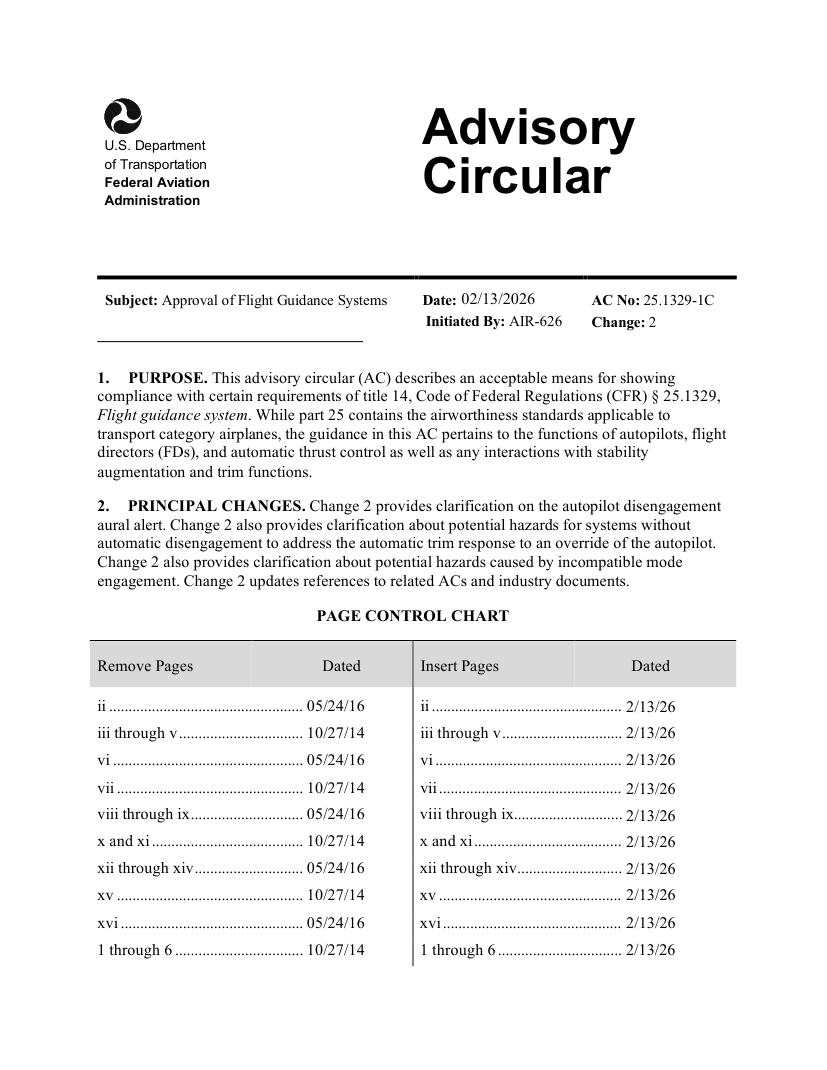
U.S. Department of Transportation Federal Aviation Administration
Advisory Circular
02/13/2026
Subject: Approval of Flight Guidance Systems Date: AC No: 25.1329-1C Initiated By: AIR-626 Change: 2
1. PURPOSE. This advisory circular (AC) describes an acceptable means for showing compliance with certain requirements of title 14, Code of Federal Regulations (CFR) § 25.1329, Flight guidance system. While part 25 contains the airworthiness standards applicable to transport category airplanes, the guidance in this AC pertains to the functions of autopilots, flight directors (FDs), and automatic thrust control as well as any interactions with stability augmentation and trim functions.
2. PRINCIPAL CHANGES. Change 2 provides clarification on the autopilot disengagement aural alert. Change 2 also provides clarification about potential hazards for systems without automatic disengagement to address the automatic trim response to an override of the autopilot. Change 2 also provides clarification about potential hazards caused by incompatible mode engagement. Change 2 updates references to related ACs and industry documents.
PAGE CONTROL CHART
Remove Pages Dated Insert Pages Dated
ii .................................................. 05/24/16 ii .................................................
2/13/26
iii through v ................................ 10/27/14 iii through v ...............................
2/13/26
vi ................................................. 05/24/16 vi ................................................
2/13/26
vii ................................................ 10/27/14 vii ...............................................
2/13/26
viii through ix ............................. 05/24/16 viii through ix............................
2/13/26
x and xi ....................................... 10/27/14 x and xi ......................................
2/13/26
xii through xiv ............................ 05/24/16 xii through xiv ...........................
2/13/26
xv ................................................ 10/27/14 xv ...............................................
2/13/26
xvi ............................................... 05/24/16 xvi ..............................................
2/13/26
1 through 6 ................................. 10/27/14 1 through 6 ................................
2/13/26
View figures, tables and original page layout
Connected references
Source-backed citations and subject-based engineering context are labelled separately. These links do not establish equivalence or project acceptance.
Related technical context
Engineering contextEvidence and scope
AC 25.671-1 and AC 25.1329-1C — published scope
Aerospace Consulting navigation suggestion based on the subject and stated scope of the two publications.
This connection does not establish regulatory equivalence, acceptance of a newer edition, or applicability of a project-specific precedent to another programme.
Supporting source