This AC recognises DO-178C/ED-12C, DO-330/ED-215 and the model-based, object-oriented and formal-methods supplements. Apply the relevant provisions to the software and certification context.
The source, within reach.
Search within this AC, jump to a source page, or download the complete saved publication.
This extraction supports search. Read the original page for complete notation and layout.
7/21/17                                                AC 20-115D


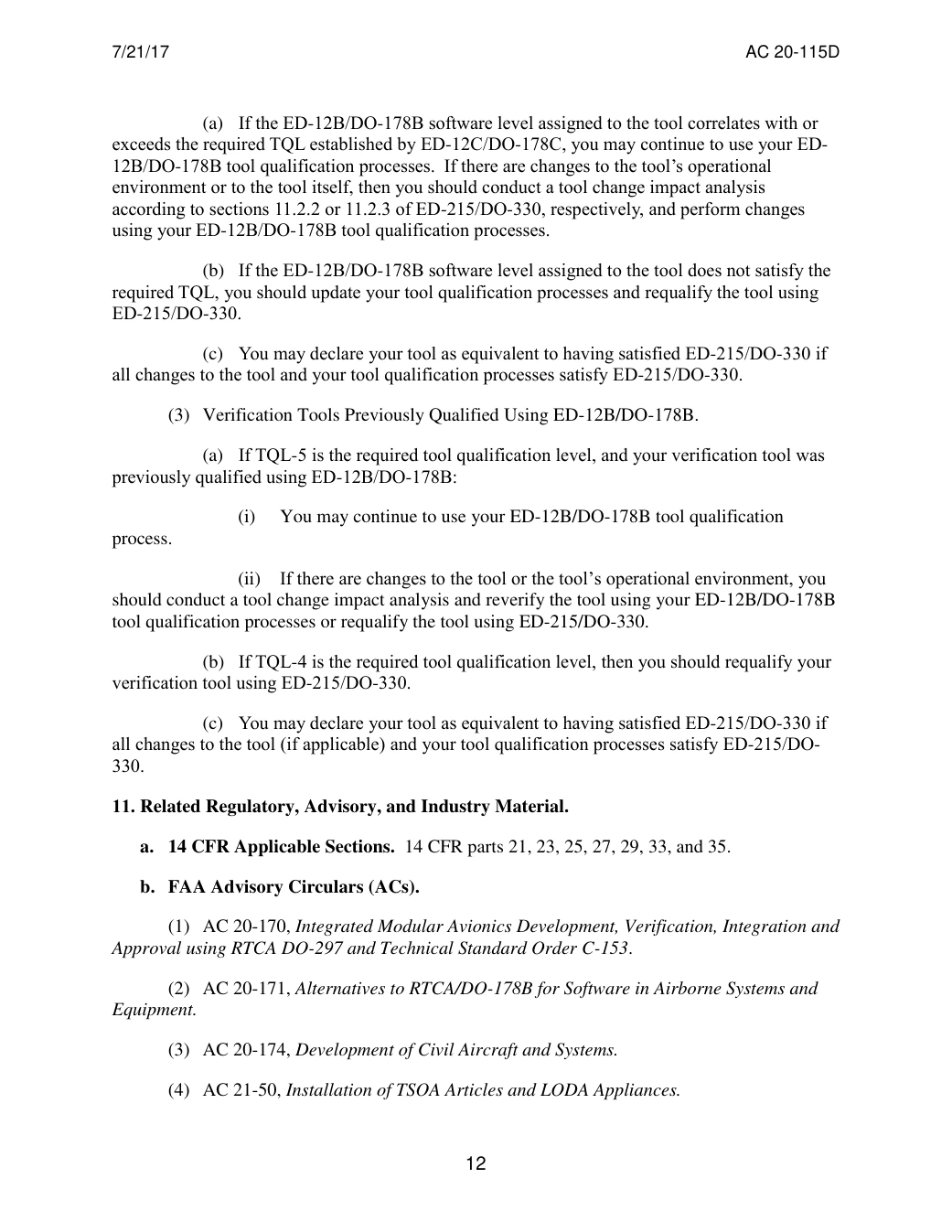
             (a)   If the ED-12B/DO-178B software level assigned to the tool correlates with or
exceeds the required TQL established by ED-12C/DO-178C, you may continue to use your ED-
12B/DO-178B tool qualification processes. If there are changes to the tool’s operational
environment or to the tool itself, then you should conduct a tool change impact analysis
according to sections 11.2.2 or 11.2.3 of ED-215/DO-330, respectively, and perform changes
using your ED-12B/DO-178B tool qualification processes.

             (b)  If the ED-12B/DO-178B software level assigned to the tool does not satisfy the
required TQL, you should update your tool qualification processes and requalify the tool using
ED-215/DO-330.

             (c)  You may declare your tool as equivalent to having satisfied ED-215/DO-330 if
all changes to the tool and your tool qualification processes satisfy ED-215/DO-330.

        (3)  Verification Tools Previously Qualified Using ED-12B/DO-178B.

             (a)   If TQL-5 is the required tool qualification level, and your verification tool was
previously qualified using ED-12B/DO-178B:

                     (i)  You may continue to use your ED-12B/DO-178B tool qualification
process.

                      (ii)   If there are changes to the tool or the tool’s operational environment, you
should conduct a tool change impact analysis and reverify the tool using your ED-12B/DO-178B
tool qualification processes or requalify the tool using ED-215/DO-330.

             (b)  If TQL-4 is the required tool qualification level, then you should requalify your
verification tool using ED-215/DO-330.

             (c)  You may declare your tool as equivalent to having satisfied ED-215/DO-330 if
all changes to the tool (if applicable) and your tool qualification processes satisfy ED-215/DO-
330.

11. Related Regulatory, Advisory, and Industry Material.

    a. 14 CFR Applicable Sections. 14 CFR parts 21, 23, 25, 27, 29, 33, and 35.

    b. FAA Advisory Circulars (ACs).

        (1) AC 20-170, Integrated Modular Avionics Development, Verification, Integration and
Approval using RTCA DO-297 and Technical Standard Order C-153.

        (2) AC 20-171, Alternatives to RTCA/DO-178B for Software in Airborne Systems and
Equipment.

        (3) AC 20-174, Development of Civil Aircraft and Systems.

        (4) AC 21-50, Installation of TSOA Articles and LODA Appliances.


                                  12
Saved from the FAA on November 17, 2026. All original pages are retained. Engineering explanations are presented separately below.
Aerospace Consulting / Engineering perspective
Keep software assurance connected to the system.
Make the software level, allocated requirements, interface assumptions and verification responsibilities explicit. Plan the evidence and review points early, and trace changes back to the system safety and certification assumptions.
A focused review, an agreed assessment package or ongoing support alongside your team. We can agree the relevant inputs and scope in the initial conversation.
This opens your email application.
Start a conversation
Tell us about your programme, the system you are developing and the support you need.
We can agree a focused use-case review, a defined evidence package or ongoing programme support.
This opens your email application.
Specialist aerospace expertise
Aerospace Consulting is led by Hussein Khimji, an FAA Designated Engineering Representative in systems and equipment, with a focus on system safety, flight controls and avionics.
We work with aircraft developers and systems suppliers to connect technical decisions, safety assessments and certification evidence.
This is the proposed introduction. The full About page will add your approved biography and associate expertise.
Systems engineering & development assurance
Tell us about the aircraft or system, its intended function, stage of development and the support you need.