This AC recognises DO-178C/ED-12C, DO-330/ED-215 and the model-based, object-oriented and formal-methods supplements. Apply the relevant provisions to the software and certification context.
The source, within reach.
Search within this AC, jump to a source page, or download the complete saved publication.
This extraction supports search. Read the original page for complete notation and layout.
7/21/17                                                AC 20-115D


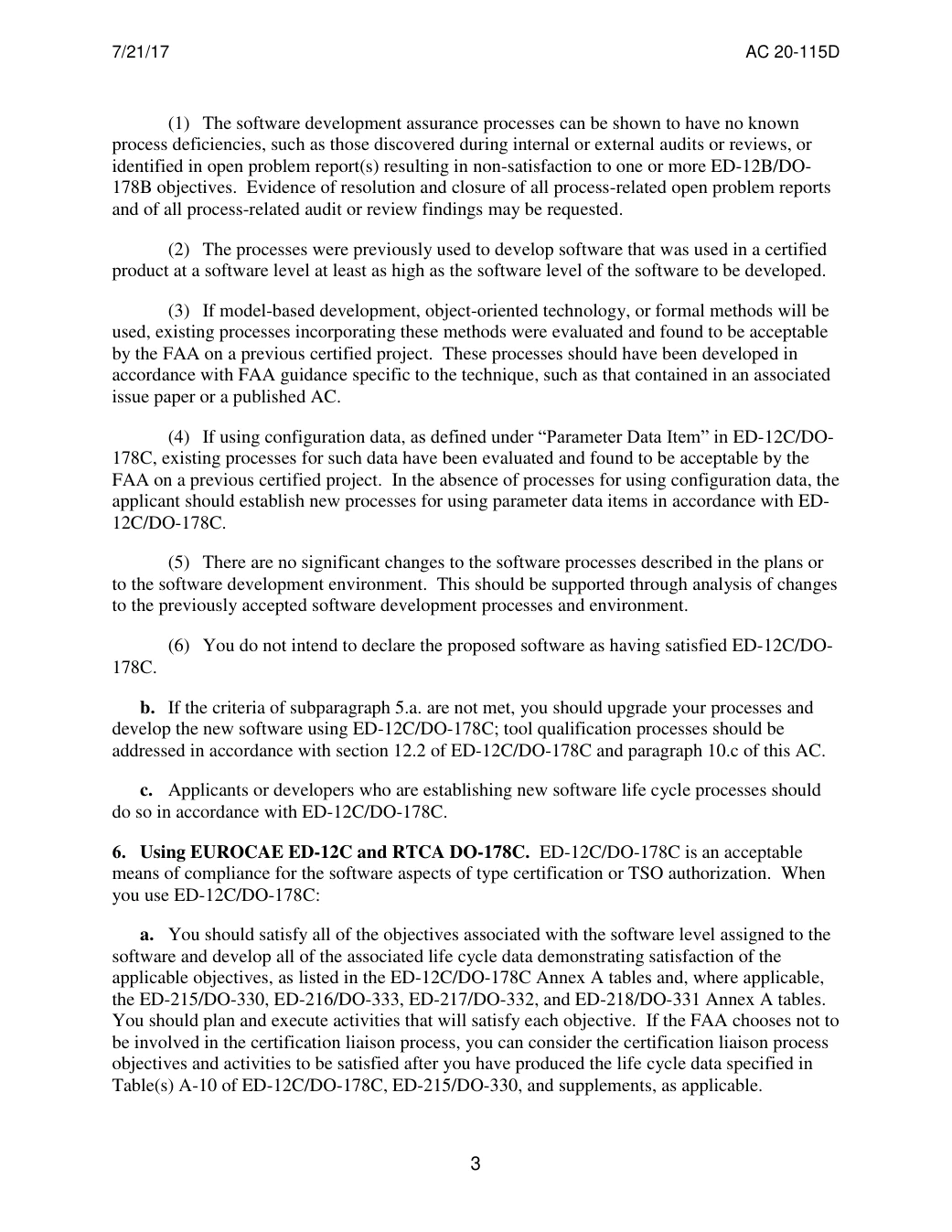
        (1) The software development assurance processes can be shown to have no known
process deficiencies, such as those discovered during internal or external audits or reviews, or
identified in open problem report(s) resulting in non-satisfaction to one or more ED-12B/DO-
178B objectives. Evidence of resolution and closure of all process-related open problem reports
and of all process-related audit or review findings may be requested.

        (2) The processes were previously used to develop software that was used in a certified
product at a software level at least as high as the software level of the software to be developed.

        (3)  If model-based development, object-oriented technology, or formal methods will be
used, existing processes incorporating these methods were evaluated and found to be acceptable
by the FAA on a previous certified project. These processes should have been developed in
accordance with FAA guidance specific to the technique, such as that contained in an associated
issue paper or a published AC.

        (4)  If using configuration data, as defined under “Parameter Data Item” in ED-12C/DO-
178C, existing processes for such data have been evaluated and found to be acceptable by the
FAA on a previous certified project. In the absence of processes for using configuration data, the
applicant should establish new processes for using parameter data items in accordance with ED-
12C/DO-178C.

        (5) There are no significant changes to the software processes described in the plans or
to the software development environment. This should be supported through analysis of changes
to the previously accepted software development processes and environment.

        (6) You do not intend to declare the proposed software as having satisfied ED-12C/DO-
178C.

    b.  If the criteria of subparagraph 5.a. are not met, you should upgrade your processes and
develop the new software using ED-12C/DO-178C; tool qualification processes should be
addressed in accordance with section 12.2 of ED-12C/DO-178C and paragraph 10.c of this AC.

    c.  Applicants or developers who are establishing new software life cycle processes should
do so in accordance with ED-12C/DO-178C.

6.  Using EUROCAE ED-12C and RTCA DO-178C. ED-12C/DO-178C is an acceptable
means of compliance for the software aspects of type certification or TSO authorization. When
you use ED-12C/DO-178C:

    a. You should satisfy all of the objectives associated with the software level assigned to the
software and develop all of the associated life cycle data demonstrating satisfaction of the
applicable objectives, as listed in the ED-12C/DO-178C Annex A tables and, where applicable,
the ED-215/DO-330, ED-216/DO-333, ED-217/DO-332, and ED-218/DO-331 Annex A tables.
You should plan and execute activities that will satisfy each objective.  If the FAA chooses not to
be involved in the certification liaison process, you can consider the certification liaison process
objectives and activities to be satisfied after you have produced the life cycle data specified in
Table(s) A-10 of ED-12C/DO-178C, ED-215/DO-330, and supplements, as applicable.


                                   3
Saved from the FAA on November 17, 2026. All original pages are retained. Engineering explanations are presented separately below.
Aerospace Consulting / Engineering perspective
Keep software assurance connected to the system.
Make the software level, allocated requirements, interface assumptions and verification responsibilities explicit. Plan the evidence and review points early, and trace changes back to the system safety and certification assumptions.
A focused review, an agreed assessment package or ongoing support alongside your team. We can agree the relevant inputs and scope in the initial conversation.
This opens your email application.
Start a conversation
Tell us about your programme, the system you are developing and the support you need.
We can agree a focused use-case review, a defined evidence package or ongoing programme support.
This opens your email application.
Specialist aerospace expertise
Aerospace Consulting is led by Hussein Khimji, an FAA Designated Engineering Representative in systems and equipment, with a focus on system safety, flight controls and avionics.
We work with aircraft developers and systems suppliers to connect technical decisions, safety assessments and certification evidence.
This is the proposed introduction. The full About page will add your approved biography and associate expertise.
Systems engineering & development assurance
Tell us about the aircraft or system, its intended function, stage of development and the support you need.