This AC recognises DO-178C/ED-12C, DO-330/ED-215 and the model-based, object-oriented and formal-methods supplements. Apply the relevant provisions to the software and certification context.
The source, within reach.
Search within this AC, jump to a source page, or download the complete saved publication.
This extraction supports search. Read the original page for complete notation and layout.
7/21/17 AC 20-115D
(1) Assess the legacy software to be modified or re-used for its usage history from
previous installations. If the software has safety-related service difficulties, airworthiness
directives, or open problem reports with a potential safety impact on the proposed installation,
establish plans to resolve all related software deficiencies. Prior to modifying or reusing the
legacy software, correct any related development process deficiencies, such as those discovered
during internal or external audits or reviews, or identified in open problem report(s) resulting in
non-satisfaction to one or more ED-12B/DO-178B objectives. Evidence of resolution and
closure of all process-related open problem reports and of all process-related audit or review
findings may be requested.
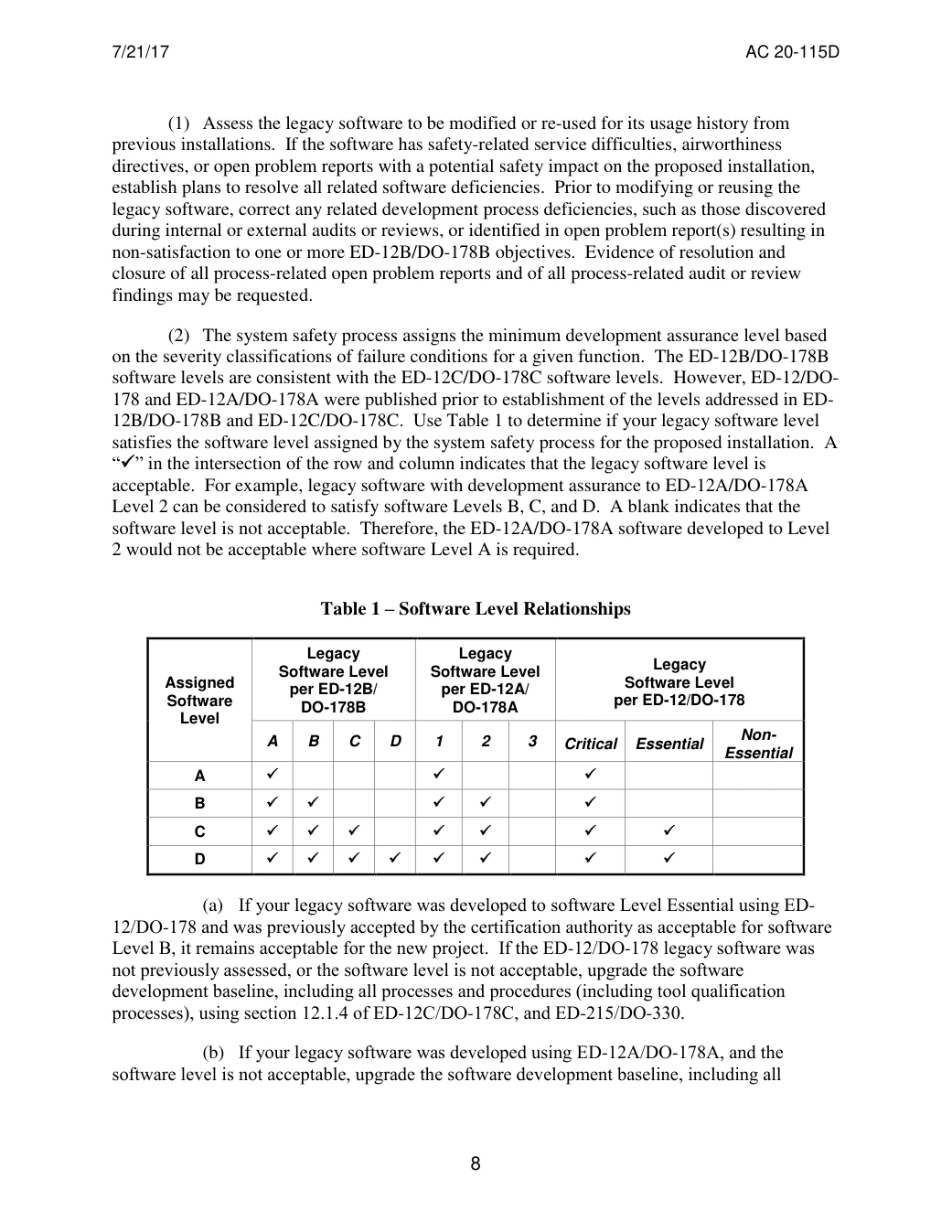
(2) The system safety process assigns the minimum development assurance level based
on the severity classifications of failure conditions for a given function. The ED-12B/DO-178B
software levels are consistent with the ED-12C/DO-178C software levels. However, ED-12/DO-
178 and ED-12A/DO-178A were published prior to establishment of the levels addressed in ED-
12B/DO-178B and ED-12C/DO-178C. Use Table 1 to determine if your legacy software level
satisfies the software level assigned by the system safety process for the proposed installation. A
“” in the intersection of the row and column indicates that the legacy software level is
acceptable. For example, legacy software with development assurance to ED-12A/DO-178A
Level 2 can be considered to satisfy software Levels B, C, and D. A blank indicates that the
software level is not acceptable. Therefore, the ED-12A/DO-178A software developed to Level
2 would not be acceptable where software Level A is required.
Table 1 – Software Level Relationships
Legacy Legacy
Legacy Software Level Software Level
Assigned Software Level per ED-12B/ per ED-12A/
Software per ED-12/DO-178 DO-178B DO-178A
Level
Non- A B C D 1 2 3 Critical Essential
Essential
A
B
C
D
(a) If your legacy software was developed to software Level Essential using ED-
12/DO-178 and was previously accepted by the certification authority as acceptable for software
Level B, it remains acceptable for the new project. If the ED-12/DO-178 legacy software was
not previously assessed, or the software level is not acceptable, upgrade the software
development baseline, including all processes and procedures (including tool qualification
processes), using section 12.1.4 of ED-12C/DO-178C, and ED-215/DO-330.
(b) If your legacy software was developed using ED-12A/DO-178A, and the
software level is not acceptable, upgrade the software development baseline, including all
8
Saved from the FAA on November 17, 2026. All original pages are retained. Engineering explanations are presented separately below.
Aerospace Consulting / Engineering perspective
Keep software assurance connected to the system.
Make the software level, allocated requirements, interface assumptions and verification responsibilities explicit. Plan the evidence and review points early, and trace changes back to the system safety and certification assumptions.
A focused review, an agreed assessment package or ongoing support alongside your team. We can agree the relevant inputs and scope in the initial conversation.
This opens your email application.
Start a conversation
Tell us about your programme, the system you are developing and the support you need.
We can agree a focused use-case review, a defined evidence package or ongoing programme support.
This opens your email application.
Specialist aerospace expertise
Aerospace Consulting is led by Hussein Khimji, an FAA Designated Engineering Representative in systems and equipment, with a focus on system safety, flight controls and avionics.
We work with aircraft developers and systems suppliers to connect technical decisions, safety assessments and certification evidence.
This is the proposed introduction. The full About page will add your approved biography and associate expertise.
Systems engineering & development assurance
Tell us about the aircraft or system, its intended function, stage of development and the support you need.