
Original FAA page; extracted words support search. Text reflow has not been reviewed.
AC 20-152A · 26Open saved PDF here ↗
Extracted text for finding words
This extraction supports search. Read the original page for complete notation and layout.
10/7/22                                                 AC 20-152A

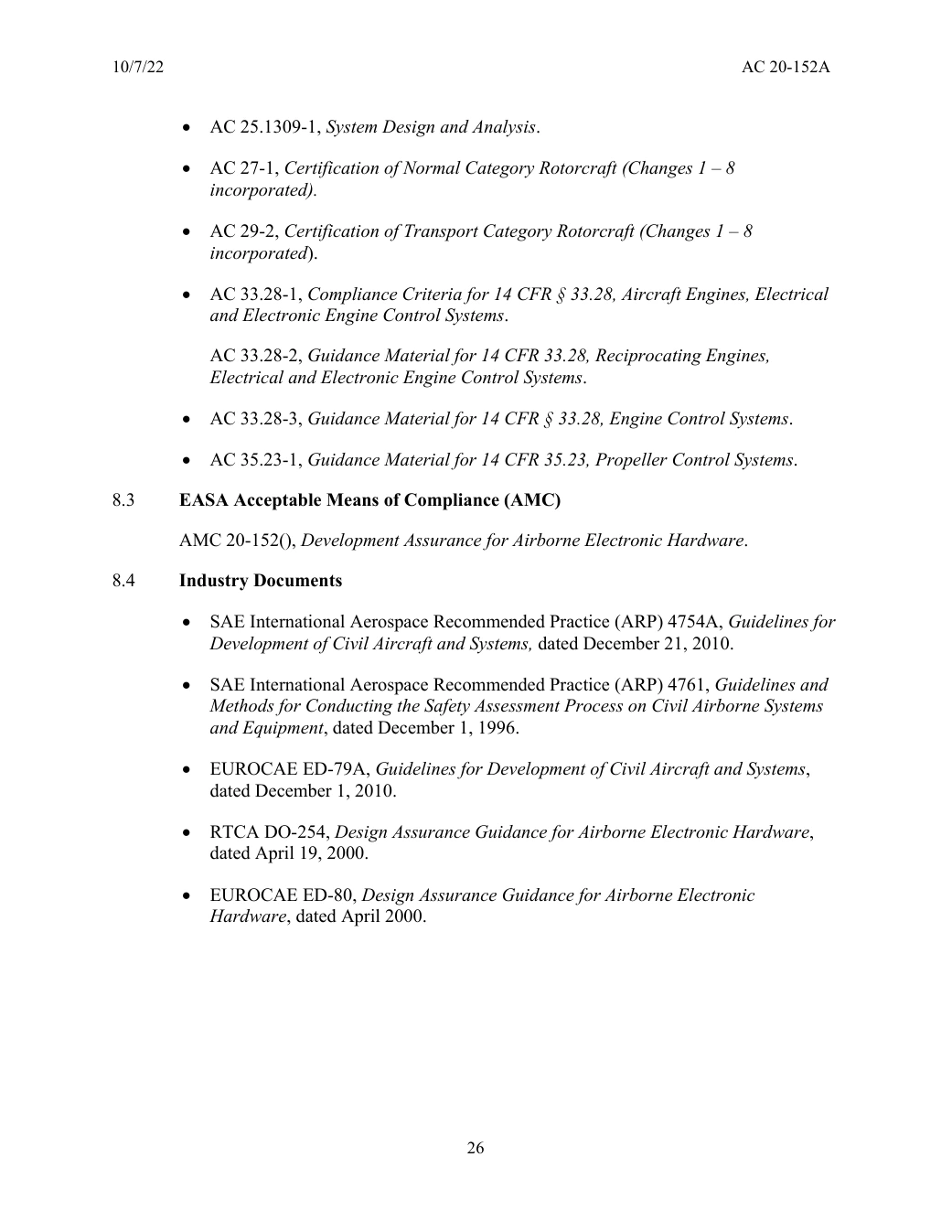
        • AC 25.1309-1, System Design and Analysis.

        • AC 27-1, Certification of Normal Category Rotorcraft (Changes 1 – 8
             incorporated).

        • AC 29-2, Certification of Transport Category Rotorcraft (Changes 1 – 8
             incorporated).

        • AC 33.28-1, Compliance Criteria for 14 CFR § 33.28, Aircraft Engines, Electrical
          and Electronic Engine Control Systems.

        AC 33.28-2, Guidance Material for 14 CFR 33.28, Reciprocating Engines,
             Electrical and Electronic Engine Control Systems.

        • AC 33.28-3, Guidance Material for 14 CFR § 33.28, Engine Control Systems.

        • AC 35.23-1, Guidance Material for 14 CFR 35.23, Propeller Control Systems.

8.3    EASA Acceptable Means of Compliance (AMC)

     AMC 20-152(), Development Assurance for Airborne Electronic Hardware.

8.4     Industry Documents

        •  SAE International Aerospace Recommended Practice (ARP) 4754A, Guidelines for
           Development of Civil Aircraft and Systems, dated December 21, 2010.

        •  SAE International Aerospace Recommended Practice (ARP) 4761, Guidelines and
           Methods for Conducting the Safety Assessment Process on Civil Airborne Systems
           and Equipment, dated December 1, 1996.

        •  EUROCAE ED-79A, Guidelines for Development of Civil Aircraft and Systems,
            dated December 1, 2010.

        •  RTCA DO-254, Design Assurance Guidance for Airborne Electronic Hardware,
            dated April 19, 2000.

        •  EUROCAE ED-80, Design Assurance Guidance for Airborne Electronic
           Hardware, dated April 2000.


                                         26