This AC recognises DO-254/ED-80 and adds objectives for distinct hardware categories. Its stated applicability covers hardware contributing to DAL A, B and C functions; the relevant objective restrictions still apply.
The source, within reach.
Search within this AC, jump to a source page, or download the complete saved publication.
This extraction supports search. Read the original page for complete notation and layout.
10/7/22                                                 AC 20-152A

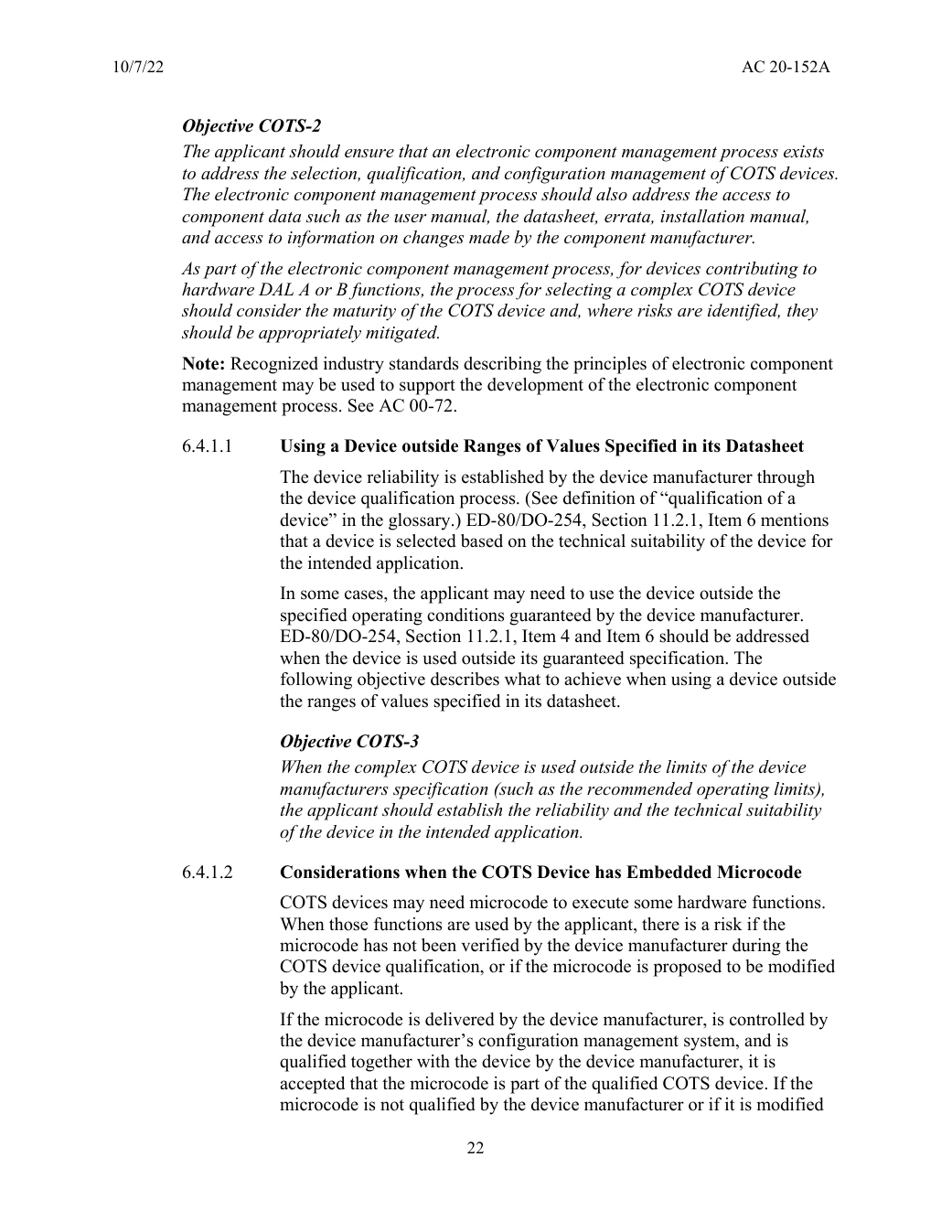
         Objective COTS-2
        The applicant should ensure that an electronic component management process exists
          to address the selection, qualification, and configuration management of COTS devices.
        The electronic component management process should also address the access to
        component data such as the user manual, the datasheet, errata, installation manual,
       and access to information on changes made by the component manufacturer.
        As part of the electronic component management process, for devices contributing to
        hardware DAL A or B functions, the process for selecting a complex COTS device
        should consider the maturity of the COTS device and, where risks are identified, they
        should be appropriately mitigated.
        Note: Recognized industry standards describing the principles of electronic component
       management may be used to support the development of the electronic component
       management process. See AC 00-72.

          6.4.1.1     Using a Device outside Ranges of Values Specified in its Datasheet
                 The device reliability is established by the device manufacturer through
                      the device qualification process. (See definition of “qualification of a
                     device” in the glossary.) ED-80/DO-254, Section 11.2.1, Item 6 mentions
                        that a device is selected based on the technical suitability of the device for
                      the intended application.
                      In some cases, the applicant may need to use the device outside the
                      specified operating conditions guaranteed by the device manufacturer.
                  ED-80/DO-254, Section 11.2.1, Item 4 and Item 6 should be addressed
                 when the device is used outside its guaranteed specification. The
                     following objective describes what to achieve when using a device outside
                      the ranges of values specified in its datasheet.

                     Objective COTS-3
                When the complex COTS device is used outside the limits of the device
                    manufacturers specification (such as the recommended operating limits),
                      the applicant should establish the reliability and the technical suitability
                       of the device in the intended application.

          6.4.1.2     Considerations when the COTS Device has Embedded Microcode
              COTS devices may need microcode to execute some hardware functions.
               When those functions are used by the applicant, there is a risk if the
                   microcode has not been verified by the device manufacturer during the
              COTS device qualification, or if the microcode is proposed to be modified
                  by the applicant.
                           If the microcode is delivered by the device manufacturer, is controlled by
                      the device manufacturer’s configuration management system, and is
                       qualified together with the device by the device manufacturer, it is
                     accepted that the microcode is part of the qualified COTS device. If the
                   microcode is not qualified by the device manufacturer or if it is modified

                                         22
Saved from the FAA on November 17, 2026. All original pages are retained. Engineering explanations are presented separately below.
Aerospace Consulting / Engineering perspective
Define the hardware assurance approach by function and device.
Use the PHAC to identify intended functions, assurance levels, custom and COTS boundaries, and the evidence needed for each applicable objective. Keep supplier information, integration verification and system-level assumptions connected.
A focused review, an agreed assessment package or ongoing support alongside your team. We can agree the relevant inputs and scope in the initial conversation.
This opens your email application.
Start a conversation
Tell us about your programme, the system you are developing and the support you need.
We can agree a focused use-case review, a defined evidence package or ongoing programme support.
This opens your email application.
Specialist aerospace expertise
Aerospace Consulting is led by Hussein Khimji, an FAA Designated Engineering Representative in systems and equipment, with a focus on system safety, flight controls and avionics.
We work with aircraft developers and systems suppliers to connect technical decisions, safety assessments and certification evidence.
This is the proposed introduction. The full About page will add your approved biography and associate expertise.
Systems engineering & development assurance
Tell us about the aircraft or system, its intended function, stage of development and the support you need.