This AC recognises DO-254/ED-80 and adds objectives for distinct hardware categories. Its stated applicability covers hardware contributing to DAL A, B and C functions; the relevant objective restrictions still apply.
The source, within reach.
Search within this AC, jump to a source page, or download the complete saved publication.
This extraction supports search. Read the original page for complete notation and layout.
10/7/22                                                 AC 20-152A

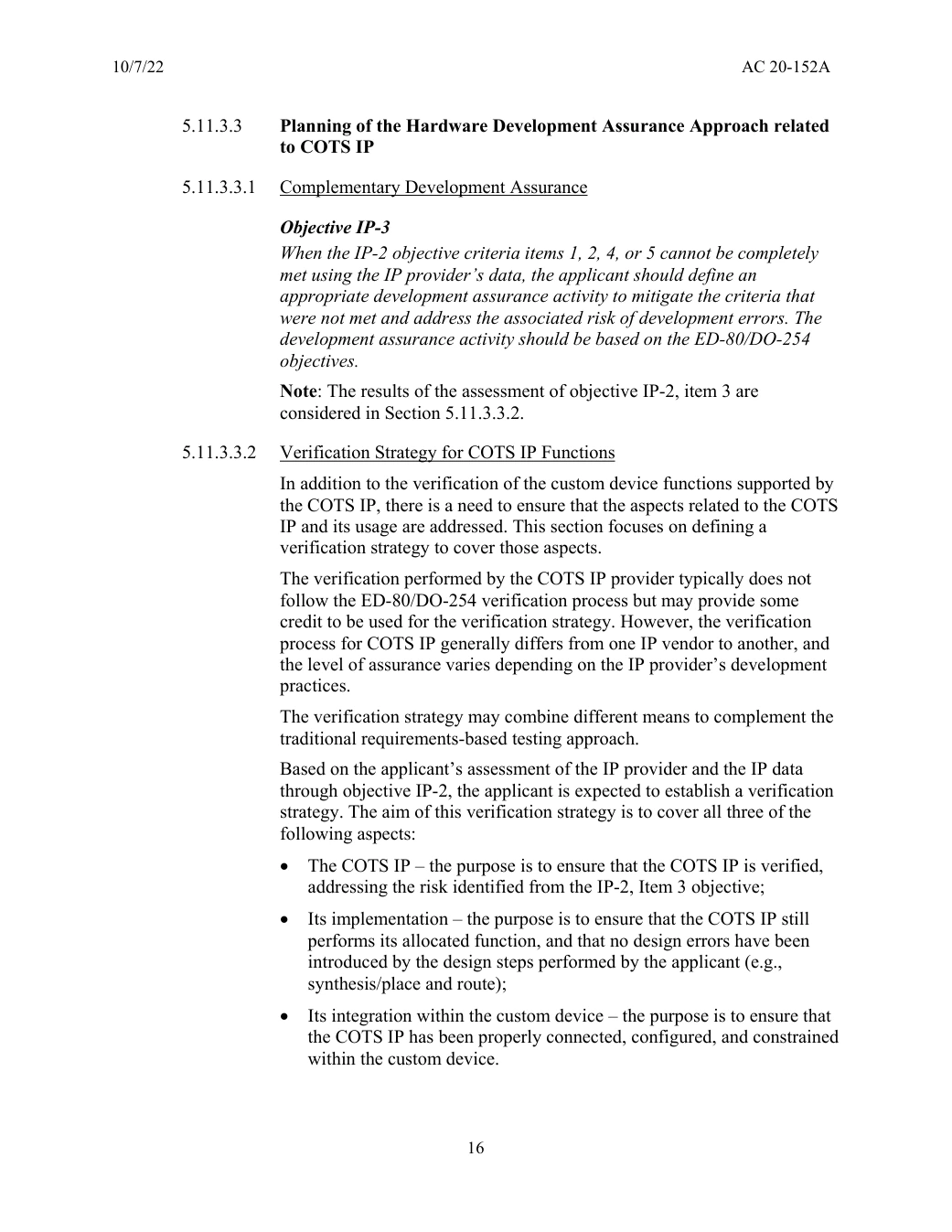
         5.11.3.3    Planning of the Hardware Development Assurance Approach related
                      to COTS IP

         5.11.3.3.1   Complementary Development Assurance

                     Objective IP-3
                When the IP-2 objective criteria items 1, 2, 4, or 5 cannot be completely
                   met using the IP provider’s data, the applicant should define an
                     appropriate development assurance activity to mitigate the criteria that
                   were not met and address the associated risk of development errors. The
                    development assurance activity should be based on the ED-80/DO-254
                       objectives.
                    Note: The results of the assessment of objective IP-2, item 3 are
                     considered in Section 5.11.3.3.2.

         5.11.3.3.2   Verification Strategy for COTS IP Functions
                      In addition to the verification of the custom device functions supported by
                      the COTS IP, there is a need to ensure that the aspects related to the COTS
                    IP and its usage are addressed. This section focuses on defining a
                       verification strategy to cover those aspects.
                 The verification performed by the COTS IP provider typically does not
                     follow the ED-80/DO-254 verification process but may provide some
                        credit to be used for the verification strategy. However, the verification
                     process for COTS IP generally differs from one IP vendor to another, and
                      the level of assurance varies depending on the IP provider’s development
                        practices.
                 The verification strategy may combine different means to complement the
                        traditional requirements-based testing approach.
                  Based on the applicant’s assessment of the IP provider and the IP data
                    through objective IP-2, the applicant is expected to establish a verification
                        strategy. The aim of this verification strategy is to cover all three of the
                     following aspects:
                    •  The COTS IP – the purpose is to ensure that the COTS IP is verified,
                         addressing the risk identified from the IP-2, Item 3 objective;
                    •   Its implementation – the purpose is to ensure that the COTS IP still
                       performs its allocated function, and that no design errors have been
                         introduced by the design steps performed by the applicant (e.g.,
                          synthesis/place and route);
                    •   Its integration within the custom device – the purpose is to ensure that
                          the COTS IP has been properly connected, configured, and constrained
                         within the custom device.


                                         16
Saved from the FAA on November 17, 2026. All original pages are retained. Engineering explanations are presented separately below.
Aerospace Consulting / Engineering perspective
Define the hardware assurance approach by function and device.
Use the PHAC to identify intended functions, assurance levels, custom and COTS boundaries, and the evidence needed for each applicable objective. Keep supplier information, integration verification and system-level assumptions connected.
A focused review, an agreed assessment package or ongoing support alongside your team. We can agree the relevant inputs and scope in the initial conversation.
This opens your email application.
Start a conversation
Tell us about your programme, the system you are developing and the support you need.
We can agree a focused use-case review, a defined evidence package or ongoing programme support.
This opens your email application.
Specialist aerospace expertise
Aerospace Consulting is led by Hussein Khimji, an FAA Designated Engineering Representative in systems and equipment, with a focus on system safety, flight controls and avionics.
We work with aircraft developers and systems suppliers to connect technical decisions, safety assessments and certification evidence.
This is the proposed introduction. The full About page will add your approved biography and associate expertise.
Systems engineering & development assurance
Tell us about the aircraft or system, its intended function, stage of development and the support you need.